
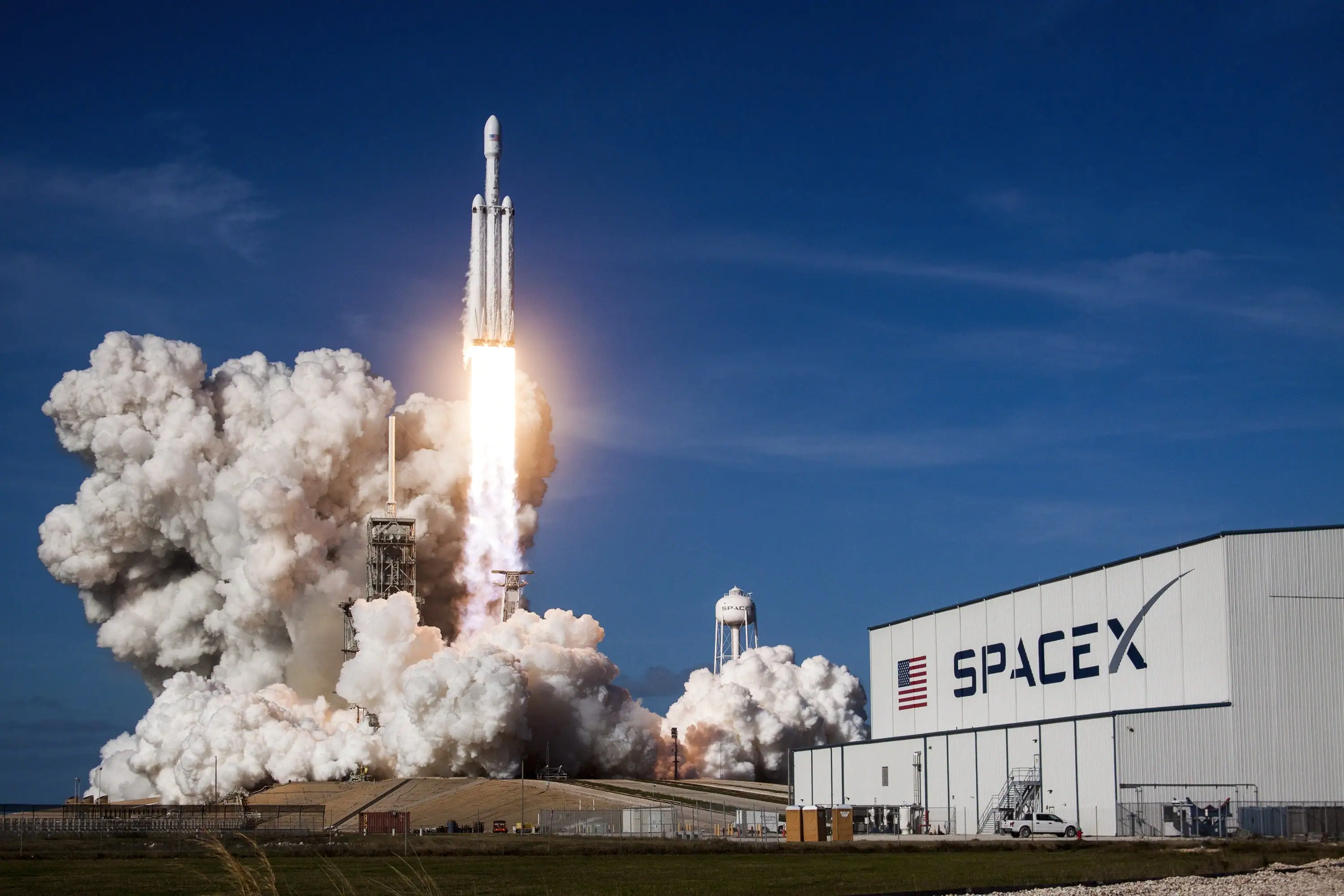
If there is one thing that generates more excitement in the world’s capital markets than Artificial Intelligence (AI), it is the commercialization of space. A huge milestone will be Elon Musk’s Initial Public Offering (IPO) of SpaceX, slated for June, with a valuation of USD 1.7 trillion. Investors have already bought into its stock through Special Purpose Vehicles (SPVs) even without a prospectus and a specific date for the IPO. Musk has said he wants to raise USD 50 billion, which would make him a trillionaire and SpaceX as the largest IPO in history.
Where does Hong Kong fit into this picture? Nowhere, some might say. But it may be just a matter of time, as China’s commercial space industry takes off and Hong Kong serves as a gateway to offshore markets and services. AmCham HK e-Magazine tapped into local wisdom around an industry that may be worth USD 1.8 trillion globally by 2035.
So far, Hong Kong’s commercial space industry is more talk than action, but it’s serious talk. Last January, the Hong Kong Chief Executive’s Policy Unit put together a brainstorming session for Hong Kong’s role in the commercial space industry. The timing came shortly after the annual policy address by the chief executive, John Lee, who announced funding for projects contributing to China’s Chang’e lunar landing program, as well as designating the industry as “strategic” for the first time.
Among those present at the meeting were barrister Anthony Neoh; Regina Ip, convenor of the government’s Executive Committee, or cabinet; Gregg Li, co-founder of Orion Astropreneur Space Academy (OASA); Ye Shalin from China’s rising challenger to SpaceX, LandSpace Technology; astrophysicist and space scientist, Quentin Parker, director of the University of Hong Kong’s Laboratory of Space Research; and financier Adam Janikowski.
Says Parker: “Hong Kong has the right stuff to be a global hub for the space economy.” He ticks off its status as one of the top fund-raising platforms in the global capital markets, by value of public listings, as a hub for the regional insurance industry in Asia-Pacific, its robust commercial law and institutions, and five of the world’s top universities, according to the most recent QS world university rankings.
“We have very strong cards to play,” Parker said at a meeting at AmCham’s Hub in February.
It’s not just about rockets
A common misunderstanding is that space is a game that only the world’s five space faring nations, plus the European Union, can play. But while so far deep space has remained the preserve of governments, the commercial opportunities are focused closer to earth.
Like SpaceX, commercial space initiatives in Hong Kong and elsewhere are focused on a zone identified as “low earth orbit” between about 100 and 1,200 kilometers in altitude, or LEO, and the “low altitude” economy of drones and autonomous vehicles. The low altitude economy works through satellite communications and technologies like LIDAR (light detection and ranging for virtual mapping). Until recently, low earth orbiting satellites were mostly in the public sector, with a few early, failed experiments like Iridium phones in the 1990s.
Once Elon Musk got started with SpaceX and re-usable rockets, the game changed dramatically. After his first launch of 60 Starlink satellites in May 2019, Musk’s “rapid reuse” Falcon 9 rockets dominated the market, which is why there is such excitement about the prospective IPO of SpaceX. He wants to put 1 million of his Starlink communication satellites into orbit and was responsible for over 2,000 satellites and 165 orbital launches last year, out of 4,500 satellites in 317 successful launches worldwide. Each launch puts up multiple satellites.

Close behind SpaceX is a significant number of Chinese launch companies. Unlike the US, which relies on one company, China has eight commercial launch firms that have completed orbital launches as of November 2025. Three of the eight are effectively state-backed spinoffs, with China Rocket being a commercial spinoff from China Aerospace Science and Technology Corporation (CASC), ExPace from China Aerospace Science and Industry Corporation (CASIC), and CAS Space from the Chinese Academy of Sciences (CAS).
The other five, Galactic Energy, iSpace, LandSpace, Orienspace, and Space Pioneer are more purely commercial, though they also have links to the state through talent transfer, supplier relationships, and support from local governments.
To date, these eight companies have attempted a total of 96 orbital launches, with 81 successful launches, at a success rate of about 84.5 percent. Most of the launches with payloads have been successful. They have put 336 satellites successfully into orbit, out of a total of 371 satellites, with a success rate of just over 90 percent.
China’s LandSpace, which is developing reusable rockets like Musk’s Falcon 9, is also planning an IPO on Shanghai’s Star market sometime this year, with a valuation of 7.5 billion yuan, or about USD 1 billion.
SpaceX, which generated USD 16 billion in revenue and USD 8 billion in adjusted earnings in 2025, has provided proof of concept. But it is only the start. A 2024 report by the World Economic Forum and McKinsey estimated 2023 revenues from the commercialization of space at USD 630 billion, with potential revenues of USD 1.8 trillion by 2035.
Hong Kong could leverage its financial and insurance markets to create expertise around the sector, and its aviation and marine infrastructure are also potential points of departure. Commercial space is not a single business model, but a hierarchy, with hardware cascading into services ranging from legal and compliance to the industries linked with the commercial space economy, from space finance and water mining on the moon to AI agents for propulsion and monitoring to AI-directed space debris removal.
In May, an acknowledgement of Hong Kong’s potential came with the hosting of the first Asia-Pacific Regional International Astronomical Union meeting. The biannual meeting attracted Nobel Prize winners and 600 participants, including policymaker from 37 countries. Kevin Choi, permanent secretary for innovation, technology and industry, seized the occasion to announce that the government had awarded a $100 million fund announced during last year’s policy address to six projects.

Call it ‘NewSpace’
The potential scale of the industry is so large that it is rapidly acquiring its own terminology, with “NewSpace” describing the supply chain that is still forming around LEO and its emerging industries. Among the most important characteristics of NewSpace is that the entry ticket is less hardware than software, above all, finance.
Among the group that met with the Chief Executive’s Policy Unit in January, Janikowski sees huge potential for Hong Kong in space finance for China’s fast growing private LEO business. Unlike the United States, there are few space focused funds in China, and foreign investment in the sector is rare, although some of China’s largest players, like Hongshan, the former Sequoia Capital, and Matrix China have participated in funding rounds.
A former banker with a PhD from the Colorado School of Mines who is heavily involved in the Hong Kong chapter of the Explorer’s Club, Janikowski describes the magnitude of NewSpace in terms of the oil and gas industry.
“By its very nature, [NewSpace] is a very big topic, the same as any new, very large emerging economy,” he said in an interview. “You need to consider geopolitical issues, environmental issues, and extraction issues.”
Janikowski was part of an award-winning team from the Colorado School of Mines that worked on technology for mining water on the dark side of the moon. Water breaks down into its constituent parts of hydrogen and oxygen, and can be cooled to make liquid oxygen, which is rocket fuel. “At the end of the day, you can create a gas station on the moon by mining the permanently shadowed regions for the water we know is there,” he says.
Hong Kong is not a newcomer to the commercial space sector. The foundation of the industry is Hong Kong’s two geostationary satellite operating companies, AsiaSat and APT Satellite, formed in 1988 and 1998 respectively. University research labs have contributed to China’s space effort, like the lab that Parker runs at HKU. But it has been slow to develop policy around the sector, partly because the central government has naturally taken the lead.
Advocates say the Hong Kong government needs more consistent focus to attract talent and investment in the specialized areas where Hong Kong could play a role. Perennial rival Singapore set up a government space office, the National Space Agency, in April, and some would like to see Hong Kong do the same.
Anthony Neoh, another member of the January forum, argues that the commercial space industry could create as many as 50,000 high-skilled professional jobs for Hong Kong, another 100,000 jobs across supporting industries, with salaries 50 percent higher than average and attract an economic cluster of 500 companies, 200 start-ups and five space industry unicorns with valuations over USD 1 billion. Hong Kong could become one of the top five global centers for space finance, he says, building on its status as China’s top offshore fund-raising center.
Size and lack of an industrial base are not important barriers to entry, most observers agree. Tiny Luxembourg, with a population of 600,000, less than one percent of Hong Kong’s, punches above its weight in NewSpace. In 2024, the Grand Duchy invested 0.13 percent of its Gross Domestic Product (GDP) in 2024 in space exploration, without any launch capability. It has attracted 80 firms and 1,650 professionals to the sector, in part by creating legal frameworks for space mining and mandatory monitoring of space activities.
Future-proofing the economy
“Fundamentally, this is about future proofing the economy,” says Janikowski. “The space economy is here to stay.”
Alongside the Astronomical Union meeting in Hong Kong in May, Hong Kong University’s Laboratory of Space Research held a parallel conference on space sustainability. Parker and fellow OASA director Perry Lam believe that one area where Hong Kong could take the lead is in organizing international collaboration around the management of space debris, which poses an existential risk to future development of the LOE supply chain.
According to the European Space Agency, since 1957 about 25,920 satellites have been launched into space, as of April 2026, and of these, 15,200 are functioning out of 17,610 that are still in orbit. Some 660 have broken into fragments. Once the pieces fragment, they continue to orbit and become deadly. The agency estimates there are 1.2 million fragments between one to 10 centimeters and 140 million fragments between the size of one millimeter to a centimeter, with a total mass of more than 16,200 tons.
What is space debris? HKU’s Parker describes it as “defunct satellites, rocket stages, miscellaneous items like if an astronaut drops a spanner, and can’t get it as it drifts out, that becomes a piece of space debris traveling at eight kilometers per second. If you’ve got something coming at eight kilometers a second, that hits something traveling the opposite direction at eight kilometers per second, the closing speed is 16 kilometers per second, and the kinetic energy, even with a tiny fleck of paint is huge. This is what we’re tracking.”

The threat of space debris comes from a theoretical event called the Kessler syndrome.
Says Parker: “The Kessler syndrome is the cascading catastrophic collapse of the entire ecosystem in low earth orbit. That is to say, in the period of about a week, you’ll get satellites smashing into satellites and then create a big debris field and suddenly have a wave of debris permeating the entire low earth orbit ecosystem, destroying every single satellite, the International Space Station, the Chinese space station, telescopes, everything gone. Starlink will go. Everything it does will go, and our lives will go back to pretty much how we used to live in the 1950s and 1960s.”
Based on current modeling, the Kessler syndrome could occur any time between 2030 and 2050, although if Musk succeeds in putting up a million satellites in low earth orbit, it could be sooner rather than later. Musk himself has started moving his satellites around to avoid potential hits.
Solving the problem of space debris has gained new urgency since May 2021, when debris made a hole in the robot arm of the International Space Station. “Had that piece of space junk been five meters further over, it would have gone through the main body of the space station, with possible catastrophic results,” says Parker. “A few grams of debris moving at seven or eight kilometers per second has the same force as a hand grenade,” he adds.
A similar incident with a tiny fleck of paint hitting the Shenzhou 20 space capsule window in November 2025, forcing a delay in the return of Chinese astronauts from the Tiangong space station.

A tech business is developing around managing space debris, by “de-orbiting” to sub-LEO levels where fragments burn up in the earth’s atmosphere. Even more urgent are regulatory frameworks to manage what Parker says is a “wild west” at present.
Parker and his colleagues have set up Hong Kong’s first non-governmental organization focused on space sustainability, S1+3, announced during the May conference on space sustainability. But there is a long way to go. The density of satellite tracks already makes astronomical observations difficult from earth-based telescopes, and space clutter grows by the day.
“It’s true that the most serious space faring nations now make sure that anything they put up will be able to de-orbit itself in due course,” says Parker. “That’s not a problem. The trouble is we’re accelerating how much we’re putting up, and we’re not bringing stuff down.”
Baby steps?
The conversations around Hong Kong’s potential role in the commercial space industry, call it NewSpace or just plain old rocket science, are clearly just beginning. Geopolitics is a significant barrier, although as geopolitics reshapes traditional trade patterns, Hong Kong may have a pivotal role because of its identity as a part of China with a separate legal and financial system.
In 2022, when Leo Group, a Chinese company, announced a $50 million investment in an SPV to buy shares in SpaceX, it was kicked out after SpaceX executives worried that it would damage the company’s government contracts, according to the Wall Street Journal. Investing directly in China’s private space companies is tough for non-Chinese passport holders, Janikowski says, although that may change once they have gone public through IPOs in mainland China or Hong Kong.
The top fundraiser in China, SpaceSail, a communication services company, has raised more than USD 900 million and could be a challenger to Starlink. Even with US and Chinese limitations, cross-border deals between China, Middle Eastern, Southeast Asian and African nations could be promising, according to Ron Chiong, a Singapore venture capitalist with a space-based fund.
The more business explores the NewSpace economy, the more the whole industry echoes Star Trek’s familiar call to “boldly go where no man has gone before.” And Hong Kong, with its depth of international, cross-sector expertise may just end up in the control room.
AmCham HK’s Sustainability Committee explored the issues around space debris and Hong Kong’s role in a meeting on February 27, with panelists Perry Lam, executive chairman of OASA, and Quentin Parker, director of the Laboratory for Space Research at the University of Hong Kong.

Dr. Adam Janikowski is the managing director of BDJ Capital, a merchant banking consultancy and co-founder of Canadian Chambers of Commerce of the Indo Pacific. He has a PhD in economics (space resources) from the Colorado School of Mines, a Master of Science in mechanical engineering and post-baccalaureate certificate in space resources, also from the Colorado School of Mines, and an MBA from INSEAD. At Queen’s University in Canada, where he is currently appointed as an adjunct professor of mining engineering, he simultaneously earned a Bachelor of Arts in Classics and a Bachelor of Applied Science in chemical engineering.

Professor Quentin A. Parker is an astrophysicist and space scientist based at the University of Hong Kong and director of its Laboratory for Space Research Research. In the last 10 years he has followed the Chinese and American space programs and the emerging NewSpace economy. He focuses on the issues, problems and possible solutions for space sustainability, space traffic management and space situational awarenes issues. He is currently the only non-Chinese fellow of the Chinese Society of Astronautics. Academically he has published more than 620 papers.