

In the May-June issue of AmCham HK e-Magazine, Zhengyu ‘Z’ Huang, former president of the Committee of 100, wrote about the importance of evidence-based dialogue in US-China relations. Wang Zichen’s opinion essay offers a similar perspective from the classroom of one of China’s leading professors of international relations, Yan Xuetong. Originally published in East is Read, the article is reprinted with permission.
Why a small Tsinghua test says something larger about China’s public debate on the world
Yan Xuetong has found an unusually Chinese way to fight bad geopolitics – an exam.
On July 5, at 7:30 pm, in Beijing’s Liaoning Mansion, Tsinghua University’s Institute of International Relations again held its International Relations Basic Knowledge Proficiency Test. The elementary level exam is open to the general public. The intermediate and advanced levels are reserved for those who have passed the previous stage. The exam is closed-book, written, multiple-choice, and free of charge. A score of 60 or above earns a certificate from the institute. The syllabus is austere: basic concepts, research design, modern and contemporary international history, and, at higher levels, theory and methods.
China is hardly short of exams. To many Chinese, the word carries both civilisational weight and modern fatigue: the old prestige of the imperial examination, and the daily irritation of credential-chasing. When the notice was mentioned to a friend, her first reaction was perfectly Chinese: “What is this exam useful for?”
Probably not very much, at least by the usual Chinese measure of usefulness. It will not get anyone into a university, secure a job, bring a promotion or confer a professional licence. Nor will it stop bad commentary about America, Europe, Ukraine, Japan, or the “changing world order” from circulating online. The loudest voices in the public arena are not waiting to be certified by the institute’s founder and one of China’s best-known international-relations scholars. The exam cannot regulate the pundit market. It can only signal, to those still willing to learn, that this field has a minimum vocabulary and a minimum discipline.
Still, usefulness may be the wrong way to judge it. The exam looks more like a small act of resistance.
The first such test was held in 2023. According to the institute, 337 people registered. Its stated purpose was to help students, teachers, practitioners and interested members of the public test their grasp of basic international-relations knowledge, and to promote the “scientification” of the discipline. The word is ungainly in English, but the intention is clear enough. International relations should have some resistance to mood, slogan, gossip, vanity and traffic-seeking speculation.

There is a deeper reason why this matters. International relations is a serious business. It is about war and peace, human lives, national fortunes, and the choices that can shape entire regions for decades. A society that talks about the world carelessly may end up understanding its own position carelessly.
Yan has been making a related point for years. In 2021, at a large academic conference attended by political scientists and international-relations scholars from across China, he warned that public visibility should not be allowed to stand in for academic merit. Clicks, views, and wanghong or internet celebrity status – even notoriety earned through provocation – are not measures of scholarly ability. A WeChat post with 100,000 views might be influential. That does not make it good scholarship.
The applause was loud after Professor Yan concluded. Somewhere in the audience sat a well-known Shanghai-based university employee and internet personality who had made his name commenting on politics and international affairs. One wonders whether he felt personally addressed.
The unease is not about public interest in foreign affairs. A country as large and internationally exposed as China is bound to debate the world around it. The problem is the deterioration of that debate. There are people with titles and institutional affiliations who have become increasingly casual with facts and extravagant in their claims. Alongside them is a large class of online personalities with little basic training but enormous confidence. Together they have made discussions of geopolitics noisier, cruder, and easier to mistake for entertainment.
This is why the old comparison with Beijing taxi drivers keeps returning. For years, they have been a minor institution in foreign reporting: voluble, patriotic, cynical, worldly, sometimes perceptive, sometimes wildly wrong, and always quotable. The joke is that some experts do not sound much better. This may be unfair to taxi drivers. It is not always unfair to experts.
No country has a monopoly on geopolitical analysis
No country has a monopoly on bad geopolitical analysis. The United States, with its think tanks, cable panels, podcasts, and social media warriors on X and other platforms produces plenty of confident nonsense of its own. But China should not treat others’ errors as permission to commit its own. A country trying to understand its changing place in the world needs a clearer view of facts, power, risk, and consequence. When basic facts are handled casually, when certainty becomes drama, and when logic gives way to mood, the result is not only bad analysis. It makes it harder for Chinese readers – especially young ones – to understand China’s actual strengths, weaknesses, and choices.

Yan’s criticisms over the years can be read as one connected argument. Inside the discipline of international relations, he has warned against the weakening of theoretical research, lower professional thresholds, the overproduction of current-affairs commentary, and the chase for online attention. In the classroom, he has worried about students who reach conclusions before acquiring enough facts. In public debate, he has objected to the habit of treating popularity as proof and position as analysis.
That concern became sharper as a new generation came of age. Chinese students born after 2000 grew up after China became the world’s second-largest economy, and many have known only a rising China and a troubled West. Such an experience can produce ambition and confidence. It can also produce a sense of superiority that is more inherited than earned.
Yan has warned China’s Generation Z ‘Zoomers’ against a crude “China versus foreign countries” frame, in which all good values are assumed to be Chinese and all bad ones foreign. He has also criticised the habit of mistaking online rhetoric for common sense, treating influencers as authorities, and reducing complex realities to conspiracy theories, economic determinism or wishful thinking about Taiwan and China’s future power.
There is an old-fashioned teacherly quality to this criticism. It is stern, sometimes unfashionably so, but not cynical. If China matters, it should be studied seriously. If the world is changing, the change should be understood with care. Young people who may inherit a larger international role deserve something better than slogans delivered as analysis.
Yan’s online message to China’s Zoomers
In an influential video addressing the younger students a few years ago, Yan described the problem with unusual bluntness. In international-relations analysis, he said, there had emerged a tendency to “set facts aside first and discuss position.” The sentence is memorable because it exposes a common temptation in discussions of foreign affairs, to decide first what should feel patriotic, correct or emotionally satisfying, and only then look for evidence. For China, resisting that temptation is not a matter of intellectual taste. It is part of seeing the country and the world as they are.
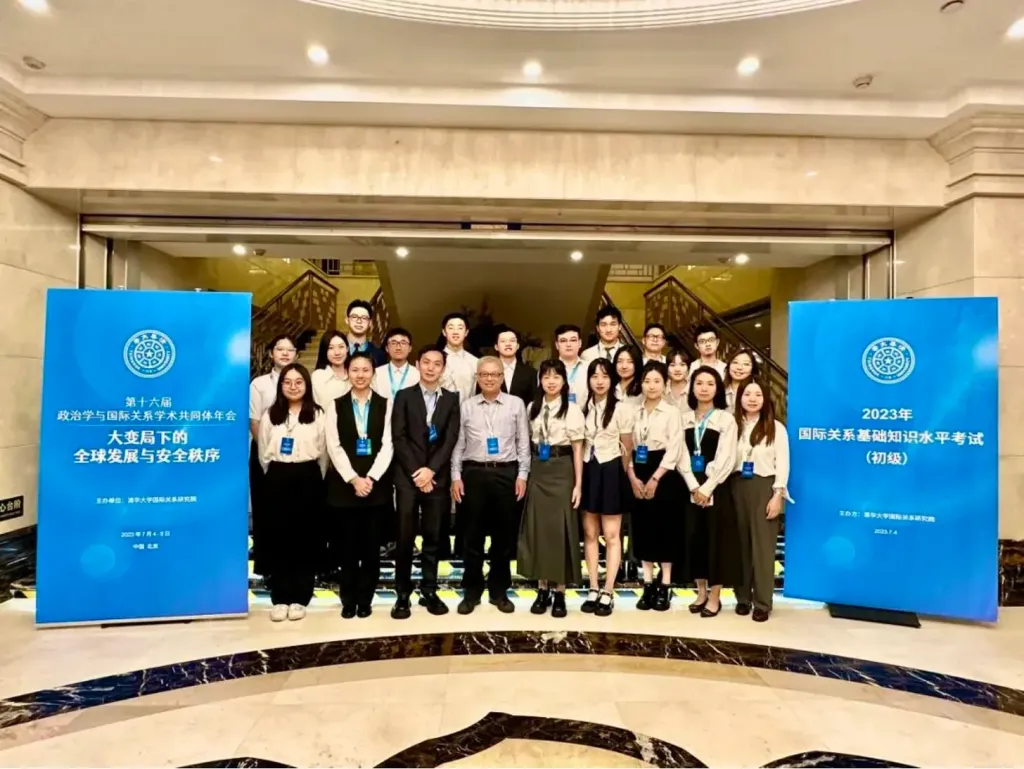
Seen in this light, the exam tries to establish a floor. Before talking about the international order, one should know some history. Before using a concept, one should know what it means. Before declaring a trend inevitable, one should know what evidence would count for or against it. Phrases such as “the West” and “since ancient times” should not be allowed to do more work than they can bear.
Responding to the age of influencers with a closed-book test may seem quixotic. Against the speed of social media, Yan’s institute offers multiple-choice questions. The gesture is almost comically modest. Yet it also reveals a stubborn faith in standards that the market has little reason to protect.
A one-hour exam will not rescue public debate. Some people will still prefer the thrill of stance to the discipline of facts. But public intellectual life is also shaped by small rituals that signal what a community still values. A multiple-choice test on international relations may be a modest instrument, but it carries a serious hope – that public discussion of the world can begin with facts, methods and the humility to learn the basics; that a grave subject can be treated with the gravity it deserves; and that China’s conversation about the world can become a little more disciplined, a little less reckless, and ultimately more useful to China itself.

Wang Zichen joined the Center for China & Globalization in October 2022, after an eleven-year career with Xinhua News Agency including a posting in Brussels, covering the European Union. In 2025, Wang earned a mid-career Master in Public Policy from the School of Public and International Affairs (SPIA) at Princeton University on leave from CCG, on an SPIA scholarship.
A graduate of Shandong University of Finance and Economics, he has been deputy secretary-general of CCG since December 2025. Wang founded Pekingology in 2020 and East is Read in 2022. Both are now hosted by CCG.