
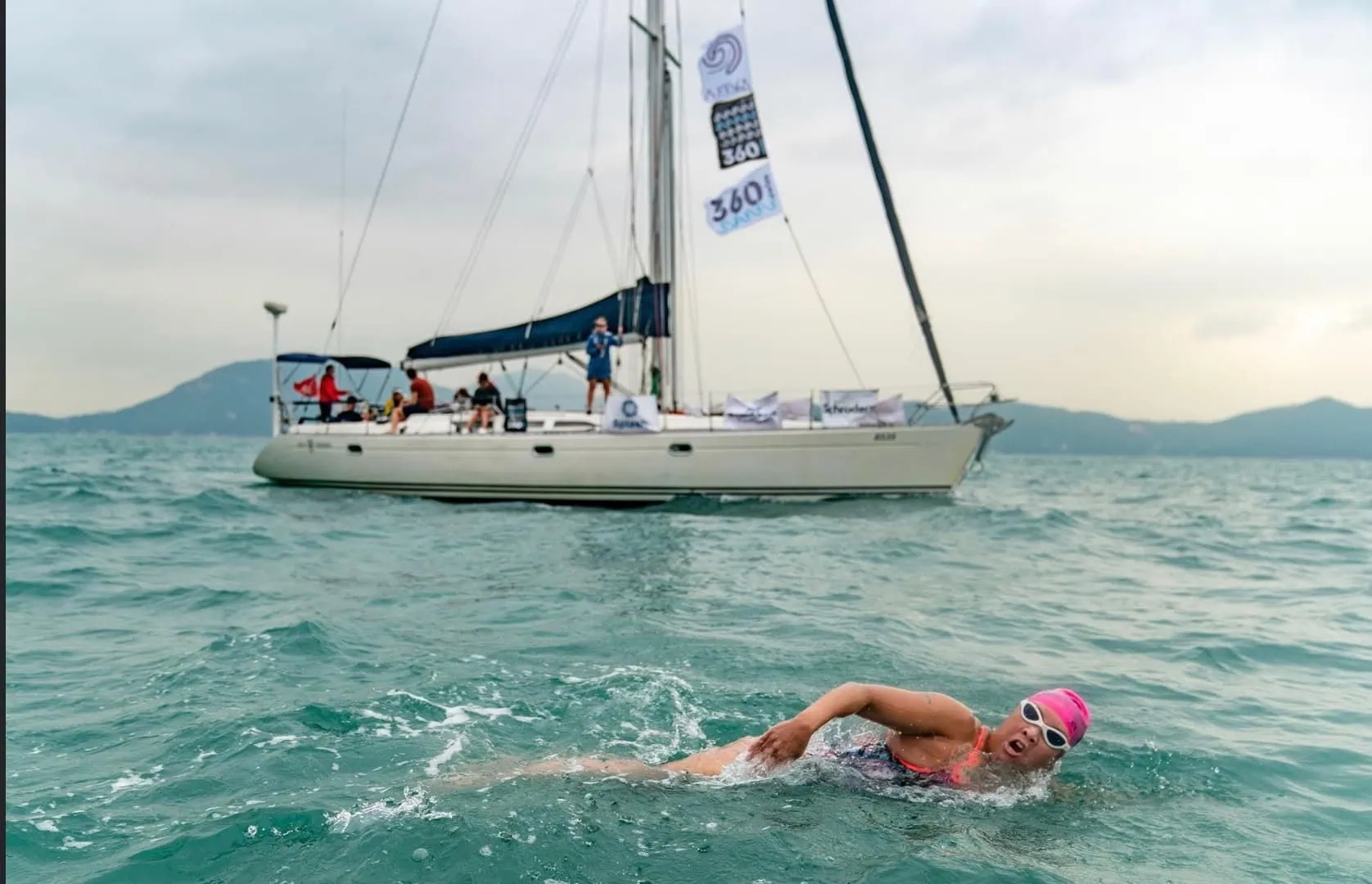
Edie Hu swimming around Hong Kong Island, November 2018
By Edith Terry
Hong Kong is one of the few major cities where mainstream professionals can do their office jobs by day and train on its highly accessible trail system and waters on weekends and after hours. Few take both their day jobs and their passion for sports to the level of 51-year-old Chinese American Edie Hu. AmCham HK asks her how she manages to do it all.
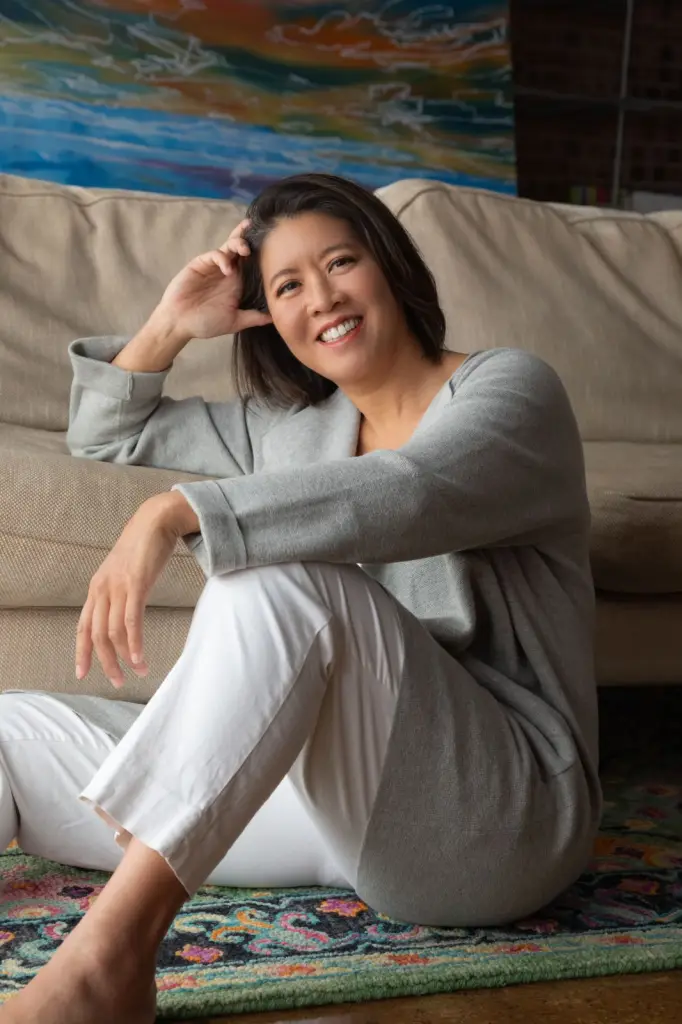
From auction house to the Guinness Book of World Records
It’s not every day you meet a Guinness World Records holder who is equally comfortable in the open ocean and the marketplace of fine arts and collectibles. Edie Hu’s career as an art appraiser and advisor spans 13 years with Sotheby’s, six years with Citi Private Bank Art Advisory, and since 2020, Centerpiece Art Advisory.
In her current role as director of Centerpiece, Hong Kong’s first independent advisory service, she works with partners in New York and Los Angeles to help collectors build value and use their collections wisely as collateral for loans. With an especially deep expertise in Chinese ceramics, she helps her clients avoid fakes and offer lending based on the value of their existing collections.
Since the price tag of a single object might be as much as US$4 million – an amount that Sotheby’s realized recently in its 2026 spring auction in New York, for a 15th century blue and white jar – expert advice on valuation and authenticity can make the difference between a fortune and a waste of time.

In Hu’s other career, ocean swimming, the milestones are far more exotic. Hu achieved her Guinness record by becoming the fastest person to swim the 20-km Øresund Strait, which forms the border between Denmark and Sweden. She finished in five hours, 10 minutes, and 18 seconds, only the ninth person to swim the heavily trafficked channel.
She has also swum five of the seven ocean marathons tracked by the World Open Water Swimming Association (WOWSA), the “Ocean Sevens.” She has swum 144.2 km so far, with 54 km to go, across some of the world’s coldest, stormiest and least forgiving bodies of water.
In December 2025, she became the first woman to swim the 65 km around Hong Kong’s Lantau Island in 21 hours and 28 minutes. In 2018, she became the third person to swim the 45 km circumnavigation around Hong Kong Island, in 12 hours and 37 minutes, raising funds for the local charity, Splash Foundation.
She is making plans to swim the last two of the seven straits, the Tsugaru Strait in Japan (19.5 km) and the North Channel between Ireland and Scotland (34.5 km). She has also knocked off the “Triple Crown” of open water swimming – the English Channel (33 km), Catalina Channel in California (32.5 km) and the 20 Bridges Swim around Manhattan (48.5 km).
Making Hong Kong a “swimmable city”
As a founding member coach and newly minted board director of Splash Foundation, she is part of a movement led by WOWSA for “swimmable urban waterways” that seeks to connect communities through rivers and harbors.
The alliance has 153 signatory organizations in 22 countries, including three in China. Splash Foundation is an enthusiastic supporter. The registered charity provides free learn-to-swim programs and water safety education for migrant domestic workers, children and adults from low-income families, children with special educational needs and refugees and asylum seekers.
Now, Hu and Splash Foundation are hoping to work with the Hong Kong government to establish an open water swimming facility on Hong Kong Island similar to the river-based, water filtering project soon to open at Pier 35 in New York’s East River – or at least a replica of the open water swimming sheds and lanes that 100 years ago were ubiquitous around the urban coastline of Hong Kong.
Her latest project, in addition to encouraging Hong Kong to join the “swimmable city” alliance, is to swim around all 263 Hong Kong islands. “We’re trying to circumnavigate as many islands as possible,” Hu said in an interview. “With some of them, we’re a little bit gray as to what actually constitutes an island.” They have used an aerial photography project by Design Trust as their benchmark, presented at Murray House in Stanley in 2025. So far, they’ve completed about 50 islands, drawing on a group of about 80 swimmers.
How this 51-year-old entrepreneur came about her twin passions – and how she keeps both going – is an authentic Hong Kong story.

No major city offers the combination of a booming art market – Hong Kong ranks third globally after New York and London and is the largest international art auction hub in Asia – and a 733 km coastline that evokes traditional Chinese shanshui “mountain and water” landscapes and ideal of beauty in nature. And while Hong Kong remains a major container port, 12th in the global ranking, a 20-year Hong Kong government project for sewage treatment has led to substantial improvements in water quality since 2015 when it was completed.
Luck has played a part in Hu’s success – since she arrived in Hong Kong in 2007, the art business has become a prominent part of the economy, and cleaner water has tempted more people to begin trying open water swimming, with the first major competition launched in 2004, the Shek O Challenge, founded by Doug Woodring of Open Water Asia.
“I think that Hong Kong is unique in that we have international art and culture, a financial hub, and great beaches and open water swimming, and we can do it year around,” said Hu.
“There are very few places in the world that have all of that. New York doesn’t. Half the year you can’t swim outside because it’s too cold, and if you’re living in Manhattan, it’s quite a trek to get to the beach. Here, we’re exploring islands, circumnavigating islands, we have white sand beaches in Repulse Bay, and it’s only 15 to 20 minutes to the beach.”
Hu now leads the swimming club that introduced her to open water distance swimming in Hong Kong, the Southside Swimming Club. She joined the club after swimming a relay with a “ragtag team” in the 15-km “Clean Half” swim in 2012. Her experience with swimming began at age five, when her mother signed Hu and her younger brother Eric up for swimming lessons in Menlo Park, California, and played water polo with her college team at Wellesley, but Hong Kong was her introduction to open-water swimming.

A relationship with Chinese art three generations deep
Hu’s relationship with Chinese ceramics began a few years before she started swimming, at age eight, when her grandfather, Jenmou Hu, who lived in Hong Kong, one of the most famous Chinese ceramic collectors of the 20th century, came to visit his son, Michael, daughter-in-law, Ginger and their family for few months.
“I grew up in California and the Bay area, and we had a few small pieces of ceramics that my grandfather gave my dad to decorate the house. My parents didn’t know that much about them, and they were just kept in a display cabinet,” Hu said. “One day, my mom said, ‘Why don’t you ask [Grandpa] about the pieces, because he’s here.’ “
“My grandfather’s English wasn’t that good, and my Chinese wasn’t that good. He just told me how old the pieces were, saying, this is Song dynasty, and 800 years old, and this is Ming dynasty, and 500 years old. For a kid, it was difficult to fathom how old these things were, but it really did stick with me. I think that’s what piqued my interest in Chinese art.”

Jenmou Hu, also known as Hu Huichun, is best known for his collection of imperial Ming and Qing ceramics, called Zande Lou, after an inscription on a prized painting by the fourth century calligrapher and politician Wang Xishi, “Transient possession, lasting delight.” The oldest son of Hu Bijiang, one of the founders of the China and South Seas Bank, Hu was manager of the bank, and took over in 1939, after his father’s plane was shot down by the Japanese army in Guangdong.
As Shanghai changed hands after 1949, Hu’s grandfather moved with his family to Hong Kong a year later, leaving some of his collection behind in the care of the Shanghai Museum, a common practice among Shanghai collectors at the time. Over 300 of his ceramics, which later were formally donated to the museum, are now on display there in an exhibition that runs through February 2027, and another gift formed the core of the ceramics collection at the Chinese University of Hong Kong Art Museum.
Pieces were put up for sale by Sotheby’s in 1985, 1992 and 2012, as well as by Christie’s and other auction houses, but Hu’s grandfather is equally well known in Hong Kong as one of the founders of the Min Chiu Society in 1960, an elite group of collectors. He also played a key role in helping the Cultural Relics Bureau of the People’s Republic of China scour Hong Kong antique dealers in the 1950s for rare ancient books, paintings and calligraphy considered national treasures.
One of Hu’s aunts, Katherine Hu-Fan and her husband George Fan also became major art collectors and donors, and it was this aunt who introduced the young Hu to Mee-Seen Loong, who would eventually become her colleague, mentor and business partner.
Her first art internship was at Christie’s in Hong Kong in 1995, after her sophomore year at Wellesley College in Massachusetts. At Christie’s, her first boss was Pola Antebi, another top-tier independent art advisor who was deputy chairman of Chinese ceramics and works of art by the time she retired earlier this year.
She had little opportunity to learn from her famous grandfather, however. He was in poor health by 1995 during Hu’s first internship and died later that year. “I was born too late to be able to spend time with him,” she said, “but I heard a lot of stories from other people.”
When she graduated from Wellesley with a degree in art history in 1997, she already had another internship under her belt, at Sotheby’s in New York, and was set on a course of specializing in Chinese art. Hu worked as a docent at the National Palace Museum in Taipei, then moved to Shanghai to intern at the Shanghai Art Museum, followed by a master’s in Chinese art history at the School of Oriental and African Studies in London.
Recruited by Sotheby’s in New York in 2001, Hu’s first job was as a cataloguer, researching and writing descriptive notes for each piece that would go to auction in the spring auctions in March and autumn auctions in September. “The more expensive the piece, the longer the description,” she said.
Hu loved the camaraderie, the long hours, and the variety, from pulling together catalogs and overseeing junior specialists, to trying to land prize objects before Sotheby’s competitors did so, and making sure that Sotheby’s clients didn’t leave them for other houses.
By 2014, however, she was ready for a change, and wanted to try out banking, her grandfather’s and great-grandfather’s line of work. Citi Private Bank had an art advisory team in New York and were looking to expand in Asia and needed a representative.
For the next six years, Hu learned a different side of the art business, branching beyond traditional Chinese art to contemporary Chinese and Southeast Asian and western art. “I didn’t have to be a specialist in any of the other stuff, but I was the face of art advisory in Asia. The bankers would take me to visit their clients who had art collections and would use me as a door opener.”
At the time, Citi Private Bank was the only bank in Asia that offered art advisory and art financing, which helped Hu and her team not only get into the homes of their clients, but sometimes even their bedrooms, where they had artwork on display.
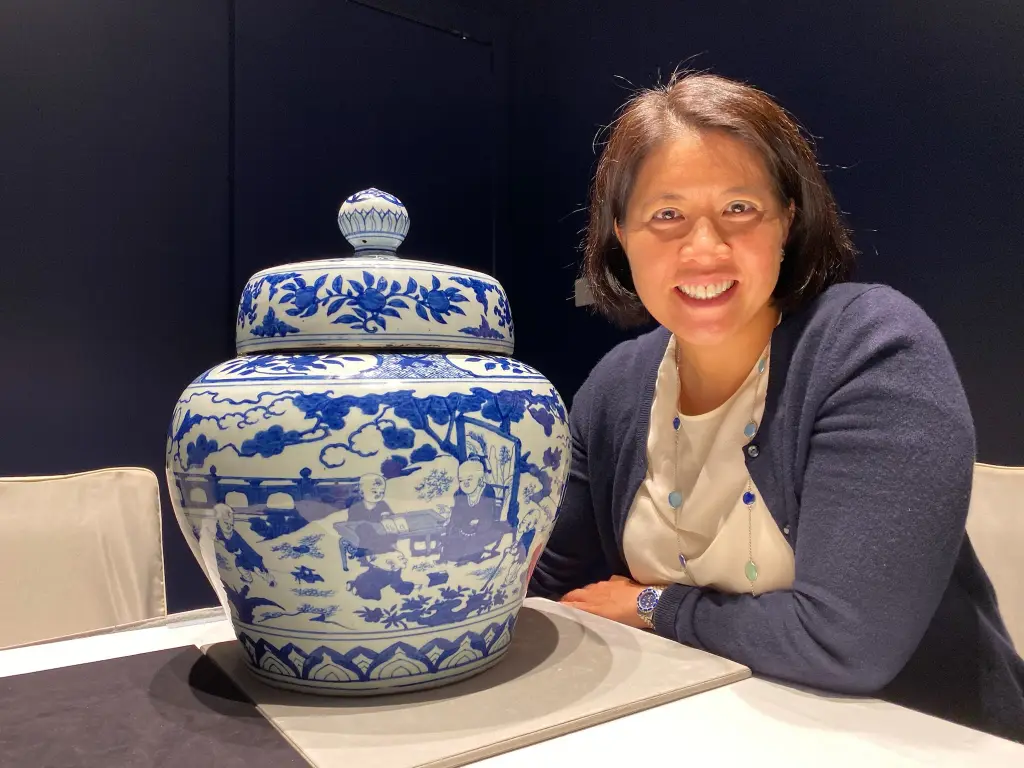
In 2020, Hu made another move, partly because during the Covid-19 pandemic, she began spending more time in the water. Leadership of Hong Kong’s first independent art advisory company, Centerpiece, was changing as founder Nancy Murphy, a Beijing-based lawyer had passed away and co-founder Marley Rabstenack moved on.
The company went dormant, until another co-founder, Katherine Don, a veteran of RedBox Studio in Beijing as well as Sotheby’s and Asia Society Hong Kong, looked for help in reviving it. She recruited both Hu and Hu’s mentor from Sotheby’s, New York-based Mee-Seen Loong, a former vice chairman for Chinese art ink painting and now is a partner at Ink Studio Gallery, in Beijing and Hong Kong.
Clients included Barbara Chu, executive vice president and partner of Emigrant Bank’s Fine Art Finance in New York. Chu had hired Hu’s former boss from Citi Private Bank, Suzanne Gyorgy. “They asked Mee-Seen and me to be consultants for them, and I felt so fortunate and so excited that I was working with these three amazingly strong women,” Hu said. Emigrant Bank’s approach with art finance is to take custody of artwork for a specified term limit, so that the customer doesn’t have to sell the pieces initially.
Into the deep end
Hu began her epic swims in 2018, starting with swimming around Hong Kong Island. From then on, she became ever more ambitious. “After I left Citi in 2020 and became independent, I had a much freer schedule that allowed me more time to train and take extended holiday to go and do these things,” she said. “When you’re in an office, and especially in the corporate world, you’re counting your 20 days of holiday a year, and you can’t go away for very long.”
She attempted her first crossing of the Tsugaru Channel between Honshu and Hokkaido in 2019, but couldn’t finish, and tried again in 2023, but did not get a chance to swim due to bad weather. She completed her first of the Seven Oceans swims in 2022, followed by two more in 2023, the Catalina Channel and the Straits of Gibraltar.
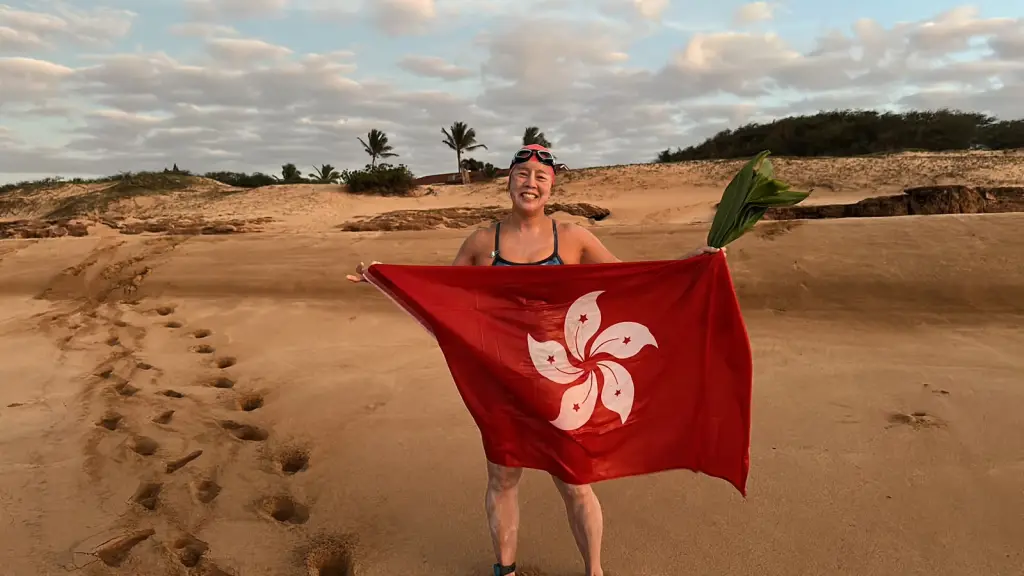
In 2025, she did her fourth and fifth Ocean Sevens swims, the Cook Strait between the South and North Islands of New Zealand and the Kaiwi Channel between Oahu and Molokai in Hawaii. Late last year, she swam around Lantau Island. In April this year, she swam the SCAR Swim Challenge in Arizona, a four-day, 41.7 open water event across four reservoirs on the Salt River (Saguaro, Canyon, Apache and Roosevelt lakes). She trains almost daily.
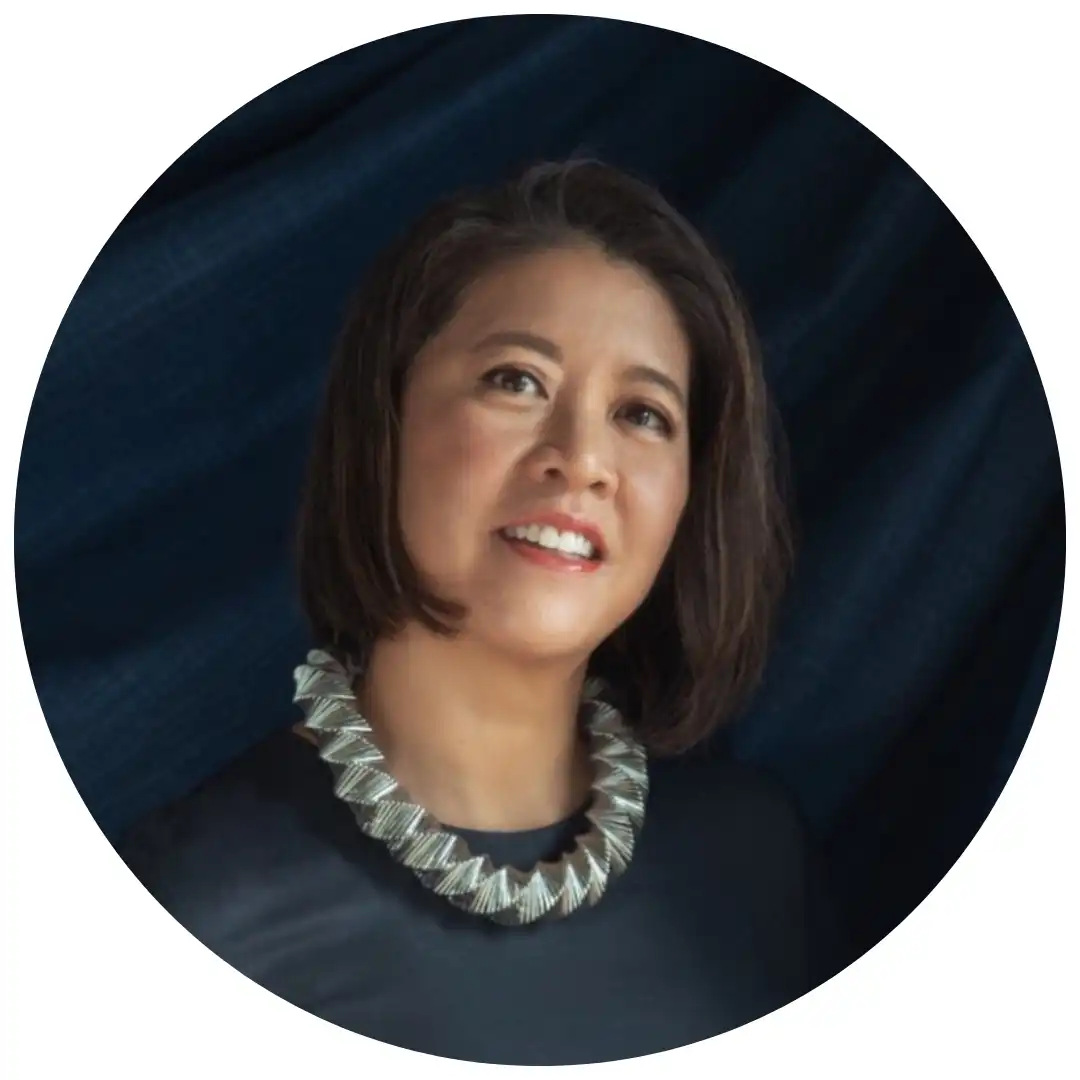
Edie Hu has become a major name in open water swimming in Asia, but she is one of several individuals and organizations that have helped to revive the sport in Hong Kong, including Splash Foundation and Doug Woodring, founder of Open Water Asia and Ocean Recovery Alliance. Hu is a 1997 graduate of Wellesley College and has a master’s degree in Chinese art history from the School of Oriental and African Studies (SOAS). She joined the board of Splash Foundation in 2026.