

When asked what he does after work, the chairman of French industrial giant Schneider Electric replies tersely, “I work.” It is only partly a joke. During Jean-Pascale Tricoire’s 20 years as CEO of one of France’s most valuable companies, its Paris-listed shares rose ten times in value.
Since 2011, Tricoire has led the global company, with 160,000 employees, from Hong Kong, a move that he took to make the company less Euro-centric and capture opportunities in Asia and North America. In an interview with AmCham HK e-Magazine, Tricoire shares his insights into the momentous changes in energy technology, with his 43 billion Euro (US$50.1 billion) company sitting at the crossroads.
Q. When you moved the headquarters of Schneider Electric to Hong Kong in 2011, it was quite radical. What was your thinking?
A. The reason I decided in 2011 to be based in Hong Kong is very simple. At the time, Schneider was largely Euro-centric, while our biggest growth opportunities were in Asia and the US. My location in Paris was not adapted to foster the capacity to ensure those opportunities in Asia and North America. Second, I was convinced that the future of companies was not to be centralized but to have an empowered local structure.
Moving for me was to prove that Schneider would be a different kind of company, where decisions would be made locally by a spread-out team. I spread the leaders of Schneider at that time everywhere in the world. Not only in Hong Kong, but it was also in Dubai, a lot in the US, in India and so on.

We would operate as a network of leaders connected by technology around the world, located within operating teams all over the world in different places. Fast forward 15 years, and our largest market by far is North America, with roughly 40% of our business. Asia comes second with 30% of the business. We’ve managed to develop an intimacy with the leading tech companies in the US and in Asia, and this is a consequence of that relocation and our ability to make decisions locally. Our objectives were to get closer to the opportunity, get inserted into the ecosystem, and put in place a model that gives power to the regions.
Why Hong Kong? Because it is a very efficient, a very attractive, a very vibrant place to lead an Asian business or a global business. Hong Kong is not only connected to Asia, but also deeply connected with the world. And it’s by nature, by culture, for many years one of the most international places in the world and has remained so. And Hong Kong has one more characteristic. It’s in permanent flux and permanent transformation, but it remains part of Asia and the rest of the world.
Q. What makes Schneider different from other multinationals? Your multi-nodal model, as you call it, is rare. How does it work?
A. I’ve been 40 years at Schneider, and CEO for 20 years. I believe what makes a difference in a company are the engagement of its people. You get engagement when people are empowered to create and to act locally in a world which is very diverse. If you want to have a great company, you need to recruit and develop great people, and great people will join the organization that gives them the empowerment to have an impact. You can’t empower people in centralized companies because key decisions are always made in the same places. You might encourage the people at headquarters, but you end up systematically discouraging people in other geographies.
What we’ve chosen to do at Schneider is to adopt a model that offers the capacity to develop fast in an autonomous manner and adapt technologies, giving local people in our local organizations the capacity to develop, manufacture and market the innovations emerging from our R&D centers.
Q. You were commercial director for China for Schneider in 1994. How did that experience affect your career, and how do you see China today?
A. I went to China in the 1990s, and I was part of a small team that started Schneider in China. And today, China is the second largest business of Schneider after the United States. We have more than 28,000 people in China, which operates as a very autonomous entity.
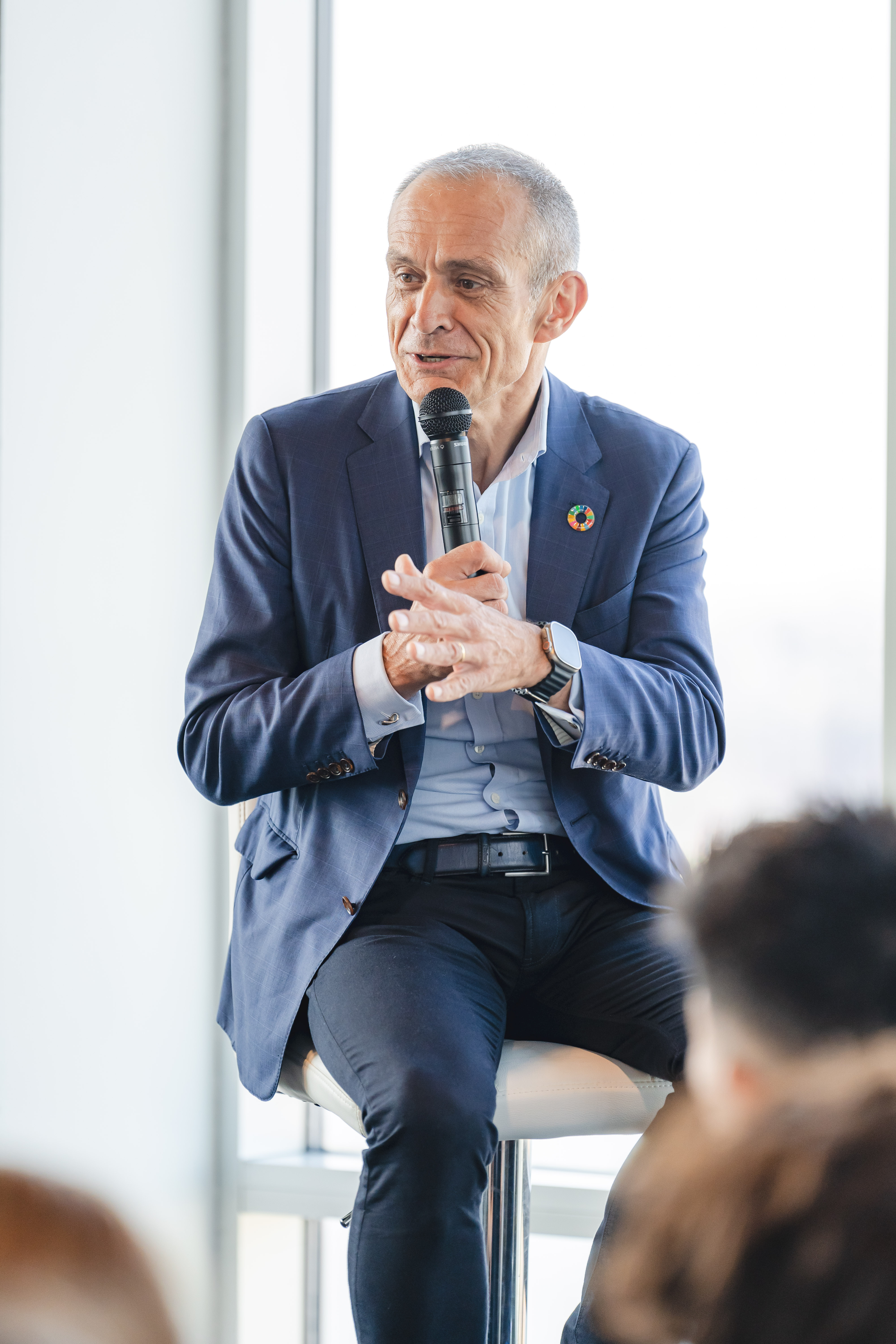
When I came to China for the first time at the beginning of the 1990s, I was impressed by the ambition of the country but also by the state of the country. At that time, China was still a very poor country in many places, and I was in charge of creating the sales and commercial network to start with. I travelled deep into every province to find partners and distributors, and meet people who would be our customers in the future. It was going to be completely transformed in the following 30 years and become what we know today, a country where every region has the best quality of electrification and energy available to people, a very high-quality infrastructure, and the largest industrial base in the world.
What struck me at that time in the 1990s, even if it was starting from a very low level of development, was the passion of the country for science. Already the universities were working on technology plans. Our customers were at a very high technical level, and they were passionate about the latest and brightest technologies.
The second strong impression was the focus on education: a nation committed to educating its people to the highest standards to meet the challenges of the future.
The third impression was one of connection and sense of community. People were really collaborating at a high level of intensity in ecosystems to develop their companies. Those were the times when foreign companies were coming to China to build bridges with the rest of the world, and the nation was working hard to educate at the highest level to meet the challenges of the future. And finally, an intense culture of entrepreneurship in an ultra-competitive environment, driving everyone to improve rapidly to survive in this Darwinian environment.
I could see at the time how all these things catalysed the development of China, but it happened much faster than I could imagine. What has struck me over the years is the capacity of China as a nation to change so fast. China has almost transformed itself every five years over the past 30 years. And people have taken those changes with a flexibility and an agility which I’ve not seen in many other places in the world.
Q. What does Artificial Intelligence (AI) mean for the structure of your business?
A. I believe that AI is by far the biggest revolution we’ve experienced in a very long time. AI is not just a sector on its own. It is going to diffuse everywhere, into every part of our society, into every object that we touch, and we are just at the beginning of what will happen.

I see it at Schneider. We are a very large company, with 40 billion plus Euros of turnover and 160,000 people. While we are completely driven to implement AI in every part of our business, we are still just scratching the surface. And we’ve already been deploying AI in the company for several years.
The need for computing in data centers that we see in the coming four years consists of more than doubling the existing capacity. That’s enormous, and it takes a lot of partnerships from chip manufacturers to infrastructure suppliers to utilities to make it happen. At Schneider, we are the world leader in energy and automation systems for data centers. We work with the major players all over the world, and we see the demand as not only real but accelerating.
I can tell you, I’ve been in this industry for 40 years, and I’ve never seen such a mobilization as the creation of infrastructure around AI. If you want a comparison, it would be the railway infrastructure in the US in the 19th century or China in the past two decades. It’s a team effort to put the infrastructure in place to serve all aspects of society.
In AI you have two phases. The first is when you train the intelligence, next is the inference, the application of the models in every part of our life, including the physical objects around us.
The second part has barely started, which means you’re going to see a lot of development in computing taking place around objects, more than just your phone or your car, all the things around you. We have barely started the stage of diffusion of AI to all applications.
Q. If this is an inflection point in the energy transition, how do you think it will unfold?
A. If you start with AI, every country, every company on earth is leveraging AI to become more competitive, to get more performance or deliver more services. What we see is that we are today at the very earliest stage of AI, where AI has been impacting mostly the digital sphere. But what we’ve seen in other transitions is that they really impact the world when they impact the real world in real time, and that is physical AI. And we are just at the beginning of that.
Our customers are rushing into automation, to connect everything they operate, and gather the best structured data to run AI on their industries, buildings, cities and data centers. AI is catalysing a massive rush to the Internet of Things, to big data, to algorithms of all sorts, to realize the digitization of the physical world, and there we are at the earliest of early stages. As a collateral effect, this is pushing more electrification.
For the past 40 to 50 years, electricity has represented 20% of the energy we consume in the world, while 80% of the energy we consume was coming from fossil fuel. It has been very flat, very stable. As we look to the coming two decades, a relatively short time, that 20% will become at least 40%, reducing fossil fuels to less than 60% of the mix, and this is why you see so much investment in generation technology. That can mean a lot of gas turbines in the US, with more power coming online, but in China it’s more nuclear plants or more renewable installations and batteries.
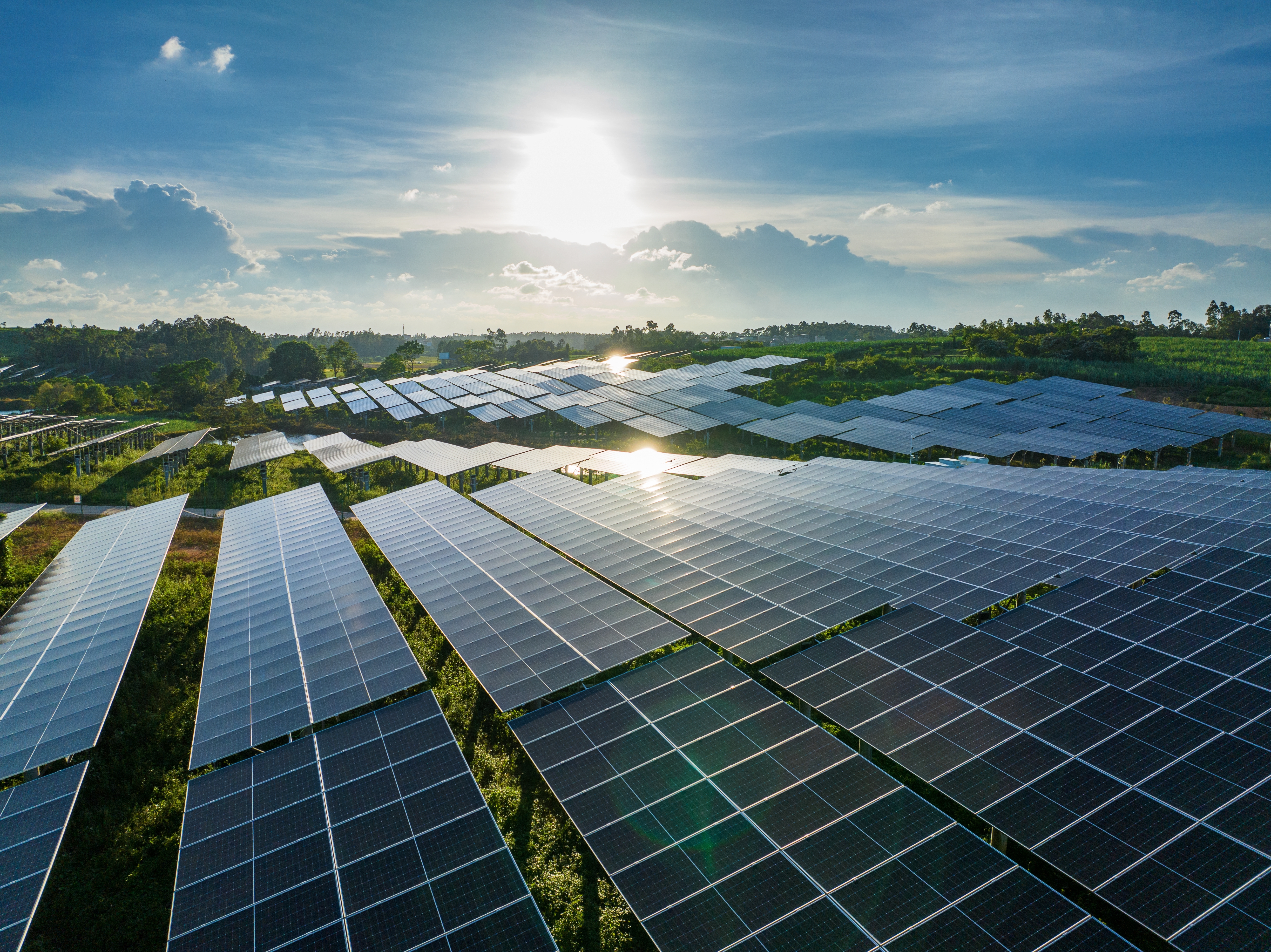
There will be a lot of investment in smart grids and electrical systems, and AI will have a massive contribution to their design. Electrical systems can become far more efficient if they leverage AI. A smart building can save 30% of electricity. A smart grid can generate a lot of valuable electrons with the same physical infrastructure, and a data center can operate with much less electricity if it has been designed for efficiency.
AI needs a lot of electricity, but the electricity of the future needs a lot of AI to manage more efficiently, to manage the intermittency of renewable energy and to make grid infrastructure more efficient.
So, there are two strong inflection points, electrification and AI, with two very different ways to look at the world in the US and China. There are different versions around the world, and this is where we operate, but in a booming environment, which is positive for us.
Q. AI has become political, with China and the US representing different governance standards. How does this strategic competition affect your business?
A. I don’t think it’s going to be two models. It’s going to be multiple models, especially as AI will diffuse into applications. People today are very focused on the models, but the value creation will be in the quality of data in the application that each company or country has, and the deep knowledge of the applications. Each geographical block will be reluctant to depend too heavily on another block, seeing the level of contention that you can observe in politics.
At Schneider, more than 15 years ago we structured the company to be multi-hub or multi-nodal, and that started not because of the geopolitics but because countries are in fact very different. The technical needs are different, and the digital ecosystems are different. This is not new. We also believe that what’s important is to be fast. One must be very reactive to the needs of the customers.
I always believe that fast beats big. It’s not important to be a big company. It’s important to be a fast company. And you cannot be fast if you try to apply one size to fit the whole world, which is very diverse and increasingly diverse as more regions of the world are emerging to a new level of prosperity.
What’s important is to have local R&D in every part of the world, working with local standards of AI, of digital and electrification. It’s important to be able to manufacture locally, and to go very fast from the ideation of a product to production at scale. It’s important to be deeply inserted into the local ecosystem.
We’ve structured Schneider around regional poles with a global overlay, but a light one, and therefore – as an example – the US operation is autonomous to develop US solutions for US customers. Europe, India and China are all very independent, and this is the way we manage it. Our model addresses agility in all sectors, from hardware to software to the ecosystem of partners.
When you travel around the world, you have electrical adaptors. You cannot use a European electrical system in the US, or a US system in Europe and the same applies to India, to China, to South Africa and so on and so on. When you are born into that environment, like me, which is very diverse from one geography to the next, you must think differently about developing your business. It’s not for the business to adapt to what you wish.
I think the human brain has a passion for creating special things. We keep simplifying and converging. But our customers have an infinite capacity to develop divergent systems, and we are here to serve that permanent creation of new variants.
Q. What is the likely impact of the energy transition on de-carbonization and climate goals?
A. At Schneider, we’ve always been a strong provider of technology for energy efficiency, and we’ve always been a sustainability pragmatist. We believe that solutions against climate change or for carbon reduction are solutions which bring more efficiency and economic competitiveness. And we demonstrate that every day with our customers and applications. What we’ve seen with the rising price and volatility of fossil fuel is that the return on investment of those technologies has improved. If you look at the climate agenda, most countries have stayed very focused on it, starting with China and Europe.

Most of our customers have exited the period of hype and are into the pragmatic application of technologies for more efficiency. They have understood that what’s good for the climate is also good for economics. It makes you more competitive, makes you more secure and more resilient.
Furthermore, the fastest growing companies in the world, which are the tech companies, have stayed very committed to making sure that their sourcing of energy would be low on carbon intensity.
To summarise, what the world is asking for, for different motivations, is more power to service the transition to electrification with less carbon, for more security and resilience as well as competitiveness.
Q. Data centers and AI have been politicised. How can the industry build public trust?
A. AI is the biggest revolution we’ve experienced in decades. As with every revolution, it generates concerns, and I believe that companies and politicians must be very serious and attentive to these concerns. The two major concerns are on jobs and ethics on the one hand, and pressure on resources, including electricity and water, created by data centers on compute infrastructure.
If I look at Schneider, we’ve seen a change in the nature of jobs, but we have also seen a lot of creation of jobs due to the AI boom. In our line of business, we have a shortage of multiple specialists, starting with electricians. We are not talking about traditional electricians, but people who are able to do smart electricity, mixing big and small electrons, putting intelligent systems into buildings, cities and industries. There is a massive shortage in that space.
To give one example, when AI is monitoring machines, it creates a lot of jobs for maintenance and predictive maintenance, which means people going into the field to address issues detected by AI. A recent study by Brookings Institution found that data centers do create local jobs with employment rising in the data processing sector by 56% over the first decade of operations, and employment in telecommunications rising by 43%.
Data centers create an ecosystem which creates new jobs that did not exist before. Data centers are not a big consumer of energy, when you look at global statistics on energy consumption. Data centers represent 0.3% of world energy consumption today. It’s going to double in the next four years, but it’s still going to be less than 1%. In some countries, like the US, which has been building the most data centers, they represent less than 10% of total electricity consumption. But the fact of the matter is that data centers are spectacular and represent a big mass of electricity in one place.
One of the biggest reasons for the rise of electricity prices in places like the US, associated with data centers, is that the electricity infrastructure is quite antiquated, and needs to be adapted with smart grids, new ways of generation, and a better way of managing electrification.
As AI goes from the centralized structure of training models into decentralized structures, it’s going to be less spectacular and probably less perceived as threatening by communities, but this is something which needs to be addressed place by place, location by location. The subject of available resources, water and electricity, must be addressed as such.
We also see data centers helping to regulate the flow of electricity in communities because it is equipped with batteries that can help manage the network locally. Again, we are just at the beginning of the AI revolution.
I think these concerns have to be heard and addressed in detail with local communities. They must be addressed with practical solutions and practical answers, but people also have to take into account that data centers are a minimal part of the electricity consumed in most countries today.
Q. What do you do outside of work in Hong Kong?
A. Hong Kong has a vibrant society and beautiful nature, and I like the outdoors and hiking and go to sea, which is close. That’s what I like about Hong Kong. It’s always on, and you always have interesting people to meet and interesting people coming to visit.

Jean-Pascal Tricoire is chairman of Schneider Electric. He served as CEO from 2006 to 2023 and has held the role of Chairman since 2013.. He joined Schneider in 1986, after obtaining an MBA at EM Lyon Business School and a master’s of engineering at École Superieure Électronique de l’Ouest (Eseo) in Angers, France. From 1989, he had postings in Italy, China, South Africa and the US, He served in China from 1994 to 1999, and as chief operating officer from 2003 to 2006. Tricoire led the expansion of Schneider overseas as well as its focus on data centers, digital, software and energy efficiency. Schneider Electric SE (SU.PA) is one of France’s most valuable listed companies, with a market capitalization of 169.5 billion Euros (US$197.5 billion).