

Joe Studwell, author of How Africa Works: Success and Failure in the World’s Last Developmental Frontier is legendary for his journalism on China and Asia. In 2013, he turned from two decades of focus on East Asia, after publishing the highly praised How Asia Works. While restoring a house in central Italy he began working on the “world’s last developmental frontier,” Africa. This concept underlies his most recent book, “How Africa Works,” in which he looks at how four African economies – Botswana, Mauritiius, Ethiopia and Rwanda.
Ethiopia and Rwanda broke into the developmental ranks through policies learned in part from East Asia. Land-locked Rwanda counter-intuitively modelled itself on Singapore; Meles Zenawi, former prime minister of Ethiopia from 1995 to 2012, analysed the growth tracks of Taiwan and South Korea in his PhD thesis.
In this article, reprinted with permission from Gavekal “Ideas,” Studwell lays out the macroeconomic themes behind successful African economies – state promotion of small-holder agriculture and manufacturing and capital controls. The Wall Street Journal, in its review of the book, says one of its strengths is “how it documents the policy vicissitudes even when they don’t support the author’s story.”
Why Africa fell behind East and Southeast Asia
How Africa Works contends that it is not governance failures, corruption or ethnic conflict that kept African development back, but low population density. The growth, and belated education, of Africa’s population is behind an improvement in economic performance that is led by agriculture, which since 2000 delivered growth that beat the world – as was the case at the outset of Asia’s development.
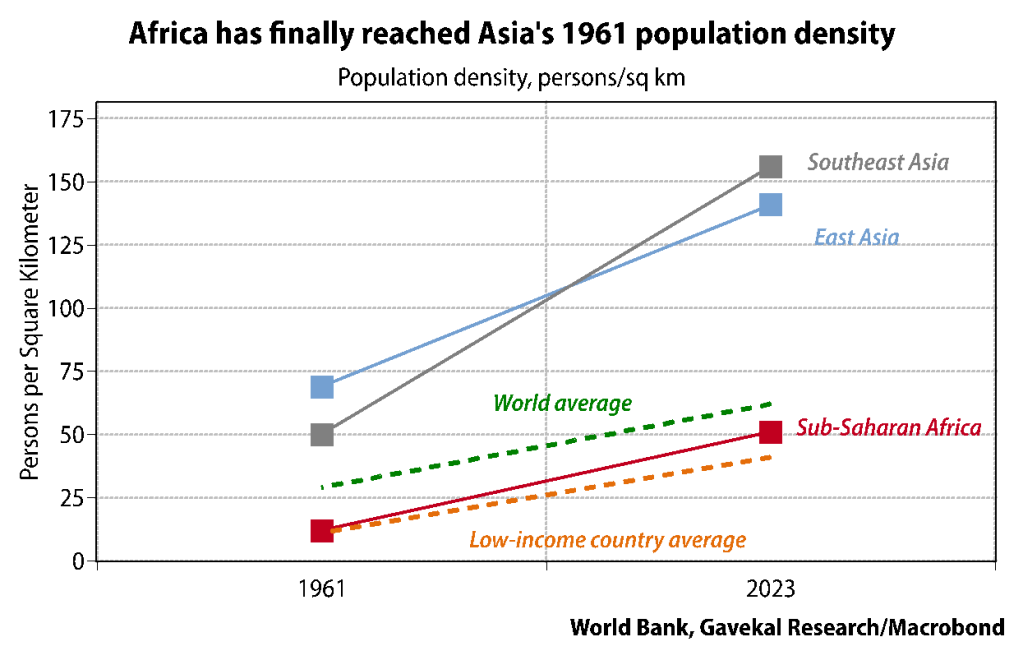
Africa is knocking at the door of your attention. From just 230 million people at the end of World War II, the continent has 1.5 billion today and will have 2.5 billion in 2050. Africa now has the same population density that Asia had in 1960, giving the continent, for the first time, “economies of agglomeration.”
In other words, density means that the per-capita cost of public goods such as infrastructure are greatly reduced, markets are larger and more numerous, the supply of labor and skills improves, the division of labor increases and people are more connected and able to share resources and hence more likely to find collective means to create economic value. Africa still has plenty of problems, but the continent is finally emerging as the last great developmental frontier.
Africa misdiagnosed
It is long forgotten that Africa’s developmental prospects seemed bright after World War II. The continent experienced considerable inward investment in mineral mining before and during the war, when Europe’s mineral trade with Asia was cut off. This included copper in then Northern Rhodesia, today’s Zambia and Belgian Congo, now Democratic Republic of the Congo and tin in Nigeria, as well as hefty investments in plantations. Africa was the prime global beneficiary of soft and hard commodity price inflation through the 1940s and 1950s. Gross Domestic Product (GDP) per capita in sub-Saharan Africa in the 1940s exceeded that in South and Southeast Asia for the first time.
Africa enthusiasm persisted into the independence decade of the 1960s. In 1967, a book by the head of the World Bank’s Economic Development Institute identified seven African economies with “the potential to reach or surpass” a 7% growth rate. East Asian economies began to hit such growth rates from the 1960s, but none of the book’s African tips did.
The reasons for African failure were subsequently held to be poor governance, kleptocracy and corruption, endemic violence and civil strife. The unstated common thread was that Africans were unable to work productively with the natural abundance with which they were blessed; it was, ultimately, a racial judgement. In reality, Africa’s principal developmental deficit was population density. This was rarely mentioned by economists or political scientists, who also failed to note that symptomatic differences in Africa – weak governance and civil strife – were rooted in demographics.
In 1961, population density across the whole African continent was less than ten people per square kilometer, the same as Europe in 1500. It was one-fifth the 1961 population density of Asia and one-seventh that of East Asia. Africa was the most underpopulated large landmass in the world. The continent might have some minerals and abundant agricultural potential, but with so few people it had insufficient workers, tiny markets and an anaemic tax base. As a result, governments were hopelessly weak and infrastructure was unaffordable.
At the start of the 20th century, the biggest cities in West and East Africa had populations of around 20,000, for instance, Lagos, with 18,000 or Dar es Salaam with 21,000). By comparison, Shanghai had half a million people, and Singapore had a quarter of a million. This reflected Africa’s unique disease burden. The leading killers were sleeping sickness and malarial mosquitoes with a much stronger appetite for human blood than those in Asia. A vast smorgasbord of communicable diseases exposed those living in close quarters in urban areas to particularly high mortality.
The politics of the demographics
Historically, low population density meant that people, not land, were the valuable commodity in Africa. Political power was manifested as control of small urban settlements and their peripheries, coupled with raiding wider areas for human captives. In a chronically people-deficient environment, societies that could acquire more captives became more powerful. Thus, domestic African slavery became, in all parts of the continent, the indigenous precursor to the infamous, industrialized export slavery imposed by Arabs and Europeans. Estimates of the shares of African societies constituted by enslaved people prior to foreign slaving range between 30% and 60%.
Africa was so vast (China, India, the US and Europe could fit inside it) and people so few that more than three thousand distinct ethnic groups could survive into the 20th century. Low population and vast territories created an environment in which groups co-existed without needing to interact or, usually, to fight. If conflict did threaten, there was typically enough space to simply move away and start afresh.

It was the polar opposite of densely populated Europe or Asia where ethnic groups fought over land, and the winners imposed their rule and values on the losers. By contrast, Africa’s ethnic fragmentation persisted through the independence decades of the 1950s and 1960s, when departing European powers declared that – as if by magic – national politics would begin. African politics born in this way took decades to acquire some stability.
Worse, Africa’s low population density made the whole colonial era – which in most places began in the 1880s – one defined by unprecedented “low-budget” colonialism. Since populations generated almost no tax, European powers ruled with tiny expatriate staffs and controlled non-urban areas through “customary” aristocratic leaders – chiefs and kings.
By the 1940s, the average British district officer in African colonies oversaw an area the size of Wales or New Jersey. So long as the delegated aristocrats furnished laborers and a bit of cash, the colonizers left rural areas in the hands of despots. There was no centralized bureaucracy and organization comparable with colonial rule in East Asia, where local elites were co-opted into centralized government networks.
Low population density also encouraged France, Britain, Portugal and Italy to create a dozen settler colonies in Africa in a manner without equivalent in Asia. White settlers displaced African subsistence farmers from the best land and moved them to “native reserves.” When the independence era came, the settlers clung to their large farms. This led to a rash of protracted and bloody wars of liberation, from Algeria to Kenya, Mozambique, Zimbabwe, Namibia, Angola and South Africa. Conflict went on into the 1990s, far beyond the years when non-settler states gained independence.
At the peak, two million European settlers in Africa farmed more than 20 million hectares. The aftermath of the wars was not positive for development as new, black political leaderships and residual white economic elites did not find working accommodations. In turn, indigenous governments from Morocco to Mozambique failed to redistribute seized settler land to small farmers, keeping it instead for rulers and their aristocratic allies.
The educational deficit
The most extraordinary impact of Africa’s low population density and consequent low-budget colonialism was the overwhelming illiteracy and innumeracy of Africans in the 1960s. Almost without exception, colonial governments did not operate schools until the 1950s. Prior to that, the small number of schools that existed were run by missionaries. The result was the lowest levels of literacy and numeracy in the world.

Adult literacy in sub-Saharan Africa in 1960 was 16%. In that year, just 8,000 children graduated from secondary school in a population of 285 million. This compared with 80,000 girls in secondary education in 1960 in South Korea alone with a population of 25 million. Where African children averaged a total of a few months of education in 1960, in the Philippines, Malaysia or Thailand the average was two to three years; Taiwan and South Korea were far ahead of this.
The best encapsulation of Africa in the 1960s was presented not by the rose-tinted lens of foreign economists and investment enthusiasts, but rather by the Burkina Faso historian Joseph Ki-Zerbo who, writing in the UN-sponsored General History of Africa, observed: “The very vastness of the African continent, with a diluted and therefore readily itinerant population living in a nature at once generous with its fruits and minerals, but cruel with its endemic and epidemic diseases, prevented it from reaching the threshold of demographic concentration which has almost always been one of the preconditions of major qualitative changes in the social, political and economic spheres.”
Six decades to become more Asian
Africa’s fundamental problem after World War II was that it didn’t have the people to play the developmental game that Asia was getting into. When a poor society starts the process of accumulation, it cannot move the economic needle by applying capital or technology that it does not have. Labor is the vital, available ingredient. Africa, with just 230 million people spread across a vast continent, was not in the game. Asia, with 1.4 billion people, was.
The good, if unrecognized, news for Africa was that the hunger and diseases that prevented its population from growing were finally being tackled. Famines were much reduced by the arrival of trucks, which could move food from surplus areas to ones of shortage. In the 1920s and 1930s, colonial governments started to build the first medical services, delivering smallpox vaccinations and screening campaigns for diseases like sleeping sickness. In the 1940s and 1950s new drugs were introduced for many African diseases and spraying campaigns against malarial mosquitoes – plus the use of chloroquine and antibiotics – greatly reduced mortality.

Population in Africa, which for hundreds of years either did not increase or rose only marginally, grew 2.4% a year in the 1950s, the same rate as the Asian peak in the late 1960s. The main reason was huge reductions in under-five mortality. Africa’s population growth topped out at 2.9% a year, meaning that population doubled every 25 years.
Africa also experienced rapid urbanization. With communicable diseases under control, people could live together, and the urban share of population rose from one-tenth before World War II to almost half today. Lagos, long the biggest metropolis in West Africa, went from 700,000 residents to 14 million. Almost one hundred cities of more than a million people were created and the total number of cities reached 7,600 – home today to more than 500 million Africans.

And while the development is lamented by (mostly white) conservationists, the mid-twentieth century also saw the control of Africa’s wildlife population – crucial for the development of agriculture. The biggest problem for farmers had long been elephants, who numbered 25 million as recently as 1800. The count was reduced to two million by 1960 and 400,000 today. Elephants, which consume 150 kg of food a day, will eat almost any crop that farmers grow and are not intimidated by weapons less potent than guns. Elephants still ranged over 63% of sub-Saharan Africa in 1950, falling to 27% in 1975.
By 2020, Africa got itself into the demographic place Asia reached in 1960, with population density of around 50 people per km2. Demographically, Africa is now at the point where Asia began to escape poverty.
Of course, Africa is still far from the 150 people per km2 in Asia in 2026. But the continent is adding more than 300 million new Africans per decade – 1 billion more between 2025 and 2050 – and is on course to move from a headcount of 1.5 billion today to 4 billion at the end of the century. That will equal the 4 billion people Asia is expected to have in 2100, down from a peak of 5 billion at mid-century.
The secret triumph in schools
The great, unreported achievement of Africa as its population grew was to deliver the fastest expansion of formal schooling that the world has seen. In the first two decades after 1960, primary enrolments increased from 36% to 63%, secondary enrolments from 3% to 13%, and tertiary from almost zero to 1%. The World Bank concluded in 1981: “Nowhere else has a formal education system been created on so broad a scale in so short a time.”

By the 1990s, primary enrollment in almost all states exceeded three quarters and, on several metrics of educational attainment, Africa surpassed South Asia. Female literacy, for instance, reached 48% by 1995, well ahead of South Asia. Meanwhile, the growth of university education led to a six-fold increase in the number of graduate scientists by 1990.
African states expended an unusually large share of resources after independence on moving the majority of their populations to basic levels of literacy and numeracy and created smaller, but substantial, subsets of people with secondary or higher education. In Tanzania, the government of Julius Nyerere raised literacy in a single generation from 10% in the early 1960s to three-quarters by 1990; primary school enrollment jumped from one quarter to four fifths.

Literacy and numeracy are the entry tickets to the modern economy, whether for smallholders reading herbicide instructions or calculating fertilizer distribution on their land, or for factory workers checking notices posted by managers or assessing advertisements for alternative jobs.
What more people and a bit of education get you
Despite these achievements, Africa’s economic performance from the 1970s through the early 1990s was disastrously bad, with less than zero growth per capita across that period. Recent estimates indicate that sub-Saharan Africa did not return to its 1974 level of GDP per capita until the mid-2000s. But starting in the mid-1990s Africa began to post solidly positive growth. Continent-wide GDP rose 5.1% a year in the 2000s and 3.3% in the 2010s. Household consumption expenditure in sub-Saharan Africa, which fell between 1980 and 2000, has since increased by 160%. In 2023, ten of the 25 fastest growing economies in the world were in Africa. The benefits of more people and a bit of education started to tell.

Growth is now led by the expansion of coastal and near-coastal cities driven by the world-beating pace of urbanization. By 2020, half of Africa’s consumption was accounted for by its 75 biggest cities, the great majority of them close to the sea. Lagos, for example, accounts for more than one-fifth of Nigeria’s GDP. In geographic terms, Africa is starting to look a little like the Americas, with most economic activity concentrated on the coasts, and inland areas more associated with minerals and agriculture.
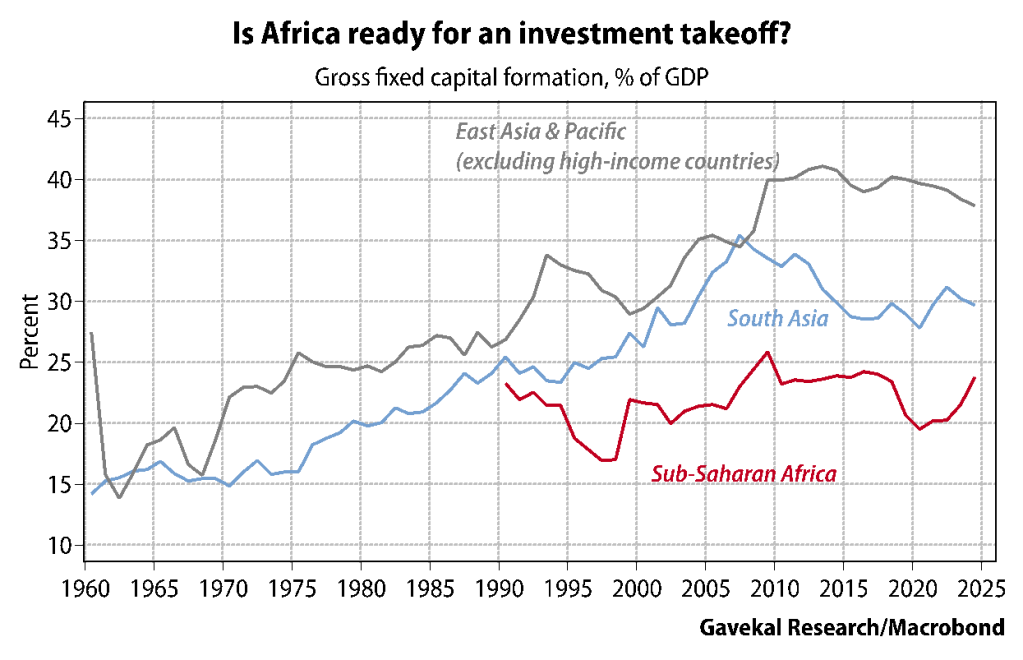
Rising population has gradually reversed Africa’s traditional disadvantage of having much higher wage rates than other developing regions. In the 1960s, African wage rates were twice those in Asia. Today, wages are one half to one tenth – depending on the African state – of those in the biggest Asian economy, China. For the first time, African economies can compete with any part of the world, at least on labor cost. The big question is whether this labor-cost competitiveness can translate into sustained investment growth. An optimistic read is that Africa is poised to push its investment rate above 25%, as East Asia and India did at the start of their respective take-off periods in the 1970s and 1990s.
Rising population and the growth of cities gave African governments greater revenues and hence capacity. Infrastructure construction has reached unprecedented levels. Meanwhile, the ethnic conflicts that plagued post-independence Africa peaked in the 1990s, when 31 nations were simultaneously in states of conflict. Thereafter, conflicts declined and more democracies put down deeper roots – an important mechanism in Africa for managing ethnic division. In 1987, only Mauritius, Botswana and Sudan were democratic states. Today, the Bertelsmann Transformation Index, which compares systems of political rule, defines 14 of the 55 African states as fully democratic, but more than twenty others are anocratic – the political science term for a mix of democratic and autocratic rule.
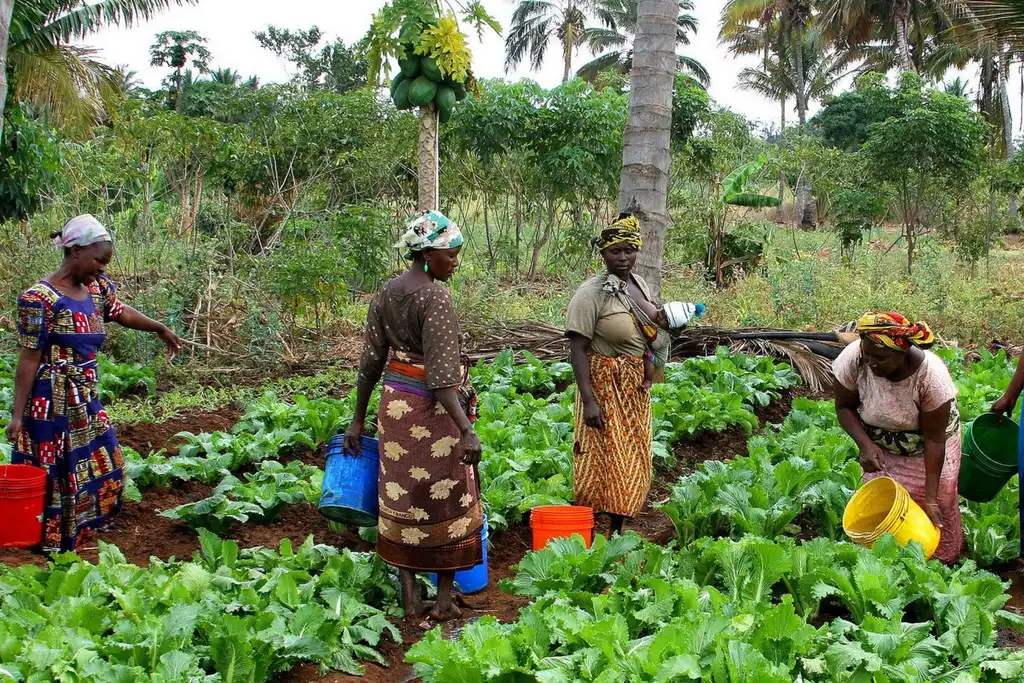
The first truly revolutionary impact of demographic change, however, was felt in African agriculture. The new cities created centers of reliable demand for foodstuffs that led to aggressive investment in food production and increases in yields that took irrigated, fertilized peri-urban agriculture towards Asian output levels. It was something unthinkable in Africa two decades earlier.
The bigger echo from Asia was that it was agricultural surpluses that proved the essential first step in overall development. Downstream in Africa, what became after 2000 the world’s fastest rate of agricultural output growth encouraged massive expansion of agricultural processing capacity. So potent was the change that it accounted for half of all manufacturing investment in Africa. It is African agriculture that points most clearly to a brighter future.
This article was published in “Ideas,” GavekalResearch, on January 27, 2026, and is reprinted with permission.
Joe Studwell is the author of books including the China Dream (Grove, 2003), Asian Godfathers (Grove, 2007), How Asia Works (Grove, 2013) and How Africa Works (Atlantic Monthly, 2026). A senior fellow at the African Urban Lab, he is also a senior visiting fellow at the Overseas Development Institute in London and non-executive director of Edinburgh-based Pacific Horizon Investment Trust. Studwell was a founder and director of Dragonomics, now known as Dragonomics-Gavekal. He has a Master’s degree and PhD from the University of Cambridge in development economics and an undergraduate degree in history from the University of Bristol.