
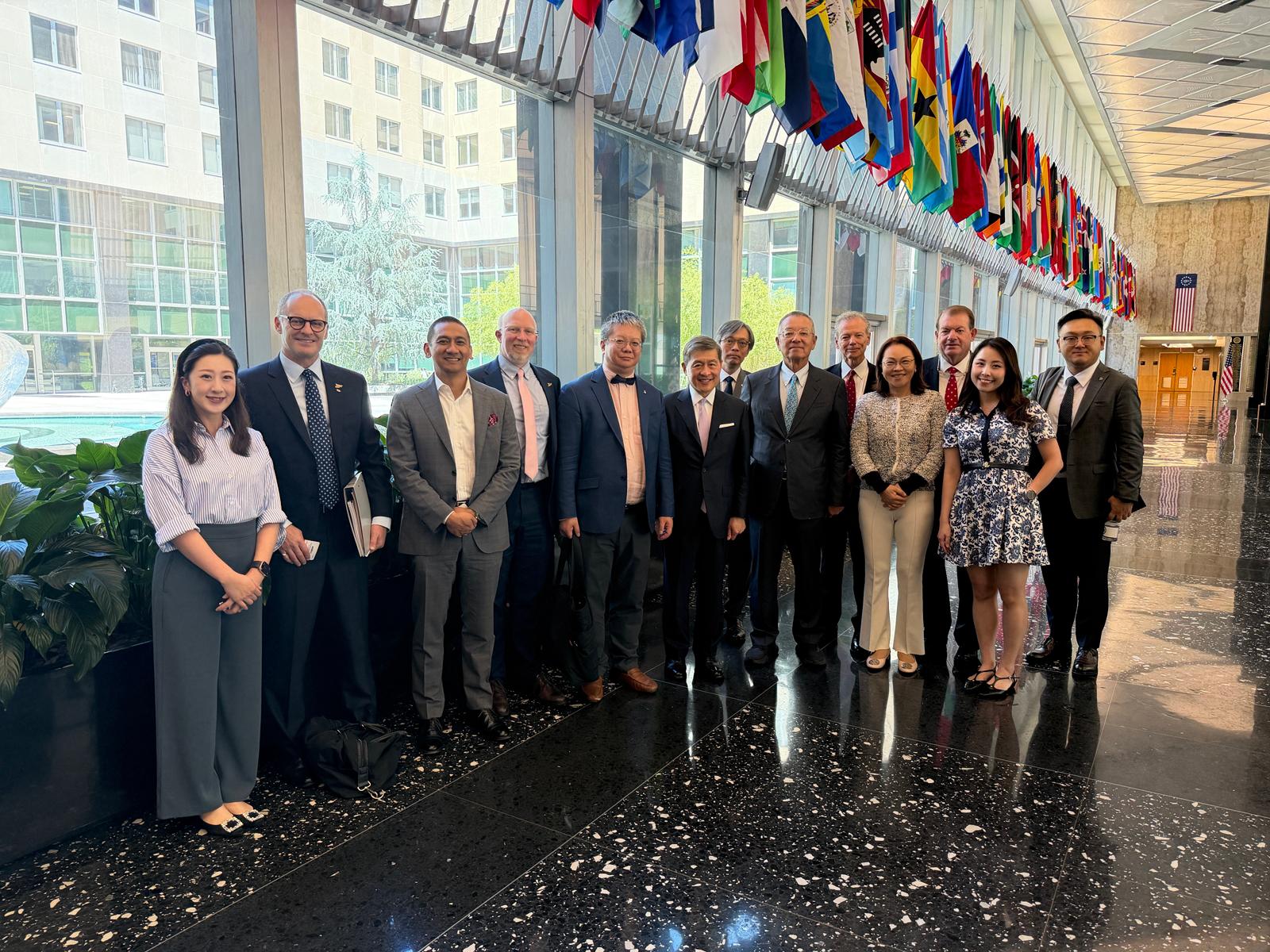
From June 21–25, AmCham HK made its annual Doorknock visit to Washington, DC, with a 14-person delegation, led by Chairman David Butts. This year’s visit carried particular significance as it took place just one week before the 250th anniversary of the founding of the United States, a month after President Donald Trump’s visit to Beijing in May, and just three months before the September visit to the US by President Xi Jinping. These events have kept US-China relations at the forefront of Washington’s policy and political discussions.
For the first two days, a subset of the AmCham HK delegation participated in the broader program of the AmChams of Asia Pacific (AAP) , which organized a 14-chamber, 50-person delegation. Meetings were held with senior officials from the US Department of Commerce and the Office of the US Trade Representative, (USTR), as well as other agencies.
The delegation met with Sen. Steve Daines (R-Montana), Sen. Maggie Hassan (D-New Hampshire), Rep. Young Kim (R-California), and Rep. Bryan Steil (R-Wisconsin). Key staff members of other congressional offices also met with the AAP delegation. Representatives from the America First Policy Institute, American Enterprise Institute, and Center for a New American Security briefed the delegation. The Asia Group hosted a reception with State Department and foreign diplomats.
For the next two days, AmCham HK delegation held Hong Kong-focused meetings with Assistant Secretary of State for East Asian and Pacific Affairs Michael DeSombre, Deputy Assistant Secretary of Commerce for China & Mongolia Duncan Willson, and National Security Council Senior Director for Asia Ivan Kanapathy. The delegation also met with USTR Director of China Affairs Jingjing Zhang and with Treasury Department officials close to the current trade and investment negotiations with China. A meeting also took place with a senior China consultant from the Cohen Group. And the AmCham HK delegation met with Sen. Steve Daines again in a private setting.
The delegation held a seminar for more than 80 attendees at a business event co-organized with the Hong Kong Economic and Trade Office. A highlight of the visit was a dinner hosted by the Chinese Embassy Chargé d’Affaires ad interim, Minister Qiu Wenxing.

So what was learned from the discussions during the packed four days in Washington? More details were shared with AmCham members by the delegation during a debrief on July 22, but it can be stated that the outlook for US-China relations remains contentious and volatile, in spite of the two nations now trying to achieve a “constructive strategic stability” as proposed by President Xi at the last Summit back in May.
The delegation observed that, for the present, Washington is busy following up on agreements in May and preparing for the September visit and two more possible summit meetings – the November visit of President Trump to Shenzhen for this year’s Asia-Pacific Economic Cooperation (APEC) Leaders’ Meeting and President Xi’s visit to the US for the Group of 20 (G20) meeting in December. Details on the Board of Trade and Board of Investment, established during President Trump’s May visit to Beijing, remain scarce – especially regarding Chinese investment into the US. For the moment, the mood remains cautious, with everyone looking ahead to a potential three US-China presidential summit meetings.
Still, during the visit, the delegation observed widespread mistrust of China in Washington, along with US concerns about specific Chinese initiatives. Those we met with appeared to appreciate that there is some stability in the bilateral relationship at present, but few believe that stability will last beyond this year. Some members of Congress and think tanks continue to regard China as an adversary, even if the focus this year has been less on “de-coupling” and more on “de-risking.” The delegation did note that the meaning of the term “de-risking” can be interpreted widely.

With regard to Hong Kong, any attention paid in Washington to Hong Kong was largely of a doubtful nature. The delegation found some interest in Hong Kong’s economic positioning and strategic importance, but that the US Government’s emphasis on Hong Kong remains narrowly focused. Delegates attempted to present a front row view of business opportunities in Hong Kong in America’s interest. However, given the poor perception and broader prevailing narrative, one can only expect that any change of attitude will take place slowly.
Even so, there were members of Congress who were more optimistic about the bilateral US-China relationship and had a more positive view of Hong Kong than in previous years. In addition, some US Administration officials were willing to begin to look at Hong Kong in a more holistic manner. (FYI: Some small action took place a few weeks after this Doorknock, removing sanctions on a few officials in Hong Kong, via the non-renewal of Executive Order 13936.)
Overall, it was very useful for the delegation to hear interagency views, and delegates communicated what AmCham HK and its members are doing in Hong Kong, how they experience the local situation, and why this benefits American interests. However, while the bilateral relationship has pockets of positive momentum, and there is a temporary hiatus to the tensions, the road ahead for US-China relations and for Hong Kong is likely to be a long one.