
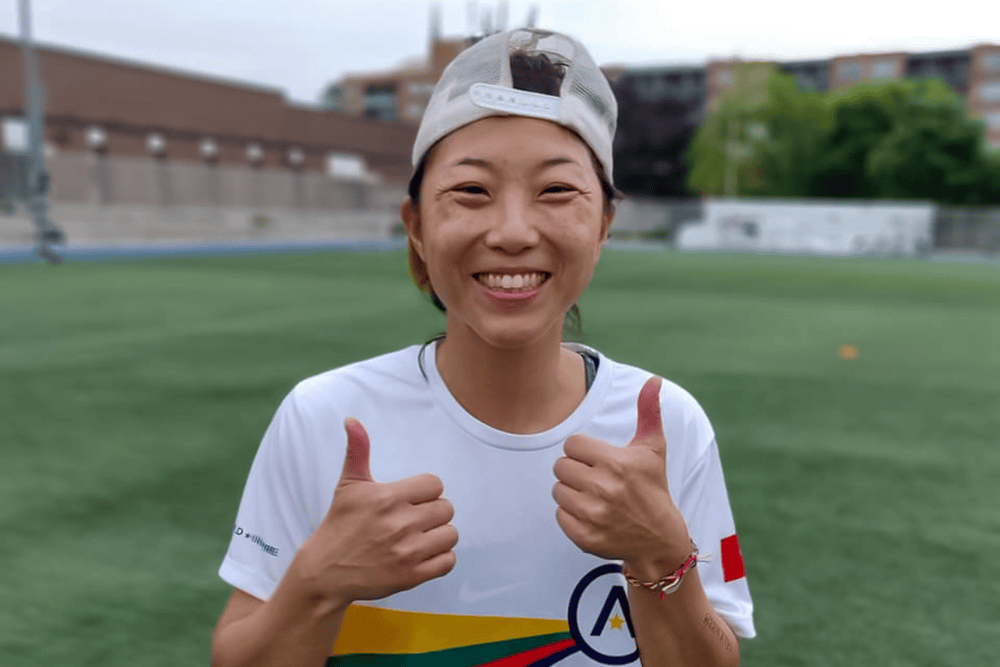
The founder of WISE tells the AmChamHK e-Magazine talks about how ultimate frisbee helped raise her confidence and learn how she could help empower other women through sports, after an initiation in business with J.P. Morgan and Accenture. She founded WISE in January 2017 and it has founded sports programs teenage for girls studying in local schools, a mentoring program with working women and girls, as well as sports activities inviting in asylum-seeking mothers and children. One of their programs for girls in schools urges them, “Oh Yeah? Girls Stand Up!”
WISE officially started in 2017, but the idea came long before that. I guess if we backtrack to before I started WISE, I was living in Beijing from 2009 to 2015, and a few things there helped to form the idea.
I joined a Lean-In Circle, the first in Beijing, after Sheryl Sandberg came to Beijing and visited Tsinghua University. I was at a point where I had all these questions in my life, so having the circle was formative for me. I also played ultimate frisbee in Beijing, which I had played since I came back from university to Hong Kong. I noticed it was mixed-gender, and you have to call your own fouls because it’s a self- officiating sport. That is hard for women to do because you have to speak up. It was a good training ground for us.
I was a captain, and I saw how women and men need different things to step up. When you’re in a single gender sport you don’t always have the luxury to do that. In the last years of my master’s in public administration at University College London and New York University’s joint program in global public administration, they ask what you want to do. I said, “something about women and girls”, but I didn’t see the opportunity until 2016 when I came back to Hong Kong.
At a panel discussion in London, 70% of the women said sport had helped to accelerate their career. In Beijing, I worked for Accenture before I left to start my own business. It wasn’t very successful, but it was a good learning experience for me. I had gone to Beijing after getting an MBA at INSEAD. I had graduated after the financial crisis. A summer job in London didn’t work out because of the financial crisis.
I’m from Hong Kong. I grew up here, in a family that encouraged me to play sports. I went to the French International School, even though my parents are not French and did not graduate from university. I was the only child, and they always wanted to give me the best. Mom grew up not encouraged to play sport and grandmother said swimming too dangerous.
Mom knew it was about more than just for physical health. She knew it would be good for me to have friends outside school. She wanted me to do more feminine sports like figure skating – not ballet because it would leave my feet in a figure 8 shape. She considered rugby too violent. I was confined to what my parents found acceptable for girls and was also limited by my height, which is only 5 feet two. I was on the swim team and did figure skating for seven years.
I went to boarding school in the UK for my last two years of secondary school because I asked for it. Then I decided I wanted to go to the US for university. Mom and Dad had friends whose kids had studied at boarding school but they had no idea how to advise me on university, and I had to figure it out entirely on my own. The Internet just starting, and at boarding school I had to use phone cards. Going from Hong Kong to boarding school to university (at the University of Chicago) I had to figure it out on my own.
It was similar to starting WISE. At end of the day, even starting a charity, was something I had to figure it out on my own. You have to be proactive in figuring out what you don’t know in starting a charity.
We incorporated WISE in 2017, then applied to become a charity in 2018, and became a charity in 2020, after two and a half years. It took a long time because I didn’t know how to do it. We ran into some questions around our objectives, the words we used on our website at the time, and the kind of activities we had done before we applied for charity. Plus, we had a pro bono lawyer to help us.
When I went to Chicago for university, I had never stepped foot in the US, but going to the US was what I felt I had to do at the time. Chicago was very cold. I thought, what is this place? I was there for three years. I came back to Hong Kong because my parents were paying full tuition, and I didn’t want them to pay a fourth year of tuition. I got my MBA at INSEAD after a few years of working.
At WISE the first thing we did was develop a questionnaire about the attitudes of women and girls toward sports. We used it to understand how often people participated in sports and launched it in March 2017 with a panel discussion on international women’s day. The working title was how what you learn in sports translates into the business world. The panelists were people who had been very involved in sports but were senior leaders.
One was a semi-pro rugby player worked for Zurich Insurance as head of one of its business unit, another was a partner at law firm and a Spartan racer mom, and a fourth was an Asian managing director of a recruitment firm who was also a netball player.
We launched mothers and daughters’ sports days and organized more panel discussions. When we became a charity in 2020, we had already started thinking about next steps. We knew we couldn’t continue doing what we were doing, because we were catering just to an English-speaking audience, mostly in international schools. We had to change our target audience.
We started changing our programing to partner with other NGOs. In 2021, we worked with another NGO, Integrated Brilliant Education, on a short pilot mentoring program. In 2022, we had our first school relationship with a local school in HK. And we started a family program where we were working with families, not just mothers and daughters. Some of the moms were single moms.
The context in 2020 was also Covid. There were not a lot of opportunities to do face-to-face sports. We had to do online activities and had to find the right moment for face-to-face activities. It was start and stop. The Covid fifth wave was in 2022. We had done five sessions and then stopped for three months.
I’m not married and know I don’t want children. I’m 42 and decided that in my 20s. Coming from a Chinese family, I have gotten a lot of pressure, but Mom and Dad don’t ask me that much anymore. Not having children, not having a family, in a way has helped me with the charity, because it has given me more time. I don’t work full time at the charity, although I have. I really admire people who wear three hats. I work full-time at the University of Hong Kong.
After started our first local school program, we had three school relationships in 2022. In 2023 we started developing more school relationships. Starting this academic year, September to July, we now have 12 relationships with local schools, and have a few more in the pipeline. Funding is not easy.
As a charity we have a lot to learn in terms of how we measure and demonstrate our impact. We’ve built a proof of concept and shown that it can work. We’ve learned that when you put girls in a sports environment, don’t make it all about sports, so they can enjoy it. Sport is just part of what we teach. We teach about personal boundaries, resilience, and managing our emotions for example.
Girls are receptive to this kind of content. It is not assessment driven like physical education class or judgement driven with pressure to be good. Girls like it. At the end of the day, our main objective is we want girls to participate in sport as a life-long habit. We have found that women’s participation in sports ebbs and flows. Young girls are very active – but during puberty your relationship to your body and sport changes. In university – it picks up again – that’s how you meet friends.
Then for many, when you get to the workplace, it gets busy. In Hong Kong, a lot of us want to climb the career ladder and sport becomes less prioritized in a Hong Kong context. You want to have a career and a family.
For many women, when they have kids, participation dips a bit and their relationship to movement and sports changes, due to hormonal and physical changes. Once kids are grown up, engagement in sports goes up again whether for health, to strengthen the bones or for some other reason. Women have a pattern of cyclical participation, and if we could make it somewhat consistent, it would be good for us. At the age that we’re targeting – the teenage years – its’s the transferable skills that we get from sports that we carry with us life-long.
We are evolving. It’s not a complete evolution, but definitely we say we have to go with what the market need is. Starting a charity is harder than starting a for-profit business. Charities have to run like a business. I was probably a bit too naïve and altruistic before.
For the health of a charity, you have to think like a business, and have to be even more strict about staff and volunteers who don’t deliver, and clear about setting expectations, and communicate well. All these things I have had to learn as a founder. As a charity we have to evolve in the direction the market is going. We have to stay on top of what our clients want. We can’t keep teaching the same sports. We have to look at technology and talk about sports as a way of future proofing skills. What are the other things we hope they can learn to use in the future? We have to stay on trend.

Alicia Lui was an analyst at J.P. Morgan Chase in Hong Kong from 2005 to 2007 and a manager at Accenture in Beijing from 2009 to 2013. She has also worked at the Sustainable Finance Initiative and for WYNG Foundation. She started Sporty Girl Journals in 2019, which encourages readers “to dream big and bold on and off the sports field”. She describes herself as a “non-profit and impact leader” and has given TEDxEdUHK talks about the “sports divide” in Hong Kong that influences women and their decision to participate in sports.