
Hong Kong gallerist Katie de Tilly takes the pulse of Hong Kong’s evolving art scene
Hong Kong’s Art March and its centerpiece, Art Basel, are long over, at least for this year, with its thundering herds of art collectors, connoisseurs, gallerists and the art-curious public. What happens afterwards? Few are better placed than American gallerist Katie de Tilly, to explain why Hong Kong has joined the ranks of New York, London, Paris, Berlin and Tokyo in setting global trends and hosting international galleries and art fairs. Her 10 Chancery Lane gallery marks its 25th anniversary this year.
By Edith Terry
When you ask Katie de Tilly, owner and founder of 10 Chancery Lane Gallery, about the current state of contemporary art in Hong Kong and her life, first you get a gallery tour, with irresistible charm and enthusiasm. Tall, blonde and athletic, de Tilly might be coming in from the surf of her hometown in Long Beach, California. Instead, she is lit up by the artwork on display, and she takes a deep dive into the artist and his traumatic history.

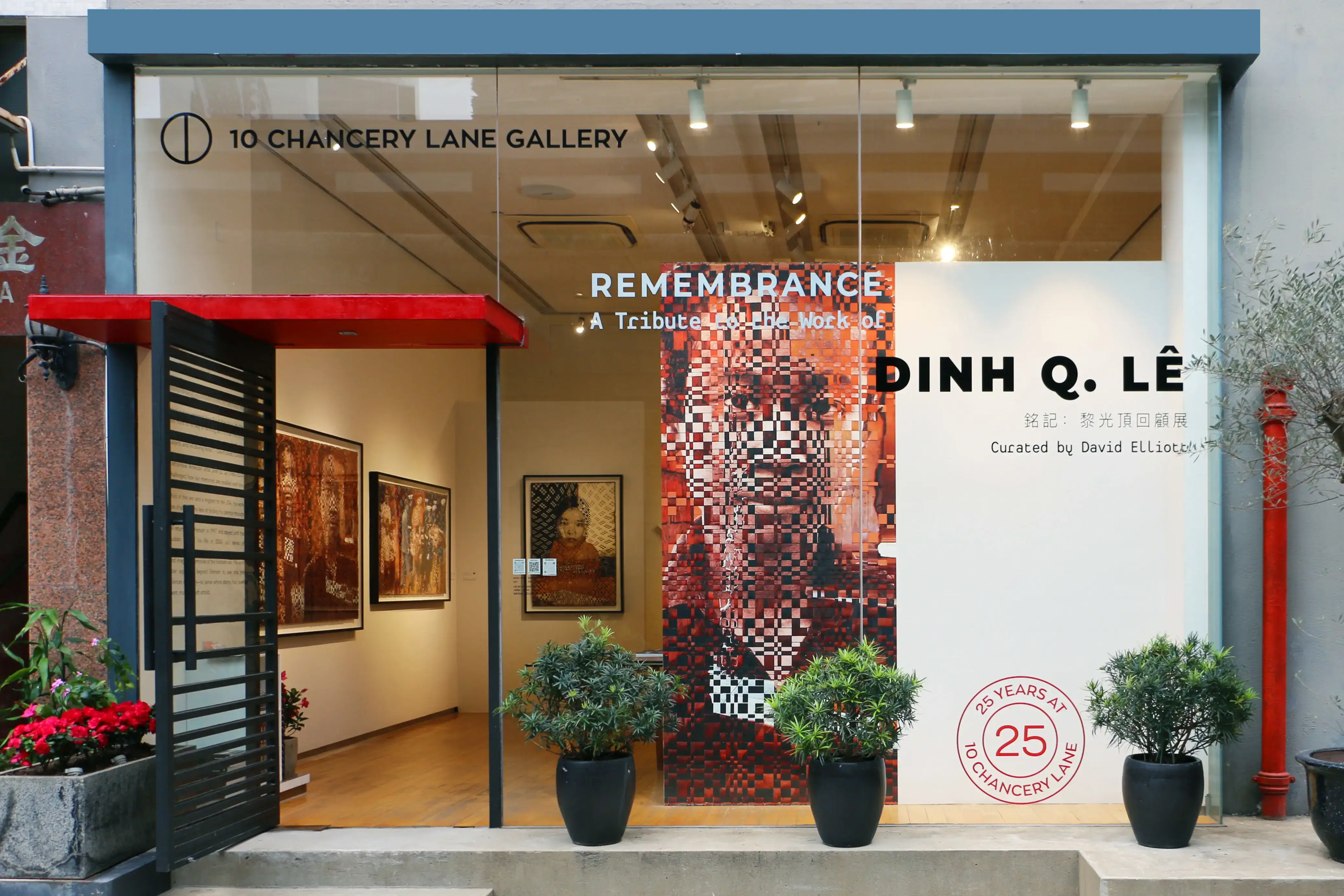
Remembering Dinh Q. Lê
On exhibition are works by the late Vietnamese artist Dinh Q. Lê. We walk through the show, from one painting to the next, including the animation video at the rear of the gallery. Her office is in a loft above, in a space that has 4.5-meter (about 15 ft) ceilings.
The exhibition, titled “Remembrance,” closed on May 23. It was a trip down memory lane for a certain generation of Americans, Vietnamese and others embroiled in the Vietnam War. Born in 1965 in Hà Tiên, a Vietnamese town near the Cambodian border, Lê was ten when he and his mother escaped as ‘boat people’ as the tens of thousands of refugees from South Vietnam were called.
They fled first to refugee camps in Thailand and then to Los Angeles, where Lê studied photography at the University of California, Santa Barbara. He earned his Master of Fine Arts from the School of Visual Arts in New York. He is famous for his technique of weaving strips of photographs together, inspired by grass mat weaving lessons he took from his aunt as a child.
Words spill out, as though she was speaking of the closest of friends. “I’ve been working with him for 20 years or was working with him until he died suddenly of a stroke in 2024. He’s known for his photo weaving, although he does other types of work as well. It’s about layering stories, layering histories, retelling of things that you know were told wrongly or differently or were not explored fully.”

“When he went to America, Apocalypse Now and all these other films were coming out, and he felt that the perspective was being told just from the American side. So, when he was an adult, he moved back to Vietnam, he wanted to talk about their perspective as well.”
Curated by David Elliott, a renowned museum director, the exhibition included South China Sea Pishkun, a 3-D animation video that refers both to the fall of Saigon in 1975 and to the Native American term that refers to “buffalo jumps,” when cliffs are used to drive panicked herds to their deaths. The thumping sound of helicopters accompanies a visual loop of helicopters crashing into a grey ocean.
Other images featured Lê’s trademark woven strips of photographs, such as The Two Widows, Jackie Kennedy and Madame Ngo Dinh Nhu, sister-in-law of President Ngô Ðinh Diêm, who was assassinated in November 1963 within weeks of President Kennedy. Another work, from his Vietnam, Inc. series, was made in 2007 for an earlier show at 10 Chancery Lane Gallery, when the economy was booming but it was then, and now, still a communist country.
“You have propaganda mixed up with Coca Cola, the economy of people selling flowers on the streets with the 1968 photograph ‘Saigon Execution’ by Associated Press photographer Eddie Adams,” says de Tilly. The iconic photograph of Brigadier General Nguyen Ngoc Loan shooting a Viet Cong prisoner was enormously influential during the Vietnam War, and Lê’s work weaves together that trauma with the spirit of commerce, memory and ideology.
De Tilly has something to say about each of the installations – how they figured in Lê’s life, what they meant in the context of Vietnam’s post-colonial experience, the technique he invented, and how he responded to being a gay man in an illiberal society.
One of the works, Skin on Skin, has a dual purpose, de Tilly says, about the politics of skin color as well as a morality lesson about a country that allows pornography to be seen, including in Internet cafes popular with the gay community, but not made. Photography shops wouldn’t develop the prints, so he had to wait until he had his own printer to make the color prints that he then turned into strips for weaving. An image like a mandala, or geometric design representing the Buddhist cosmos, dissolves into disconnected erotic images in radiant colors.
A 342-page exhibition book, Remembrance: A Tribute to the Work of Dinh Q. Lê, is de Tilly’s posthumous “love letter” to the artist, consisting of works exhibited at 10 Chancery Lane Gallery since 2004. “I was then a young and somewhat naïve entrepreneur, searching for the defining artists of our generation,” de Tilly writes in a foreword. “The first time I encountered Dinh’s work, I fell in love. For months I tried to find him.” Then she took a lucky guess at his email address and got it right. “You found me,” he wrote back.
California dreamin’
Now in her early 60s, de Tilly has been a force in contemporary Asian art in Hong Kong since 1997, when she organized an exhibition at the late Sir David Tang’s China Club of the artist Yin Xin, known for his paintings of Chinese figures in variations on famous Western compositions.
Sir David gave her the entire 14th floor. She says some of those paintings are still in the China Club’s huge collection of contemporary Chinese art, crowding the walls of the 1930s-style Shanghai restaurant, stairwells and library. She went from that successful exhibition to build a portfolio of artists from mainland China and across Asia-Pacific that have since become legends, thanks in part to her passionate approach to representing them.
Her A-list includes sculptor Wang Keping and painter Huang Rui, both members of the 1979 Stars Art Group, or Xingxing, a foundational collective of self-taught, avant-garde artists who rebelled against state-sanctioned Socialist Realism and represented the first wave of contemporary Chinese art. Mobile sculptor Laurent Martin “Lo,” who works in bamboo, was another of her finds, along with Indonesian FX Harson, Filipina Josephine Turalba and Hong Kong artist Lewis Lee.
She brought all seven to her booth at Art Basel HK earlier this year, which was called one of the ten best booths this year by Artsy, the leading global marketplace for buying and learning about fine art.
De Tilly’s next exhibition, starting June 3, will feature Turalba’s work, curated by Caroline Ha Thuc. Called “We are the sea,” timed to coincide with World Oceans Day on June 8, and is the gallery’s first solo exhibition by a Filipina artist.

In 1995, before the China Club show, she was inspired in part by the China Club to host a show in her own apartment of a Spanish artist, Marques de Jadraque, who was a friend from California. That led to the Yin Xin exhibition and shows in Hong Kong’s Exchange Square and New York.
These were years when expatriate bankers were virtually the only collectors of contemporary Chinese art, together with Swiss businessman and diplomat Uli Sigg in Beijing and a handful of others. Sigg’s collection now serves as the anchor collection of the M+ Museum of Contemporary Art.
De Tilly arrived in Hong Kong in 1994, with her French husband Georges de Tilly, a banker with Jardine Fleming. By that time, some of Hong Kong’s first galleries of contemporary art had already opened – Fred Scholle’s Galerie du Monde in 1974, Johnson Chang’s Hanart in 1977, Alisan Fine Arts, founded in 1981 by Alice King and Sandra Walters, Plum Blossoms Gallery in 1987, Videotage, a new media artists’ collective in 1988, and Catherine Kwai’s Kwai Fung Hin Gallery in 1991.
ParaSite, now one of the major non-profit arts institutions in Asia, was founded a few years later, in 1996. It had been decades since a schoolteacher, Dorothy Swan, opened Chatham Gallery, Hong Kong’s first art gallery in 1962, but Hong Kong was still considered a cultural backwater.
The sparse commercial environment for contemporary art was particularly difficult for local Hong Kong artists. Hon Chi Fun, founder of the Circle Art Group, worked for the post office. Gaylord Chan, now a celebrated Hong Kong artist, worked as a telecoms engineer for Cable & Wireless, the predecessor to PCCW.
De Tilly followed an unlikely path to working in the art business. A first-generation Polish American, de Tilly’s mother ran a pharmacy and drugstore, and her father, an engineer, opened a sporting goods store next door. Her Polish parents had both grown up under the hardships of the former Soviet Union. Born in 1964, de Tilly flourished in the California sunshine. At California State University, de Tilly started out as an art major but switched to a science major with a minor in comparative literature.
She did a pre-med and got her degree in biology and chemistry. Her first job was with a pharmaceutical company, but she quickly turned to fund-raising for Médecins Sans Frontières (MSF) and became West Coast director in 1990. After she married Georges in 1992 – they have four children – the couple moved first to Germany and then Hong Kong.
In Hong Kong, she reconnected with MSF and became its corporate fundraiser, during a time when Hong Kong was managing refugee camps for Vietnamese boat people like Dinh Q. Lê. The organization was recruiting Hong Kong doctors to go abroad, and she went to South Sudan to visit the doctors there, as well as Kenya, Somalia, and refugee camps on the Thai-Burmese and Thai-Cambodian border.
Meanwhile, she began putting art shows together. “It was exciting to feel that you were at the beginning of something, but at the same time I didn’t know what to do with my life,” she told Kate Whitehead of the South China Morning Post in 2020. “I always had one hand in art and one hand in science and felt pulled back and forth.” Searching for an alternative, she enrolled in a two-year certificate program in acupuncture at the University of Hong Kong.
The opportunity to become a gallerist came out of the blue. She was having dinner with friends on Chancery Lane, an alleyway behind Victoria Prison off Old Bailey Street, and noticed that the ground floor shop space was for rent. She could see that it had high ceilings, although the shop windows were covered with black paper. She rented the space with Jeanette Helleu, a woman friend, who shared the rent and took turns putting on exhibitions. The friend soon returned to the United Kingdom, and de Tilly was on her own.

Her first exhibition, in May 2001, was with Wang Keping and it sold out. The success made de Tilly’s new career. She had met Wang when he was artist in residence at the Hong Kong University of Science and Technology in 1997. Wang had moved to Paris with his French wife in 1984, and de Tilly began collecting his work and would visit him there.
No longer a backwater
As de Tilly began rolling, she established an adjunct loft gallery in Chai Wan in 2006, helping to build the community as a secondary art district, began HKFOREWARD, an annual summer art show for Hong Kong artists in 2011, and became a co-founder of the Hong Kong Art Gallery Association in 2012.
And back to the original question? How has the contemporary art scene changed in the past 25 years?
“I wouldn’t say Hong Kong’s contemporary art scene is changing so much as maturing,” says Katie de Tilly, founder of 10 Chancery Lane Gallery, in response to a question about what has changed in Hong Kong’s contemporary art scene since her gallery opened in 2001.
“There are better essays being written, better books being published, better understanding of art movements and things happening, and better following by the museums,” she said in an interview.
“Hong Kong itself is our museum, with so much interesting culture around us. And now we have the contemporary art culture that exists in other cities,” says de Tilly. “The M+ Museum of Contemporary Art is one of the most amazing museums in the world, and the Hong Kong Museum of Art has started to find its own positioning because of M+. They have a new identity, which is great to see. The Tai Kwun JC Contemporary has been putting on great shows. Its new director, Philip Tinari, is the former head of the UCCA Center for Contemporary Art in Beijing, and now he will be next door.”
And what about the other question – what happens after Art Basel? The answer, of course, is the galleries – over 60 in the Hong Kong Art Gallery Association. It may not seem much – Art Basel this year featured 290 galleries from 41 countries. It regularly accounts for half of 10 Chancery Lane’s annual revenues.

But it is often where artworks are first seen and enter their commercial journeys. In a 2020 interview with Dr. Henrietta Tsui-Leung, CEO of Ora-Ora Gallery, she said: “As a gallerist, you know that every time you have an exhibition, it is really trying to show the soul of an artist to the public.”
“You are a medium,” de Tilly continued, “the interface between the public and the artist to communicate their messages and what they are creating. And you know that there are so many different stories, a million stories and million histories that led to creating that story. As a primary art gallery, for the most part, we’re the first place that an artwork is shown and then seen by the public on a wider scale, and it goes off from there.”
Victoria Prison has been replaced by the glamorous Tai Kwun events space, with its Herzog & de Meuron-designed JC Contemporary Art Museum. Go a few steps farther up Old Bailey Street and turn left at Chancery Lane. 10 Chancery Lane Gallery is right there, and de Tilly – if she is there – will be your joyous and unforgettable docent.

Katie de Tilly is the founder and owner of 10 Chancery Lane since 2001. She has been on the board of the Tate Modern Asia Pacific Acquisitions Committee (APAC), as well as the Program Advisory Committee (PAC) of RMIT University School of Art /Hong Kong Art School. She was a founding member and Co-President of the Hong Kong Art Gallery Association (HKAGA). She is a Founding Patron of the M+ Patrons.
She is on the working group of Art Power HK. Katie was awarded “Master of The Arts” in 2019 by the Women of Influence committee of the American Chamber and was a distinguished judge for the awards in 2021. She lives in Sai Kung with her husband and a large art collection