
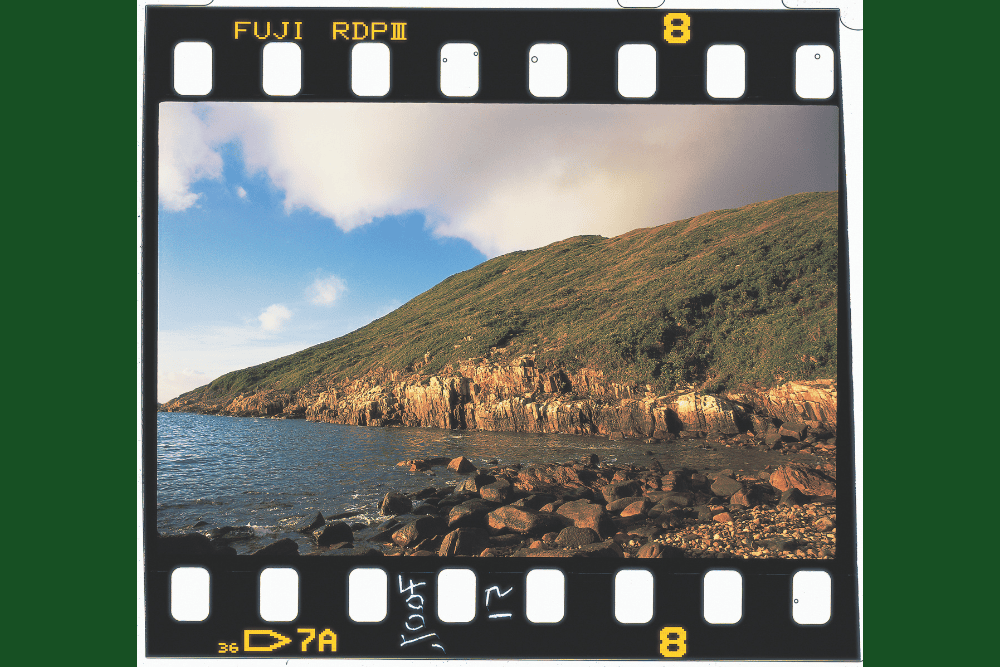
AmCham members will remember Edward Stokes from the 2024 annual ball on October 5, which celebrated “The Great Outdoors of Hong Kong.” Three of the photographs from Stokes’ retrospective book, Hong Kong Nature Landscapes, were among the prizes put up for auction. In his keynote, Stokes celebrated the enduring appeal of Hong Kong’s outdoors.
“Since 1993, about half my years were spent exploring Hong Kong’s wild places,” said Stokes. “Massive population growth – repeated economic transformations – progress – often against the odds, with buildings spreading ever farther and higher. Yet remarkably, Hong Kong’s nature resources today are richer than before.” AmCham HK e-Magazine explores how this champion of the outdoors has helped Hong Kong realize the value of its natural environment, only minutes away from its high rises.

Among Hong Kong’s assets, its natural environment is only beginning to get the attention it deserves. Much of the credit goes to one individual, who with his zeal for Hong Kong’s outdoors and creative skills has helped put Hong Kong’s extraordinary landscape on the map for visitors and residents alike.
When you ask Ed Stokes what he does for a living, the answer is complicated. “Over the years, if you do creative work, you change and evolve. I certainly began as a photographer, but even at the beginning, I was a writer, too. For various reasons, I’ve become a publisher and curator with a great interest in history. Still, I would always say I’m a photographer, no question. I’ve always been a photographer who only takes photographs for projects that I’ve conceived, planned and done a lot of historical research. It’s telling visual stories where the sum is greater than the parts.”
Stokes’ work output, despite of, or because of its eclectic quality, is prodigious, structured, and has had a powerful impact within Hong Kong and beyond. He has published 19 books, including six Chinese editions or bilingual books, and curated multiple exhibitions at venues including the Hong Kong Maritime Museum, Asia Society’s Hong Kong Center, the University Museum and Art Gallery of the University of Hong Kong as well as its libraries, the Rotunda at Exchange Square in Central and Singapore’s Art House. These have shared not only his own photography but images of Hong Kong that might otherwise have been lost to view in storage boxes in libraries, hidden in library stacks and in one case a tiny public housing flat.


His Hong Kong Nature Landscapes, published by Hong Kong University Press in 2010, is the product of trekking with his beloved 35-mm Olympus OM series and PENTAX medium format cameras to the tops of mountains before dawn, sleeping in the rough and waking up with the occasional barking deer staring him in the face. The photos that were auctioned at the AmCham ball were taken from the book.
The best of his photographs between 1993 and 2002, they show a Hong Kong Island where the high rises are visible in the distance through a foreground of lush bamboo, the great volcanic rocks of Cape D’Aguilar loom in mythic grandeur, and streams and reservoirs provide habitats for birdlife and small mammals a short hike from Central.
Beyond Hong Kong Island, mountains plunge into the sea and Hakka hamlets nestle in valleys in the northeastern New Territories. Shorelines, trails, and the biodiversity incubator of Kadoorie Farm and Botanic Garden glow with deep, rich colors that were anything but accidental.

Stokes told journalist Annemarie Evans in the South China Morning Post that he would get up at 2 am to look across to spot the radar light on Mount Parker 14 kilometers away. “Unless that light was crystal clear and bright red, I’d wait for another day,” he said. Hong Kong’s high humidity and air pollution were among the biggest obstacles to his work. Rain, wind and the winter dry season were gifts, however messy they might be for hauling gear up slopes and through jungle.
Reimagining Hong Kong
Stokes was the first photographer to build a body of work around Hong Kong’s outdoors. His first book on Hong Kong, Hong Kong’s Wild Places, published by Oxford University Press in 1995, was backed by the Swire Group, which owns Cathay Pacific and Swire Properties among other huge businesses, reflecting Swire’s environmental and sustainability concerns.
“It was a daunting but memorable project,” Stokes recalls. “The book brought into focus Hong Kong’s interconnected saga of human interaction with the land over many centuries.” It presaged a decade of environmental advocacy for better air quality and against marine pollution.
By that time, Stokes had published five previous books in Australia and had a good idea of the challenges involved. After more than two decades away from Hong Kong in the United Kingdom and Australia, in 1990 he began planning his return. In 1992, while visiting his mother – also a writer – in Oxford, he put together his funding proposal for Wild Places.
“I was refining my plans for work in Hong Kong, and the first project was to be a book about the entire natural landscape of Hong Kong,” he says. “After various contacts, I had a wonderful lunch in London with Sir Adrian Swire and his brother Sir John Swire, who saw the potential and said they would support it.” Stokes returned to Hong Kong in May 1993. “I remember clearly landing at Kai Tak and the smell of the Kai Tak nullah. Oh my God, I’m back in Hong Kong! And I began working on that book pretty much straight away.” It was followed by a series of nature books – Shan Shui Yau Ching, the Chinese translation of Wild Places, Across Hong Kong Island and Garden in the Sky.
Exploring the past
Then came an entirely different series of books with images taken decades earlier by other photographers – by Hedda Morrison, who worked in Hong Kong for just six months immediately after World War II; Lee Fook Chee from the 1950s; and photographs of Singapore by Marjorie Doggett, also from the 1950s. These books led to a series of exhibitions curated by Stokes for the Photographic Heritage Foundation.

Foreshore labourers, 1946 – 1947
Both Hedda Morrison’s and Lee Fook Chee’s photos of Hong Kong would have been lost without Stokes. In 1995, Stokes was in the open library stacks at Hong Kong University browsing through old government publications, when he noticed Hedda Morrison’s byline on some poorly reproduced photos from 1946 and 1947. By then, Morrison had passed away, but her 1930s photos of China were well-known, and so his interest was piqued, knowing that photographers never get rid of their negatives.
In a process that stretched over several years, his search took him to Australia to meet her husband, who introduced him to Dr. Raymond Lum at the Harvard-Yenching Library in Cambridge, Massachusetts. Lum noticed a box labelled “Hong Kong Negatives,” and sent Stokes a fax, who immediately realized they must be the missing Hong Kong photos.
Lee Fook Chee’s story was even more dramatic. An orphan in 1920s Singapore, Lee arrived in Hong Kong in 1947 and taught himself photography, earning his living from selling souvenir photographs on the Peak.
In 2010, Stokes was visiting the Peak with his brother and sister who were on holiday. “At about 4 o’clock in the afternoon, we were planning to go to Repulse Bay, when we said ‘Oh no, we’ve done that. Let’s go up to the Peak’. So we went up on the Peak Tram and turned left and walked to the little lookout, purely by accident, and there was an old man selling photos with images from the 1950s. The prints were of very poor quality, but you can have great negatives and yet make poor prints. I bought a few and gave the man my contacts.”
About a month later, a woman emailed Stokes from Singapore, and said that her uncle, Lee Fook Chee, wanted to meet him. Initially cool to the idea, the niece was persistent, and Stokes eventually met with Lee in a Starbucks in Central, then went to his tiny, one-room flat in Tai Wo. Lee reached up to a shelf above his bed and handed Stokes three mooncake tins that held his negatives.
“I started going through them, and I was just mesmerized,” Stokes says. Bernard Chan, chairman of Asia Insurance, who had been involved with several of Stokes’ projects, introduced him to Carrie Lam Yuet-ngor, then Hong Kong’s Development Secretary. Her department had oversight of Hong Kong heritage projects. Says Stokes: “She gave up an afternoon and came out with her deputy secretary, Jessie Ting, to meet Mr. Lee. They looked at the negatives, and Mrs. Lam said, ‘These are incredible’ and promised to find funding for the book.”
It took five years to publish the book, and Lee Fook Chee had passed away beforehand. His photos, mostly taken between 1954 and 1960, reflect a decade of immense change in Hong Kong as it began the economic take-off that would make it one of Asia’s wealthiest economies.
Voyage Through Time


Stokes’ latest exhibition is as much about the ordinary people who forged Hong Kong’s maritime industry as it is about the infrastructure that made it the world’s busiest container port on and off from 1987 to 2004, when mainland China’s ports took up the top rankings, in part due to Hong Kong investment. Voyage Through Time, at the Hong Kong Maritime Museum, is sponsored by the Robert H.N. Ho Family Foundation Hong Kong and the Swire Group Charitable Trust. It displays photographs by German-born Hedda Morrison, Brian Brake, a New Zealander who is best known for his “Monsoon” photographs of India, and Stokes himself, as a “Beginning Photographer.”

Victoria Harbour, about 1972
The exhibition includes Morrison’s photos from 1946-47, Brake’s work on assignment from Time-Life while he was living in Hong Kong between 1962 and 1976, and Stokes’ work from his first photographic trip to Hong Kong in 1979 on assignment for Geo magazine, where he covered the Vietnamese refugees, the construction of Sha Tin’s New Town and the reclamation of Tolo Harbor.
Morrison’s stunning photographs show the workers who helped rebuild the port and begin its journey back from destruction. In one evocative photo of Victoria Harbor, the masts of a sunken ship off the Wan Chai shoreline interrupt the busy traffic of the renascent deepwater port, not far from where the Maritime Museum sits today.
Brake’s photos over the decades of the 1960s through 1970s show Hong Kong as a rising metropolis, towers glinting with gold. They range from aerial photographs of the Aberdeen typhoon shelter and dragon boat races to intimate photos of everyday life. Among Stokes’ photos, two young boys paddle a makeshift float by the Sheung Wan foreshore, against a backdrop of tinted oil slicks on the water, reflecting his emerging concern with the pollution that resulted from the city’s industrial surge and rise as a major shipping hub.
At the opening reception of Voyage Through Time on November 12 last year, Bernard Chan, chairman of M+, gave the keynote. In Hong Kong terms, the event was star-studded, with former chief executive Leung Chun-ying, senior politician Regina Ip Lau Suk-yee, Richard Kendall, director of the Hong Kong Maritime Museum, Nicholas Brooke and others in attendance.
Like an earlier exhibition at the Asia Society, Recovery, Resilience, Resurgence, the Hong Kong Maritime Museum exhibition tells a similar, powerful story – the ability of Hong Kong to emerge phoenix-like from the worst disasters. Those who joined the vernissage reception share with Stokes an admiration for the people who built Hong Kong as well as the topographical and natural wonders of the city.
A Hong Kong story
Stokes was born in Adelaide, Australia on May 19, 1948, but some of his earliest memories are from Hong Kong, and he has lived in Hong Kong on and off for most of his adult life. His career has been anything but predictable. His father’ first visited Hong Kong with the Australian navy in September 1945, and he liked it so much that he came back as a teacher with his young family in September 1953. They remained in Hong Kong until 1971.
In 1964, Stokes decided to follow one of his father’s careers – in the Australian navy – and joined the Royal Australian Naval College in Jervis Bay, New South Wales as a cadet midshipman. It took a year to discover that he was not made out for the naval life, and another two years to get a discharge. In 1967 he went back to Hong Kong, where he spent eight months as a cub reporter with the South China Morning Post.
In 1968, he began a politics, philosophy and economics degree at Oxford University, and followed another of his father’s professions by teaching school in London for a few years before deciding to go back home to Australia, where he became a primary school teacher. With a friend, he traveled overland, and he says it was on the journey that he decided to become a photographer, “particularly in India, with the color, the vibrancy, the diversity and the excitement of the journey itself.”
In Australia, he continued teaching six years but used all his spare time to become a self-taught photographer. During holidays, he completed small projects and later magazine stories. This led to assignments with Geo and another publication, Australian Geographic, and a series of books about Australian explorers.
For the first of his books, an oral history of the gigantic lead, zinc and silver mine at Broken Hill in New South Wales, he took a year off. The town was where Broken Hill Proprietary, better known as BHP, got its start in 1885. The book is based on the glass plate negatives of a photographer, James Wooler, who chronicled the town in the early 20th century. Much as was later the case with the photographs of Lee Fook Chee, the negatives had been lost. Stokes put the photographs together with an oral history of the miners and others with memories of the era.
Books on three mid-19th century Australian inland explorers followed. Stokes used landscape photos – taken on three expeditions across Australia – to show the challenges of distance, terrain and lack of water the explorers faced.
In his last year as a schoolteacher in 1983, he was sent to the remote, drought-stricken town of Pooncarie, an old wool port on the Darling River in New South Wales 200 kilometers southeast of Broken Hill. “The NSW Education Department isn’t known for kindness to teachers returning from that ultimate indulgence, leave-without-pay,” he writes. It was a one-teacher school, and although his 10 students were full of enthusiasm, after a year living in a trailer he moved to Canberra to become a full-time photographer.
The rest is history. After moving back to Hong Kong in 1993, he has been here ever since, except for two work stints in Singapore. “In everything we all do, there’s a great deal of fate and luck,” he says. “And I do believe, a lot of luck you make. You’re prepared, you’re ready. Your antennae are open, you’re looking around so you can grasp things when they pass in front of your ship, so to speak.”

Edward Stokes lives and works in Hong Kong. He leads The Hong Kong Photo Heritage Program’s projects. Its opening exhibition, Voyage Through Time, Maritime Photos 1940s – 1970s, is at the Hong Kong Maritime Museum until March 31. His website is www.edwardstokes.com. The website of the Photographic Heritage Foundation, which Stokes founded in 2008, remains a useful reference for photo heritage experts, other researchers and the Hong Kong community.
Copyright
Hedda Morrison photo: President and Fellows of Harvard College. Brian Brake photo: Wai-man Lau. Edward Stokes photos: Edward Stokes; Voyage Through Time photos: Vincent Chen