
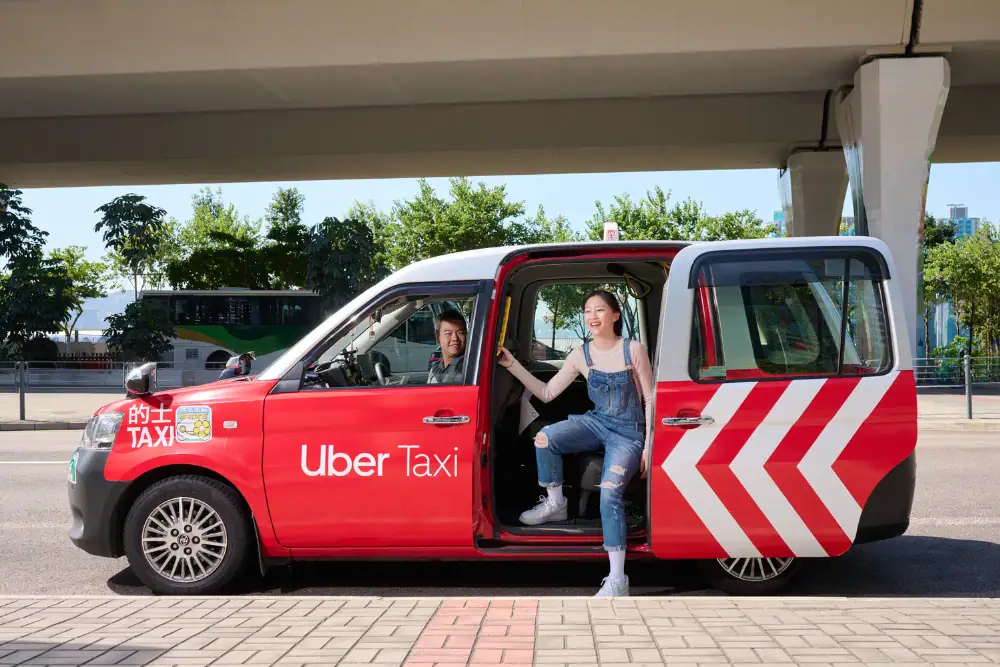
In 2014, when ridesharing pioneer Uber entered the Hong Kong and China markets, CEO and co-founder Travis Kalanick spent one in five days in the region just four years after his startup received its first ride request. Fast forward, and Uber’s China and Southeast Asian ventures are long gone, along with Kalanick as CEO.
Today’s Uber, after its USD 8.1 billion initial public offering on the New York Stock Exchange and with Dara Khosrowshahi at the helm, is less a disruptor than an empire builder, and highly profitable. Uber revenue was up 18 percent in 2025 to USD 52 billion, with non-GAAP net income up 32 percent to USD 5.2 billion, booking 42 million rides and delivery orders daily in 15,000 cities worldwide. It isn’t yet considered one of the “Magnificent Seven” tech giants, but it is getting there, with a current market cap of USD 153 billion.
Meanwhile, has Uber gone quiet in Asia? AmCham HK e-Magazine turns to Estyn Chung, General Manager of Uber Hong Kong, to find out.
From disruptor to stakeholder
Under CEO Dara Khosrowshahi since 2017, Uber Technologies has positioned itself as a long-term stakeholder across Asia-Pacific, with equity stakes in former competitors Didi Chuxing in China and Singapore-based Grab in Southeast Asia. Across the region, Uber operates under a range of locally tailored models, alongside its classic ridesharing model elsewhere.
When it first arrived in Hong Kong, Uber operated in a regulatory grey area and continued to do so alongside its competitors. This has been despite Uber’s efforts to obtain regulatory clarity. It celebrated last October, when Hong Kong’s Legislative Council (LegCo) passed its first rules on ridesharing. Regulatory details are still being filled in. Meanwhile, Uber and three competitors have proved popular with the Hong Kong public.
By 2015, Uber was no longer alone. Didi Chuxing had entered Hong Kong in 2015 together with Kuaidi Dache. The two later merged. Amap, a ride-hailing and mapping service owned by Alibaba Group Holdings joined them in 2024, along with Singapore’s Tada ride-hailing service.
Fast forward to October 2025, when Hong Kong’s Legislative Council (LegCo) passed a Road Transport Amendment Bill that previewed a licensing system for ride-hailing platforms, drivers and vehicles. It was not a moment too soon for Uber’s Estyn Chung, General Manager of Uber Hong Kong since 2019.

“It’s etched in my memory,” said Chung. “Eleven years, two months and 25 days is the time that it has taken from when we first started operations in Hong Kong to when the framework for ride-hailing was finally passed by LegCo. It’s been an epic journey. Now we are waiting for some of the finer details of regulations to come through.”
The journey is not quite over. On May 11, Hong Kong’s Transport Department came out with its first discussion paper for consideration at a special meeting of the Legislative Council’s transport panel. The paper sets out requirements for vehicle age and insurance and registration by ride-hailing platforms, with five-year renewable licenses.
An unworkable ceiling on drivers?
It was not all to Uber’s liking. An issue that remained unresolved in the policy paper is the number of rideshare drivers that will be licensed under the new framework. Taxi drivers proposed a cap of 2,000. Uber asked for flexibility based on demand, with an estimated 30,000 drivers active in the market already. The paper referred to industry “voices” suggesting a cap of between 10,000 and 15,000 drivers.
In a formal response, Uber said: “Following the release of the Government’s policy brief, we are deeply concerned by the majority views on the suggested ride-hail vehicle licensing quotas. A quota of between 10,000 and 15,000 licenses would fall far short of serving current demand in Hong Kong and risks dramatically limiting access to ride-hailing services for both locals and tourists.”
Half of Uber’s drivers in Hong Kong would risk “losing an income source overnight, while also drastically reducing service availability for drivers,” Uber added. In its own submission to LegCo, Uber said that a cap set at 15,000 drivers would double waiting time and lead to fare increases of up to 70 percent during times and locations that are already strained.
Between April 2024 and March 2025, 2.5 million customers used Uber in Hong Kong, including 1 million visitors from over 150 countries, according to the company.
The pressure to keep the cap low comes from Hong Kong’s 40 to 50 taxi operators, representing about 18,000 taxis and 40,000 to 46,000 drivers, according to the Transport Department. Taxi associations and fleet operators have said the limit on ride-hailing services should be no higher than 2,000, or at most 10,000. Total daily ridership is around 880,000 passengers, with taxis accounting for 78 percent of rides or 690,000 passengers, and ride-hailing services carrying the remaining 190,000 passengers across approximately 114,000 trips.

The math gets complicated – each taxi vehicle normally has two drivers working in shifts across an 18-hour day, while drivers for ride-hailing services typically work part time. According to Uber, 31 percent of drivers rely on ride-hailing services as their primary source of income, while more than 60 percent get more than half of their income from driving passengers.
The government wants to finalize the quota on drivers and other features of the new regulatory framework before LegCo’s legislative recess in mid-July. It plans to ask ride-hailing services to apply for licenses in the fall. The new regulatory framework will take effect in the last three months of the year.
The ceiling for ride-hailing drivers is still negotiable, according to media reports. Uber would like to see a data-based monitoring system to review the quota on a continuous basis, including key efficiency indicators. What seems fixed at this stage is an enforcement and penalty structure, with fines for platform operators up to HK$1 million (USD 127,700) and 12 months in jail upon conviction.
Uber was the only one of the four ride-hailing services to submit its view to the Transport Department on the proposed regulatory framework, but Chung admits that there are “certain shared viewpoints around the development and regulation of the industry. We share viewpoints around quota flexibility, data driven reviews, a fair and transparent eligibility process and licensing application process for drivers. I think these are things that all the drivers will be striving for.”
Uber adapts
Few now remember the buzz around Uber when founders Travis Kalanick and Garrett Camp tangled with transit authorities from San Francisco to Paris and London when they founded UberCab in San Francisco in 2009 and launched their mobile app the next year.
Uber was hailed as a paragon of the shared economy and mocked as a trendsetter of the gig economy, with riders paid per trip based on algorithmic calculations. It was often controversial, and Uber lost billions while it was still a private company. Kalanick said he wanted to delay the IPO as long as possible, so that he would not have to answer to shareholders.
From a passenger viewpoint, in Hong Kong and elsewhere, Uber was an instant success. It beat standing in lines for taxis and cycling through a range of phone numbers for taxi operators with their often-cranky dispatchers. Says Chung: “We launched in 2014 and it’s unbelievable that it’s been 12 years now. Since then, we’ve been very well received by Hong Kongers. We’re a very popular service for everyone here, and a critical part of the transport infrastructure.”
In contrast to the rollercoaster ride of Uber in mainland China, in Hong Kong, Uber has grown incrementally, introducing services that meshed with local taxi operators, building on its experience in other, highly regulated environments in Asia, including Japan, Taiwan and South Korea.
In 2019, Uber Flash was introduced on a pilot basis, which linked users with the closest available vehicle, whether UberX, Uber’s standard rideshare service, or taxi, without having to switch through different apps and with upfront fares. In its first month of operation, it took over 180,000 orders despite the withdrawal of one of its taxi partners. A survey taken at the time by researchers at the University of Hong Kong showed that 74 percent of respondents believed that Uber should be allowed to operate legally in the city.
Says Chung: “That was quite a pivotal milestone moment for us. We had the lowest estimated arrival times (ETAs) that allowed users to get anywhere in the shortest time possible. All that started in 2019 and evolved into the broader Uber taxi product that you see on the app today.”
He adds: Uber Flash “was about giving Hong Kongers more choice. We realized that people, while loving ride sharing, might also love taxis and that to give consumers more choices was beneficial to our platform. We do see that riders who take both taxis and rideshares are more engaged on our platform. We continue to see that symbiotic relationship, and we are continuing to grow both products.”
In 2021, Uber bought Hong Kong’s most popular taxi hailing app HKTaxi, finally shutting it down in 2025 and migrating its drivers to the Uber app. In May, it bought online taxi hailing app FlyTaxi, which is widely used across the city.
Other innovations have been more functional, such as developing Uber for Teens and XXL services for larger groups, cars fitted with child seats for family users, pet-friendly drivers and drivers trained to handle people with disabilities and the elderly, called Uber Assist. Uber recently marked the first anniversary of its Uber One membership program, with plans to allow users to accrue Uber One credits internationally from June. Separately, Uber riders can also currently earn Cathay Pacific Asia Miles on taxi trips through the platform.

“Right now, the benefits only accrue for use in Hong Kong,” says Chung. “But as we expand the program, it’ll be a real benefit to be able to earn those benefits, given how much we travel, even if you’re using Uber in say, Japan, Australia, or the US, etcetera.”
Last July, Uber partnered with Tencent Holding’s WeChat app to provide a mini program for travellers from mainland China. Uber’s relationship manager for Tencent, Anthony Wong, told the South China Morning Post in January that the Uber WeChat channel was being used in 20 markets, out of the 70 markets that Uber operates in globally. About 90 percent of users on the WeChat channel are new users to Uber, he said.
During the 2026 lunar new year holiday in February, Uber offered 40 percent discounts to new users on its WeChat channel. Says Chung: “WeChat is obviously ubiquitous to people and tourists from mainland China. We have 40 million mainland tourists coming to Hong Kong every year, and so being able to facilitate transport of visitors from the Greater Bay Area to Hong Kong is something we’re very focused on.”
Uber has also revived its service in Macau, possibly encouraged by the new regulatory certainty in Hong Kong. It closed Macau in 2017, part of its withdrawal from the aggressive push earlier in the decade. The relaunch of Macau service, announced in February, will be its first expansion in Asia in years. It will include a cross-border limousine service as well as a booking and payment system for taxis in multiple languages.

Robotaxis are the next big thing
Such steps have helped to build Uber’s revenue in Hong Kong, according to Chung, although it does not provide breakdowns by city. Uber’s next big thing is autonomous vehicles (AVs), or robotaxis. In Asia and the Middle East, it is partnering with some of China’s major robotaxi companies. In July 2025, it announced a partnership with Baidu Inc., which has 1,000 fully driverless cars around the world, with an initial collaboration with Baidu in Dubai announced in February. Uber has also struck an agreement with WeRide, for deployment of 1,200 robotaxis across the Middle East. Baidu was an early investor in Uber China’s operations, and Uber has around five percent of WeRide’s shares.
Uber has not said which company will be its partner, or when, but Hong Kong will be its first robotaxi launch in Asia. Baidu has a license to test its AVs on a small scale in Hong Kong, and the Transport Department formed a working group to develop the infrastructure for AVs in February. Uber is working with over 25 autonomous vehicle partners worldwide, and has services in multiple cities in the US, Middle East, Europe and the UK.

“Robotaxis are core and central to our global strategy,” says Chung. He adds: “Hong Kong is a natural fit for AV technology, especially given the concentrated urban environment we live in. The main thing we need to think about is getting regulatory alignment and having a framework that allows the deployment of robotaxis across the city, in a way that balances safety with benefits to residents.”
Hong Kong’s Transport Department has issued six trial licenses, with 62 AVs in six locations across the city – Airport Island, Tung Chung, Sunny Bay, the West Kowloon Cultural District, Cyberport, and Kai Tak in Kowloon East. Don’t be worried if you see driverless cars in those areas whizzing past with their Light Detection and Ranging (LIDAR) systems that Chung describes as “upside down rice cookers.”
In the US, Uber is already using AVs in Austin, Atlanta and Dallas, with tests underway in the San Francisco Bay Area. Hong Kong is one of four international markets where it plans to introduce AVs this year, together with London, Madrid and Munich. It may have been a long road trip for Uber, but the ride has become much smoother. An open question is how the new regulations for ride-hailing will work with driverless cars.

Estyn Chung, General Manager of Uber Hong Kong, leads Uber’s business in Hong Kong with responsibilities across strategic, operational, regulatory and human resources. He has driven five times to line growth, launched Uber Taxi in the market and led the acquisition of HKTaxi to develop Uber’s leading taxi business globally. Prior to Uber, he spent over a decade in investment banking at UBS, then became a co-founder and CEO of Canopy, a career platform for millennials based in Hong Kong. He holds a Bachelor of Commerce and Bachelor of Laws from the University of Melbourne.