
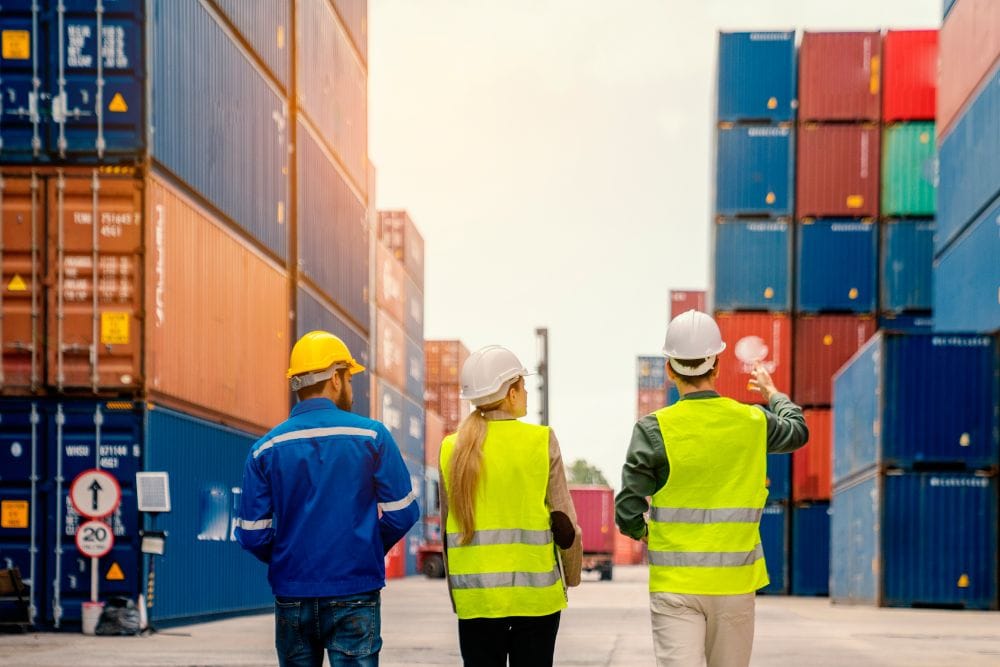
(Not) cracking the secret code of supply chain digitalization
Will Artificial Intelligence (AI) simply take over the global shipping industry? The answer is no, or at least not yet, and lies in the stubborn human factor that exceeds AI in both flexibility and knowledge.
Today’s giant container ships, carrying up to 22,000 20-foot equivalent (TEUs) containers are part of a network known for its efficiencies but also for physical blockages that create vicious price spikes and loading and delivery delays. Over the past two decades, logistics startups have tried and failed to create the shipping equivalent of an iPhone or Android app, with seamless connectivity from the point when a purchase order is issued until the product is delivered.
While decades of technological innovation have inspired these companies, the movement of physical goods continues to fall short of a closed loop without the intervention of human handlers at origin. Even with billions of dollars in investments by innovators, in 2024 nearly 95% of the world’s freight is booked with ocean and air carriers at the originating port using human resources to submit requests for space.
The reasons for this disconnect are due to a myriad of local carrier rules, divergent governmental regulations and port authority receiving processes, and long-standing traditions which prevent ports and airports from establishing even regional standards. Carrier rules differ greatly across the world.
Let’s look at a few examples of companies that tried and failed to digitize shipping and logistics without human intermediaries other than the customer.
Starting in the summer of 2013, Shyp, a shipping company that operated between 2013 and 2018 before it went bankrupt, had an app-based business model that tried to simplify the shipping process by providing pickup, packaging, and shipping services for individuals and small businesses. The company raised $62 million during its operational life and even managed to partner with the e-commerce giant eBay. Sadly, the company ceased operations in 2018 after struggling to scale its business model.

ShipChain, another logistics startup leveraging blockchain technology, aimed to revolutionize supply chain management. However, regulatory challenges and a cease-and-desist order from the US Securities and Exchange Commission (SEC) in 2018 forced the company to close its operations.
Optoro, a startup in the private equity space focused on supply chain and logistics, provided solutions for managing returned inventory. Despite initial success, the company closed down its operations in 2020 due to challenges in scaling and achieving profitability.
Barriers including market acceptance, fragmentation of the shipping industry and a complex ecosystem made it a daunting task for startups to digitalize supply chains. Logistics operations involve interconnected systems, including transportation management systems, warehouse management systems, customs systems, and more. Startups that aimed to streamline the supply chain faced integration challenges when connecting with existing infrastructure and technologies.
Another major barrier is local knowledge about specific regions, cultures, regulations, and business practices. This information is of paramount importance when managing global supply chains and is difficult to program.
The shipping industry today is primarily controlled by a few large container shipping companies that operate globally. Over time, smaller shipping companies have merged, formed alliances, or been acquired by larger players. This consolidation has resulted in the creation of major global container shipping alliances and fewer independent shipping companies. As a result, a smaller number of dominant players now shape the market.
Technologies such as digital platforms for tracking cargo and optimizing routes have enhanced communication. The industry views technology as a tool that supports human-decision making rather than replacement of human expertise.
There is still no automated booking standard between carriers, and booking requirements vary from port to port, making standardization and complete automation impossible. Individuals with “boots on the ground” and relationships remain crucial for consistent booking engagements, navigation of carrier-specific requirements and compliance with regulators and stakeholders.
Human involvement remains crucial, particularly in certain aspects of the shipping process. The complex nature of shipping operations, including navigating international and local regulations, managing diverse stakeholder requirements such as shipping lines on a port-to-port basis, and adapting to geopolitical risks, still heavily relies on the experience and expertise of human professionals.
Each shipping carrier may have its own booking system and processes, making it necessary for human agents or freight forwarders to interact with these systems and navigate the complexities. They play a vital role in understanding carrier-specific requirements, negotiating rates, and ensuring compliance with regulations.
Even if the electronic interchange of business information (EDI) booking connections using a standardized format are available, they are likely individual connections with each carrier in each load port creating a cost burden beyond the scope of most service providers.
Moreover, shipping operations are subject to local government regulations and port rules that can vary from one region and one country to another, meaning human experts, including freight forwarders and customs brokers, possess knowledge and expertise in navigating these regulations, ensuring compliance, and managing the necessary documentation.
Some 40 years since the mass introduction of containerized liner shipping in the 1980s, individuals with local knowledge and relationships remain crucial to linking end-to-end global supply chain to the digital world. Only human agents with local knowledge and relationships have the capability to bring the insight and networks that can help navigate the nuances of unique business practices, cultural norms, and regulations in each region, port, and country effectively.
How global shipping has evolved
In the 1980s, before the rise of email and telephone, information exchange was slow by comparison with today’s nanosecond standards. Long-distance communications relied on manual documentation and Telex machines. Telex operated on a switched station-to-station basis with teleprinter devices at the receiving and sending locations and worked by transmitting coded messages between telex machines. By the mid 1980s teleprinters began channeling rudimental messaging through an updated portal, but they still moved via the Telex system.
As soon as something faster was available in the early 1990s, every business moved to Blackberry phones for instant communication and Microsoft Suite for office automation.
Technological advancements have revolutionized numerous industries, improving efficiency, automating processes, and enhancing decision-making capabilities. Sectors including manufacturing, finance, hospitality and retail experienced significant transformations as they embraced cutting-edge technologies.
In the shipping industry, digital freight forwarders or digital logistics platforms emerged, leveraging technologies to streamline and automate various logistics processes, such as quoting, booking, track and trace, and documentation management providing more transparency, efficiency, and convenience in international shipping and logistics operations.

Source: Electro Props
Communications are not the only aspect of global shipping that has evolved.
Unknown in the 18th century at the beginning of the industrial age, steamships became notorious for their high sulfur emissions, contributing to air pollution and environmental degradation. The fuel used in steamships contained sulfur levels of up to 4.5%, making them one of the largest contributors on earth of carbon dioxide emissions. The need for change slowly developed over the years but only became punitive as legislative efforts began taking effect some 25 years later.
As global warming impacts became commonplace the International Maritime Organization (IMO) finally put in place global standards controlling emissions through reduced sulfur content starting in 2005, culminating in 2020 with a maximum fuel sulfur level of 0.5%.

Source: NYK Line
Governance has also become a major concern. In the early 1980s, the shipping industry was managed under the “Old School Conferences” system, with rigged rate making practices that often-resembled bulk shipping pricing schemes. Carriers were engaged in collective ratemaking practices which allowed carriers to work together to determine rates and other terms without individual carrier transparency, leading to unfair practices, reduced competition and limited transparency.
To tackle these problems, the United States Congress enacted the Shipping Act of 1984, which introduced the concept of contract carriage under individual carrier service contracts, Independent Actions (IAs), and introduced a new category of Ocean Transportation Intermediaries (OTI) which spawned the influx of Non-Vessel Operating Common Carriers (NVOCC) in a growing global marketplace.
While the conference system remained, new rules for increased competition were put in place. The act revolutionized the pricing of liner services through negotiated direct contracts direct with shippers and buyers, providing greater commercial flexibility for the global marketplace. These culminated with China joining the WTO in 2001. Since then, global trade value has increased over 400% (Statistica 2024).
Looking ahead: balancing technology and human expertise in the shipping industry
The global shipping industry is interconnected and relies on a complex network of suppliers, carriers, ports, and logistics providers. Any disruption to any point of this network can have far-reaching effects on global shipping operations, leading to price fluctuations and supply chain challenges.
Recently, geopolitical factors have been a big disruptor. War and political tensions in Israel and Gaza have limited the movement of goods and impacted shipping routes in the Red Sea, leading to sky-rocketing costs and prices for shipping services, shipment delays and equipment shortages.

Source: Roya News
Although technology has helped to streamline processes and enhance efficiency, it cannot replace critical thinking and adaptability of human professionals. Successful integration of technology requires recognizing its limitations and leveraging it as a tool to augment human expertise. The shipping industry must strike a balance between technology and human involvement to navigate geopolitical risks effectively.
To excel in the tumultuous global trade arena, companies seeking logistics and supply chain partners should consider companies with a global network of staff serving all major sea ports and airports, who are also committed to embracing technological advancements to ensure data accuracy, enhance and evolve data and financial security, increase operational transactional productivity through control tower solutions, improve upon global communications, and yet remain cost competitive.
Companies need partners with the expertise to navigate the intricacies of international trade, effectively manage unforeseen challenges and adapt quickly to alternative solutions. Their agile supply chain capabilities make it possible to proactively adjust operations in response to disruptions, while leveraging extensive networks and market insights to seize business opportunities and maximize growth potential.
References:
https://www.fmc.gov/about-the-fmc/our-history/
https://www.freightwaves.com/news/flashback-to-enactment-of-shipping-act-of-1984

Greg Meisenheimer is the General Manager of Supply Chain Solutions Group Global Control Tower at Yusen Logistics Global Management headquarters in Hong Kong. With a career spanning 39 years in the Port, Liner and Logistics industries, (36 years with NYK Group companies in the USA and Asia), Greg has witnessed first-hand the dramatic physical and technological leaps that have taken place within the international shipping marketplace yet remains inspired by the fact that even with advances in global scale and infrastructure, it is the human touch, intuition and relationships that still connect the global marketplace.