
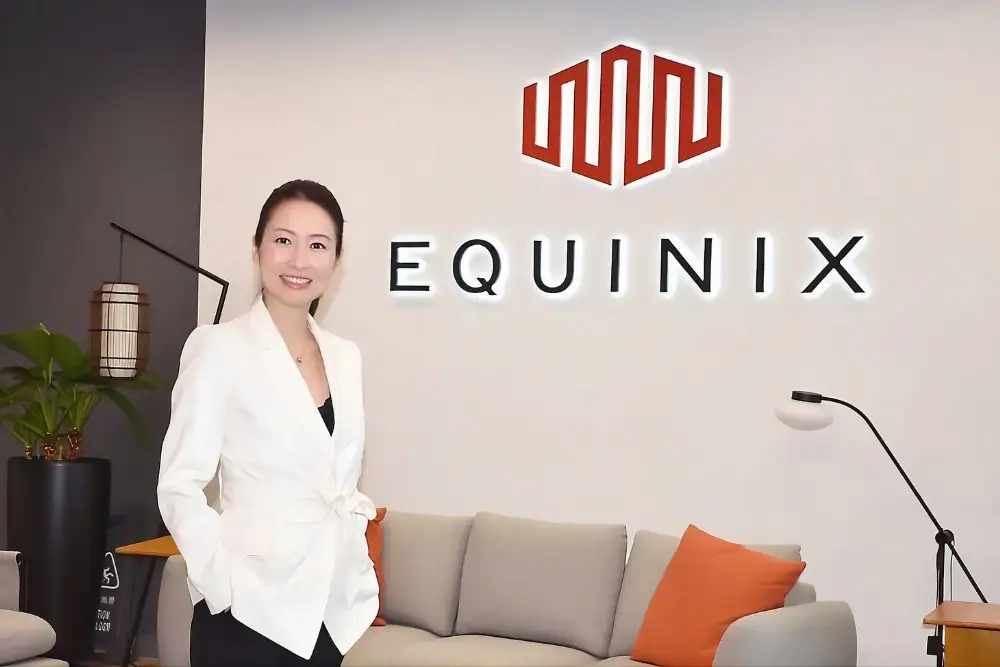
Benny Yeung @IT Pro Magazine
“I like to watch my son’s coaches a lot, because it’s so like what we do every day at work, coaching our teams with our colleagues.”
Joanne Hon got into the China business in the late 1990s, when it was considered a minor part of asset management. Her career has led her through a varied range of industries, and now many of them are her customers at Equinix, the world’s largest co-location and interconnection provider, with record first-quarter gross bookings, the largest in the company’s history on an annualized basis. The driver is Artificial Intelligence (AI), which has led to a dramatic expansion of demand for compute power and ferocious electricity consumption.
Q. You’ve had leadership positions across Insurtech, big data analytics, intellectual property (IP) management and other sectors before joining Equinix in January 2024. How did these varied experiences help prepare you for your role?
A. My first few jobs I worked for investment banks on the asset management side, and I think this laid the foundation of all the journeys that I’ve had. My first job I was as a trainee in asset management, and what I was being tasked to do was to look after the China market.
This was almost 30 years ago. Few fund managers wanted to work on China because it was so small. I looked after the smallest portfolio, 0.8% of MSCI’s Asia Pacific Index, but it gave me a training ground because I had to travel to China, and there were all these companies trying to list themselves in Hong Kong.
The experience allowed me to really understand not just the profit and loss (P&L) of different companies, but the real situation on the ground. I would take taxis in different provinces in China to have a look at the factories, to see whether the lights were on during the time that they said they had production. I would sit next to a dusty expressway looking at my watch and counting the number of cars going through every minute and see whether it matched up with the earnings reports in terms of traffic.
This gave me a very good foundation in terms of how to run a company without actually running one, if you see what I mean. And then I worked for Thomson Reuters where the technology side came in. I really believe that finance and technology will converge. Thomson Reuters gave me the opportunity to learn about technology, and then CPA Global, now part of Clarivate, taught me about intellectual property technology and gave me ideas about how innovation comes to life and is commercialized.
Each company gave me technical knowhow, industry expertise, as well as experience managing different types of experts, in banking, financial technology, law and then Mercer was insurance. Each of them allowed me to work with different aspects of people and therefore gave me the opportunity to understand how different experts look at their businesses. And now in data centers, all these people are my customers, and I can understand what it is like to be in their shoes, what they worry and are most concerned about, and how we can help them.
Q. Do you have a specific leadership mantra or philosophy?
A. I don’t have anything as fancy as that. But I do believe you need an empire to win. No single person can win. I do embrace teamwork tremendously. I think an individual can win in the short term, but it takes a big team to win together in the long term.
Q. Is there a race to build data centers in Asia Pacific, and how is Hong Kong doing in it? Why does the industry have so much excess capacity – as of March, it had a vacancy rate of 19.1 percent, according to Cushman & Wakefield.
A. With 20 percent annual growth in sales over the last five years, naturally we will see more data centers, and it takes time for the customers to then put the equipment inside data centers and occupy and make full use of them. First, we need to expect that from the build to the moving in of the customer, then full utilization, there is a timeline, which we acknowledge.
As to a race, I don’t see it from the lens of a race, because at the end of the day, it comes back to where the demand is. Globally, we’re seeing a big trend of AI evolving and changing how business is done. We’ll only see more of it, and data centers and digital infrastructure are the backbones. We will see growth across the board, but there are places where you will see even more benefits. These are the places where we see more activity and more interconnection, and Hong Kong is one of them.
Because of our location and our role, we play a role as a springboard between China and the world, and that is number one. The other key point that I feel very confident about is with our power company, some of the long-term planning of our government and the business players in Hong Kong.
When I conduct data center business, we plan together with our key stakeholders. Hong Kong benefits from the spillover of our country, neighboring countries and cities, where some may run into a bit of a constraint with power and water or even space. We benefit from that, as well as market demand, so broadly speaking, these are the reasons why Hong Kong is enjoying growth in data centers.
AI is the key driver, from training to true inferencing, where AI applies its knowledge to generate content in real time. After training AI, firms can identify the AI models they can use and add value to their business. We are starting to see the convergence from training to inferencing, and that’s a key driver of the Asia-Pacific market.
The other is the growth of our economies. Here in Hong Kong, if you look at the growth of our financial markets and our trading, the growth of initial public offerings (IPOs) and wealth management services, these all need big data and big data analytics to service their customers, and that’s another key driver.
Q. What is the scale of the data center ecosystem in Hong Kong, and how does it contribute to the Hong Kong economy, specifically the financial sector?
A. Hong Kong is renowned as a financial center, and we all welcome its emergence as one of three major centers of global finance. It’s undebatable that finance is Hong Kong’s key hub, and that Hong Kong connects China with the rest of the world and the rest of the world with China.
Data centers play a key role in facilitating trading among key participants in the financial system, including banks, brokers, dealers and the stock exchange. Trading needs a very low latency trading strategy, that is real-time response, and it needs a very secure place to happen. It also needs robust connectivity and interconnectivity, so that a bank can trade with another bank or dealer or the buy side in a very secure and low-latency data center, like one of our data centers in Hong Kong. For instance, they need to execute trades between Hong Kong and Singapore, or with Japan, in a very short time – 20 to 30 milliseconds. That means a lot of digital infrastructure investment.
In addition, as a city the adoption rate of AI in Hong Kong is 90 percent. If financial or insurance companies want to be more effective in serving their customers, and provide more real-time customer support, they need very fast AI tools, and data centers are the backbone of that service.
In 2025, data centers contributed USD 4.12 billion to Hong Kong’s Gross Domestic Product (GDP). By 2030, the estimate is that data centers will grow by 20 percent annually in terms of revenue, to USD 9.5 billion, double the present number. And that’s remarkable.
Q. On the first day of the war in Iran, two AWS servers in United Arab Emirates (UAE) were damaged by Iranian Shaheed drones. What do you do to mitigate physical and other types of risk?
A. We don’t anticipate physical risk at Equinix in Hong Kong, although we are always very aware of it. We make sure that we prevent and pre-manage risk. We never allow a single point of failure in our operations. The way we set up our security with access control and our network, we make sure that there is resiliency built into our data centers.

That is very important, and something that we work on constantly with our customers, because it’s important that there is a multiple layer of security in both Equinix and our customers. For example, the way we prepare multi-layer audited access control is to enforce identity verification across all procedures. Even if I bring someone into our data center personally, an identification check must be in place. There is no exception. We enhance vehicle inspection based on regional risk assessment. We also continuously monitor network resiliency and make sure there is redundancy.
I always say things happen, whatever the industry. The difference is in how the company and the employees respond. We have very robust emergency control and response so that our on-site team, managers and leadership have a protocol they react to immediately.
Q. One of the key criticisms of data centers globally is their power consumption, which has reportedly been driving up electricity prices. Can you tell us about Equinix and its views on sustainability?
A. Sustainability is core to our values. We were the first data center company globally to commit to 100 percent coverage of renewable energy by 2030, and we have also committed to net zero by 2040. We have an office of excellence to make sure that we achieve these goals.
Currently, we have achieved 96 percent coverage of renewable energy globally. By ‘coverage’, we mean the percentage of electricity consumed by our data centers that is matched by purchasing clean, renewable energy, including long-term power purchasing agreements (PPAs) with wind and solar developers. In Hong Kong, we have met the goal of 100 percent coverage of renewable energy since 2020, despite the limitations of the environment for generating renewable energy. Sourcing renewable energy is very important to us. Around the world, we have 29 PPAs under contract for 1.4 Gigawatts (GW). We offset our power consumption mainly with solar energy sources.
We use Power Usage Effectiveness (PUEs), the global industry standard for measuring how efficiently our data centers consume energy, to pursue improvements in efficiency. PUE is calculated as the ratio of total power entering a facility to the power used to run the servers and other information technology equipment.
We reported 1.37 global average PUE in 2025, which represents an improvement from 1.54 PUE in 2019. This number translated into about 5.3 percent year-over-year improvement and 31.5 percent improvement over six years. We don’t disclose performance of individual countries, but Hong Kong is in line with these numbers.
Q. Most people only have a vague idea what a data center is, and how important data centers are to the Hong Kong and global economy. Can you share some of the basics?
A. Data centers are a bit of a black box to most people, who think it is a piece of land and with a lot of buildings and data inside, with very cold servers. That’s what normal people think, including myself, before I joined the data center industry. But in fact, data centers, especially Equinix data centers, are all of that, with the power of machines, servers, technology and engineers. What is interesting is that underneath all of that is a foundation of connectivity.
At Equinix, when we build a data center, we are thinking about security, disaster recovery and robust connectivity, but also, how to help our customers to connect with their trading partners and suppliers, and the rest of the world.
Q. How do you reconcile the physical footprint of data centers with Hong Kong’s urban density?
A. Data centers raise questions not only about space but also about power. Both are critical to us when we expand. At Equinix, we operate more than 280 data centers around the world, and Hong Kong is one of our most important markets.
Whenever we build a data center, we first consider the market dynamics and characteristics. To your point, land is very precious in Hong Kong. Hong Kong also has a lot of older industrial buildings because it moved from manufacturing to a services economy.
At Equinix, we are very aware of that, so our first three data centers were in older industrial buildings. We upgraded them and worked very closely with our key stakeholders, including local utility companies to make sure that we had sufficient power in that neighborhood for us to be able to draw on it.
First, we look at the characteristics of the city, and the suitability of built infrastructure and the existing power distribution. And then, data center infrastructure is a very long-term investment. We continuously upgrade our data centers.
Q. Do you have an example of upgrading your older buildings?
A. For example, our longest standing data center is about 20 years old and is a mature data center building. Last year, we looked at the building and asked if we could turn it into a building with liquid cooling, which is essential for AI. We wanted to showcase that we didn’t need to give up our older buildings. We worked with our partners, Dell, Schneider and our power company, CLP, to upgrade the building, which we call HK1, to test liquid cooling for the future growth of AI. We were very successful and have shared the case with the market.

Two years ago, my engineering team did another study of our existing data centers in Hong Kong, using air flow. You see a lot of air conditioning in data centers, which is a huge consumer of power in the city. The engineering team looked at new ways of managing the airflow, working together with CLP and Hong Kong Polytechnic University. They found that we could save 30 percent of power consumption by managing the air flow differently. We think about how we can scale our data centers in the age of AI without scaling up the environmental impact. That is our focus.
Q. Can you tell us about your newest data center, HK6, and the Equinix data center ecosystem in Hong Kong?
A. HK6 is a new build in an industrial area. It will join our first three data centers in the Equinix campus in Tsuen Wan. They are close to each other, and HK6 will add to that portfolio. The interconnectivity and the ecosystem are very tight there. The difference with HK6 is that it is a purpose-built data center space for AI and new machines. We also have HK4 in Fotan, Shatin, and HK5 in Tseung Kwan O.

The three locations provide distributed connectivity to our customers, so that if they want to strategize the way they connect, or have business disaster recovery, they can strategize with Equinix in our distributed locations.
HK6 is AI-ready, and is built with liquid cooling, a requirement to cool down the power consumption of the compute of Graphics Processing Units (GPUs) and the equipment. GPUs can be so hot when they are in full use that they can burn your fingers. To cool them down, one of the key technologies is liquid cooling.
HK6 is enabled from top to ground with liquid cooling, which means that the GPUs and AI can be serviced with a significantly higher rack density than the older data centers. With our HK1 through HK5 data centers, we are proving that we can upgrade to AI capability if our customers need it. We have an actual work case in HK1, where we were one of the first to retrofit liquid cooling.
Q. How did you navigate your varied career, and what led you to Hong Kong?
A. My parents moved to Canada when the conversation between China and the United Kingdom happened on the future of Hong Kong. In the 1980s, there was a great deal of uncertainty in the market.
They took my brother and me to Canada, which gave me a tremendous opportunity to learn how to study in a different environment. My parents came back to Hong Kong a few years later because of the opportunities here. My dad has been in investment banking his whole life. My mom was a very successful businesswoman. They came back to Hong Kong and continued their careers.
Immediately after graduation, I felt like I wanted to come back to my parents, but also Hong Kong really fascinated me. Each summer vacation I came back. Hong Kong people were so dynamic and energized, and they could always make things happen.
Right after school, I chose to return. And if you were to ask me, going back 30 years ago, would I have done things very differently. No, I would still have come back to Hong Kong. I would still invest my time in Asia Pacific, because it gave me opportunities. And being a woman, I cannot imagine where I would have had better opportunities than here. I haven’t felt I was being disadvantaged throughout the 30 years I have been here in Hong Kong. There was always so much opportunity.

Q. How do you spend your off-duty hours here?
A. I have a son, Brendan, who is 13 years old. Brendan loves sports. My husband and I basically spend every weekend driving him to different basketball competitions. That’s what we do.
And my husband and I love sitting there just watching him, but also the rite of driving him to the court and taking him back home from the game, coaching him to get him ready for the game, and reviewing the game with him. But what I like most is to watch how his coaches coach the team. It’s fascinating. My son goes to an English Schools Foundation (ESF) school and the basketball coaches are amazing. I watch how they coach the whole team within a 60-minute game, but also how they coach individuals.
How do you coach individuals as well as the team, so that the performance can be maximized? But more important is how everyone can take the game and use the learning to shape their character, making them more confident, more positive, and with less self-doubt.
I like to watch my son’s coaches a lot, because it’s so like what we do every day at work, coaching our teams with our colleagues.

Joanne Hon was appointed as Managing Director, Hong Kong by Equinix in January 2024, after 25 years of experience in financial technology, investment, insurance, legal and professional services, leading companies through major growth and transformation in the Asia-Pacific region. She previously worked for publicly listed multinational companies as well as private equity-backed technology firms, including Thomson Reuters, Mercer, Dealogic, CPA Global and Broadridge. Hon holds a master’s degree of Science in Financial Management from the University of London, and a bachelor’s degree of Arts in Economics, majoring in Asian Studies from the University of British Columbia.