
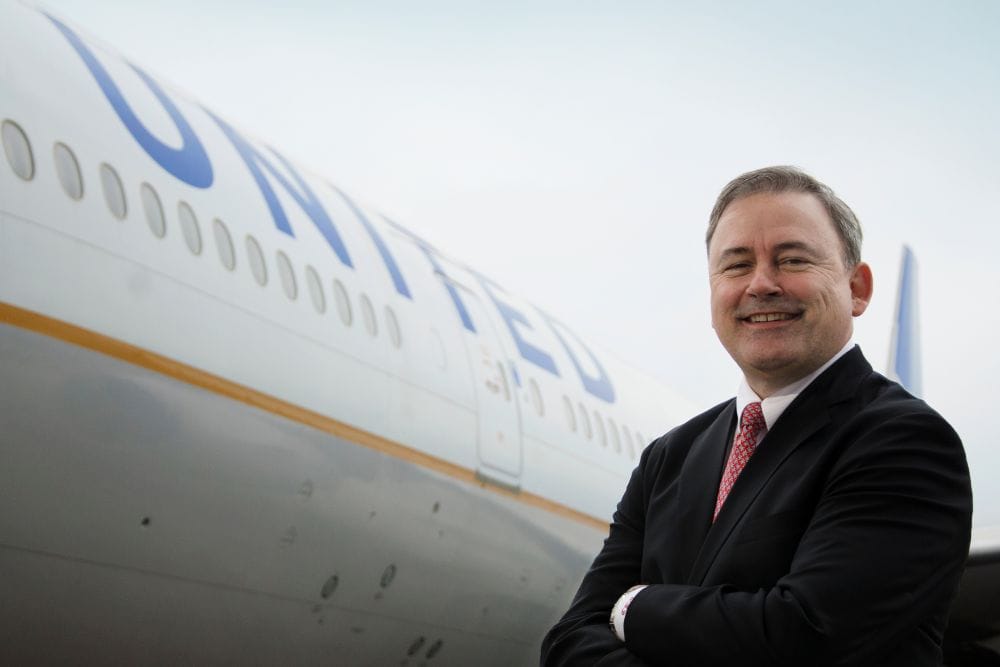
The career path of Walter Dias, a former chairman of the American Chamber of Commerce in Hong Kong, has been anything but ordinary. Growing up outside Philadelphia, where his father owned a service station, he did a finance and accounting degree at Penn State, graduating in 1982. His first job was doing audits for PwC in Houston, which was then a boom town. His second job, with a Houston-based oil exploration company, took him all over the world, and his third, with Continental Airlines, to Guam.
Since the merger between Continental and United Airlines in 2010, he has been United’s lead in Greater China, Korea and Southeast Asia – managing the highest volume passenger network of any airline in the region, at least until Covid-19 came along. Here he talks with AmCham HK e-Magazine about the impact of the pandemic and the rebound in travel post-Covid, as well as his own extraordinary career path.

Q. Since 2019, the Hong Kong-based aviation industry has seen little but turbulence. How did it affect United?
A. Looking back, 2019 was really the beginning of some challenging times, not only for United but for the entire airline industry.
Prior to the pandemic, United was operating the largest number of seats between the United States and the Asia Pacific. We were also the largest operator of seats between the United States and mainland China. In the depth of the crisis in March and April of 2020, we were down to just two passenger flights a week in the Pacific, whereas we used to have hundreds a week. These were extremely challenging times.
Q. What was your survival strategy?
A. We did something that was uniquely United. We were very aggressive in pulling down seats during the height of the pandemic, because no one was traveling.
But our leadership was very smart, and had a vision for what the industry would look like after the pandemic. We’re the only large global carrier that did not retire any of our international wide body fleet. We sat them on the ground, but we didn’t permanently retire any of them. We kept them all available to bring back when traffic came back. We were the only big carrier that didn’t lay off any of our pilots. We made a deal with them to keep them current, and they were able to come back as traffic returned.
We were in relatively good shape when the government started removing traffic restrictions and were able to be more aggressive during the recovery. The first region to open up, post pandemic, was the European market. In 2021, we started adding capacity back between the US and Europe. At one point in time, we had added 30% more capacity to Europe than we had prior to the pandemic. We became the number one carrier between the US and Europe for the first time in our history.
Q. How did that pan out?
A. The pundits and the experts were saying that business travel would never come back to 2019 levels, and leisure traffic would take five to 10 years to recover to the 2019 levels. We didn’t believe that. We thought as soon as the governments started removing the travel restrictions that people would need to travel. It sounds like a cliche, but you see it painted on the side of every one of our airplanes.
We talk about connecting people, uniting the world, and we really think that it’s just human nature that you need to have face-to-face encounters to build relationships. We felt that travel would come back faster than what everyone was saying. That’s why we took the approach of retaining as many resources as we could prior to the start of the recovery.
In addition, we doubled down during the pandemic. We ordered a large amount of narrow body aircraft for our domestic US system. And in 2022 we ordered up to 200 more Dreamliners, the new Boeing 787, which are one of the wide body aircraft models Boeing makes. Our order book is one of the largest order books in the industry, with about 725 new aircraft that will be delivered over the next eight years or so. We’re taking a significant amount of those, especially the narrow bodies over the next three or four years, as the recovery continues.
Q. On the labor front, how is the recovery from the Covid-19 pandemic affecting resources?
A. For US carriers, the US government did a program that allowed airports and the airlines to retain their frontline staff, the people that fly the plane, the flight attendants as well as airport staff, because they were worried about not being able to spool back up once, once the recovery started. That helped US carriers retain some of the talent that they had. But we all did lose some talent, especially in the domestic US market. Since the recovery, we’ve all been aggressively out there hiring new people, especially on the flight attendant side.
We’ve hired thousands of new flight attendants. On the pilot side, even though we retained all our pilots, there was an industry pilot shortage right after Covid. We have still been out there hiring additional pilots. These were not necessarily easy to find at first, but we’ve done a lot of interesting things. Our airline owns a flight training center, United Aviate Academy, so we have a program to develop new pilots as well.
One of the things we did during that time was to make sure that we’re trying to get talented people that wouldn’t normally have the financial resources to pursue a license. The challenge in the US is that traditionally, a lot of pilots came from the military, and received their training in the military. But if you’re a private person and you go do your own training, it can be a $100,000 to $150,000 investment getting your license. That is a significant barrier to entry.
We created Aviate Academy to help the people who didn’t have $150,000 but had the talent to be a pilot. We also tried to get at least 50% of the candidates as cadets would be women or people of color to create more diversity in the front of the airplane. We’re very excited about that program. It’s done well, and the pilot situation in the US market has alleviated to a certain extent.
In addition, we expanded our United Flight Training Center in Denver that is the world’s largest and industry leading pilot training center in February 2024. The center facilitates ongoing training for all active pilots and newly recruited pilots.
It’s the same thing on the flight attendant side. We have new facilities for flight attendant training and have been bringing thousands of flight attendants over the past four or five years now. Here in Hong Kong, we did have a flight attendant base prior to Covid, and unfortunately, we lost that. Now all flight attendants are based out of the US.
Q. Did the pandemic change the industry?
A. One of the other things we noticed during and after the pandemic, which everyone’s still trying to wrap their heads around, is that demand for leisure premium travel has increased. And it’s not revenge travel, which was right after the pandemic when travel restrictions came off. This is a fundamental change about how people think about travel. They want to have a good experience when they’re traveling. We’ve seen a nice increase in premium product demand from the leisure side of the business. So that’s exciting.
We’re in the middle of upgrading all of our aircraft in the domestic system to have more premium cabin seats in the marketplace. We have also reconfigured all our international wide body aircraft to have the same Polaris business seats that lie flat in the front cabin. Then we have United Premium Plus economy and premium economy seats in every wide body aircraft as well.
We have a consistent product internationally, around the world, and that’s very nice to have in place after the pandemic. That’s the foundation of where we were and what has happened over the past five years or so.
Q. What about Asia-Pacific?
A. Unfortunately, Greater China was really the last region remove travel restrictions in the marketplace. Singapore was one of the earlier markets that opened back up in late 2021. We were able to go back to our double daily service from Singapore to San Francisco by October 2022. That’s back to the normal 100% of what we were flying in 2019.
Hong Kong was one of the last places to open up for passenger traffic. One of the things that really helped United during the pandemic is that we’re one of the largest airlines carrying cargo in our belly space. We were up to almost five daily cargo-only flights to Hong Kong just with cargo demand. Cargo really helped keep the airlines afloat during that time frame. When travel restrictions were removed, we re-launched our San Francisco service in March 2023, and we were very happy to do so.
2023 was the 40th anniversary of United offering service in Hong Kong. It was really an appropriate time frame for us to be able to add back that flight. As we did, we were pleasantly surprised by the demand that was coming back. And although, if you look at the industry numbers, it’s not completely back to 2019 levels, but we did see some good demand, and so we started adding even more flights back.

By the end of 2023 we were up to three daily flights. We were operating two daily flights to San Francisco and one daily service to Los Angeles. That was a pretty rapid spooling up of our capacity in the Hong Kong market. And then in 2024 we were able to add a fourth daily flight with a second daily flight to Los Angeles. Now we’re operating about 37% more seats than we were in 2019 between Hong Kong and the US.
Q. Now we’re in 2025. How do you see the Hong Kong and China markets shaping up?
A. We’re cautiously optimistic for 2025. We just added the fourth flight from Hong Kong to the US in October, so right now we’re only in the third full month of operation. And of course, the October, November, February, periods are a little bit off peak. As we look back at 2024, we had a nice year-over-year increase in our total passengers in Hong Kong, almost 30% better than the previous year. So, 2024 was a good year. I think it’s going to continue in 2025 but with the fourth flight being added so recently, we probably can’t do much more than that right now.
The other challenge for United is that, due to government sanctions, we are not allowed to fly over Russian airspace. Many of our customers in Hong Kong and back in the US are asking, you know, why haven’t we added back our direct New York service? We were the first airline to add a Hong Kong-New York service in 2001. We do want to operate that service at some point, but we have to wait for the governments to find a solution.
China is a special case. When we look at our system in the Asia Pacific region, for the summer, we were probably about 6% larger than we were in 2019 but when you carve out the China piece of it, for the summer period, China was about minus 70% compared to 2019 as far as the number of travelers going back and forth. Unfortunately, the demand has not yet come back for the mainland China market.
Currently, the aviation agreement between the two governments is that the Chinese carriers can operate 50 flights a week from the mainland and US carriers can operate 50 flights a week between the mainland and the US. Currently, the Chinese carriers are operating all 50 of their flights. On the US side, we are operating 45. Five are currently not being used. United recently received approval for three new frequencies for Beijing-Los Angeles, which will launch May 1, 2025.
Even so, currently we’re operating the largest number of seats between China and the US – one daily service from Shanghai to San Francisco, one daily service from Shanghai to Los Angeles, and one daily service from Beijing to San Francisco. We’re the only US carrier serving Beijing. The additional flights that we’ve applied for would be going from Beijing to LA.
Q. You presided over the boom in pan-Asian air and cargo traffic prior to the pandemic and have always been a visionary on that front. Are you still an optimist?
A. This is really the Pacific century. And when you look at all the forecasts around the world for international travel, the center of the universe is here in the Pacific. I think aviation has a bright future in this region and United is very excited to be part of that. During the recovery, we maintained our position as the airline operating the most seats from the US to Asia Pacific. We’re very optimistic, and we’re very committed to the Pacific region.
Last year, we celebrated our 40th anniversary of doing business here in Hong Kong. We’ve been in mainland China for 35 plus years. We have a commitment to the region, and we’ve looked for different opportunities. I think, for mainland China, it’s going to take a few years to recover and rebuild back the network to where it was prior to Covid-19. We have to see demand coming back from both the US market as well as the mainland China market to justify putting in additional capacity.
Q. Hong Kong has not had an easy time the last few years. From an aviation perspective, what are its principal assets, and how will they shape its future?
A. I’ve been saying for years that the Hong Kong International Airport is the best intermodal connected airport in the world, with the SkyPier Terminal Transfer Coach and ferry service connected directly to the passenger terminal. That’s an incredibly slick product for the Hong Kong Airport. And of course, ground transportation. There’s a significant amount of traffic that comes across the border by road or over the Hong Kong- Zhuhai-Macao bridge and the high-speed rail from Kowloon. A significant number of customers are coming from there.
The airport’s connectivity is really important to its success. We are very busy and focused on making sure that we attract customers from across the border. A lot of our American business customers travel to South China via Hong Kong. So it’s really a great asset to have the Hong Kong airport so well connected to the Greater Bay Area. It produces a significant amount of traffic for the entire industry, not just United.
We are always looking for opportunities to enhance our connections.
Q. Now that it’s open for business, is the third runway a game changer or a wait and see situation?
That project has been talked about for more than a decade in the planning process. We supported it, from the beginning, because you could see that with the growth of the region that the airport would cap out at some point around now, if they just stayed static. It was great foresight for the airport authority and for the Hong Kong SAR government to make that commitment and build out that new resource with the third runway and all the ancillary activity that’s going on along with it.
We definitely support it. It’s looking at capacity out to 2030 being in place for growth. So, so right now, it’s definitely helpful and it’s a game changer in the long term, as the markets recover and then start growing, at their natural pace. Over the last 10 or 15 years, the average passenger traffic flowing through the Hong Kong Airport was growing at an average of about 8% a year. As we are still not back to the 2019 passenger volume yet, it will take more e time to get there. But we’re seeing good growth, year over year, and even, quarter over quarter. We’re very optimistic about it.
It’ll eventually definitely be needed. As you look around the Greater Bay Area, it’s such a dynamic place with so much economic activity and economic growth. The Hong Kong Airport is really well positioned to kind of serve that growth, with the facility that that we’ve built here now.
When you’re in that planning process, everybody’s always a little bit worried that they’re getting ahead of their ski tips a little bit, right? But in the intervening years, the airport did see pretty strong growth. If they hadn’t made that commitment back then, they would start hitting their ceiling on how many flights they could operate into the airport.
Q. What about all the other commercial infrastructure like Skycity, with its 11 Skies mall between the airport and Hong Kong-Zhuhai-Macao bridge? Good, bad or neutral for business?
A. It depends on the type of customers that that are coming through the airport facility. Hong Kong generates a lot of connecting traffic. Customers will want to travel through a nice facility with additional features. It definitely will be attractive for a certain segment of customers. It probably won’t impact their decision for another segment of customers on how to get to a certain location, business travelers and so forth.
On the leisure side, it may also help attract visitors from around the Asia Pacific. Some of the successful hub airports have designed features other than just the runway and the airport terminal, and they seem to be more successful than the others. I won’t name names, but you probably know who they are. There are a couple nice airports around the region that do have those types of facilities, and they do seem to do well.
Q. Beyond Hong Kong and China, are there any new developments in the United network?
A. One of the reasons I ended up in the Pacific is because of our operation on the island of Guam, with Boeing 737 narrow body aircraft. One of the things you may have seen us doing just over the last six months or so is because we a have pilot base, a flight attendant base, and airplanes based on the island, we looked at creative ways to use those resources to operate to underserved markets.
To give you a couple of examples. I was in Cebu for the launch of our Cebu-Narita service. Narita was traditionally a big hub for a lot of airlines back in the day. We all flew there. We had flights from Narita to Hong Kong, Narita to Singapore and all over the Pacific. But as aircraft technology evolved over the last 30 years or so, we now have Boeing 787s and Airbus 350s that that can fly longer than older aircraft, but more efficiently, and can serve smaller markets economically.
As a result, most of the airlines have pulled down their hubs in Asia Pacific. You don’t see many American carriers flying intra-Asia flights from Narita or from Hong Kong to other places in Asia, and that’s because the aircraft technology has changed so much.
Instead of flying San Francisco-Narita-Singapore, now we have an airplane that can fly San Francisco to Singapore. We don’t really need to do that Narita-Singapore flight anymore. Our wide body hub in Tokyo went away over the last 15 or 20 years. But, unique to United, we have narrow body 737s, sitting in Guam. And they all fly to Tokyo anyway, because there’s a decent tourism market from Japan to the island of Guam.
We have some extra airplane time sitting on the ground in that fleet in Guam. Now we’re using it to fly to smaller cities that don’t have as much service from Tokyo. The first example was Tokyo-Cebu. We have five daily flights from the US, from our hubs in the US to Tokyo Narita airport. And we also have five dailies to Tokyo Haneda airport. In all, we have 10 dailies to the Tokyo metropolitan area from the US domestic market. it’s like a giant funnel coming into Tokyo, and we’re taking those five flights and then selling Cebu from the US.

From each flight, we get a certain number of people from the inbound flights from the US and then put them on the Cebu flight. And we also of course have customers in Cebu that want to go to the US. Those flights are also connecting to the outbound flights back to the US from Tokyo. And then we also have Japan customers that want to fly to Cebu and Cebu customers that just want to go to Japan. With all these points of sale and different customers, we’re able to fill up the 737s. The aircraft has 160 seats on it, and we’re able to fill those up with all those different points of sale.
We’ve announced four different routes. Cebu was the first one. We are also launching Narita-Kaohsiung in Taiwan, and then we’re launching Tokyo-Palau, and then the last but not least, very unique market, we’re adding Ulaanbaatar, Mongolia from Narita. All these flights are designed to connect the United States to these smaller destinations that don’t necessarily have a lot of service from the US. And we’re very excited about it. The Cebu market has done very well so far since we launched it.
For the first time ever, in October 2023, we launched a service from San Francisco to Manila, non-stop. We’re the first US carrier to operate a non-stop service from the United States mainland, to the Philippines.
Can you share about your career? Where did you grow up, and how did you get into the airline industry?
I grew up on the east coast of the US, in Pennsylvania and went to university there. I was a finance and accounting person in university, and ended up working for Pricewaterhouse, and then going to work in the oil business. When I was a kid, I always really enjoyed geography and history, and when I joined the oil business, they sent me to some unique destinations. I really enjoyed that and enjoyed the travel experience of it.
I was working in Houston, Texas in the oil business. Continental Airlines, which was based there, enticed me over to the airline industry. I worked in the finance department, doing internal consulting to the different departments within the airline. It was a great place to be, because it really allowed me to see all facets of the airline business, at the airport, in the sales force, on the international routes, in the technical operations, in the frequent flyer program. I received a 360-degree review of how the airline business works.
I really enjoyed that but always wanted to gravitate towards sales and marketing. One of my former bosses was sent out to Continental Micronesia to be the chief financial officer. They asked to borrow someone from Houston, and I volunteered to come out. It was only supposed to be a year, and that was 32 or 33 years ago. It’s been a great experience and a great journey.
I love working in the business, because it’s all about bringing people together. I went into the sales side of the business when I moved to Guam. And so I spent a lot of time in Japan talking to leisure customers that were looking forward to going on a vacation somewhere and marketing the islands, Guam and Micronesia to them. It was great to be able to do that, to bring people together and show off the culture of Micronesia as well.
I was in Guam for 15 years. At one point, I was responsible for all the sales and marketing of Continental Micronesia for Asia Pacific. Back then, the aviation treaty between the US and mainland China only authorized two airlines from the US to fly to China, which were United and Northwest.
In 2005 the treaty was liberalized and authorized additional airlines to fly between the two countries. Continental was the first new airline to be authorized to fly between the US and China in 18 years. I was tasked with going to mainland China and opening the Continental offices in Beijing and Shanghai. Prior to that, in 2001 when I was in Guam, I was responsible for Hong Kong, which is a different aviation treaty.
In 2001, I worked on opening our office here in Hong Kong for the Trans-Pacific routes. Continental was the first airline to launch service to New York from Hong Kong. At the time, in 2001 that was actually the longest commercial flight in the world. And it was also the first commercial flight to use the polar route, to fly over the top, which was a very innovative flight at the time. We were really proud of that, and United at the same time, launched a similar service from John F. Kennedy International Airport in New York to Hong Kong.
So we were really the first airline to open up the East Coast for Hong Kong. And because of the treaty opening in 2005 between mainland China and the US, I started opening offices in Beijing and Shanghai. At some point, my boss said, you know, you really need to get closer to your customers. That’s when I moved from Guam to beautiful Hong Kong. And by now, I’ve been in Hong Kong longer than I was in Guam, almost 16 years.
Q. What has been your experience of Hong Kong?
A. It’s been a privilege to have the opportunity to live and work in Hong Kong and a fantastic experience. My wife, Sonya, worked at TV Pearl in news, and we’ve been here since that time. We’ve always really enjoyed Hong Kong. It’s such a dynamic place and the people are fantastic here. We really love our time here.
This is where I really got involved in AmCham as well. I was on the board of directors of AmCham for almost nine years and had had the great privilege to be the chairman for two years in Hong Kong as well. It’s just been a fabulous experience to be here in Hong Kong. We really enjoy it.

Walter Dias began his aviation career with Continental Airlines, as an internal auditor, in Houston and Guam, before Continental merged with United Airlines in 2010. He was managing director for Greater China and Southeast Asia for Continental before the merger, when he became United’s regional director for Greater China and Korea in 2011. From 2016 to 2017, he was chairman of the American Chamber of Commerce in Hong Kong.