
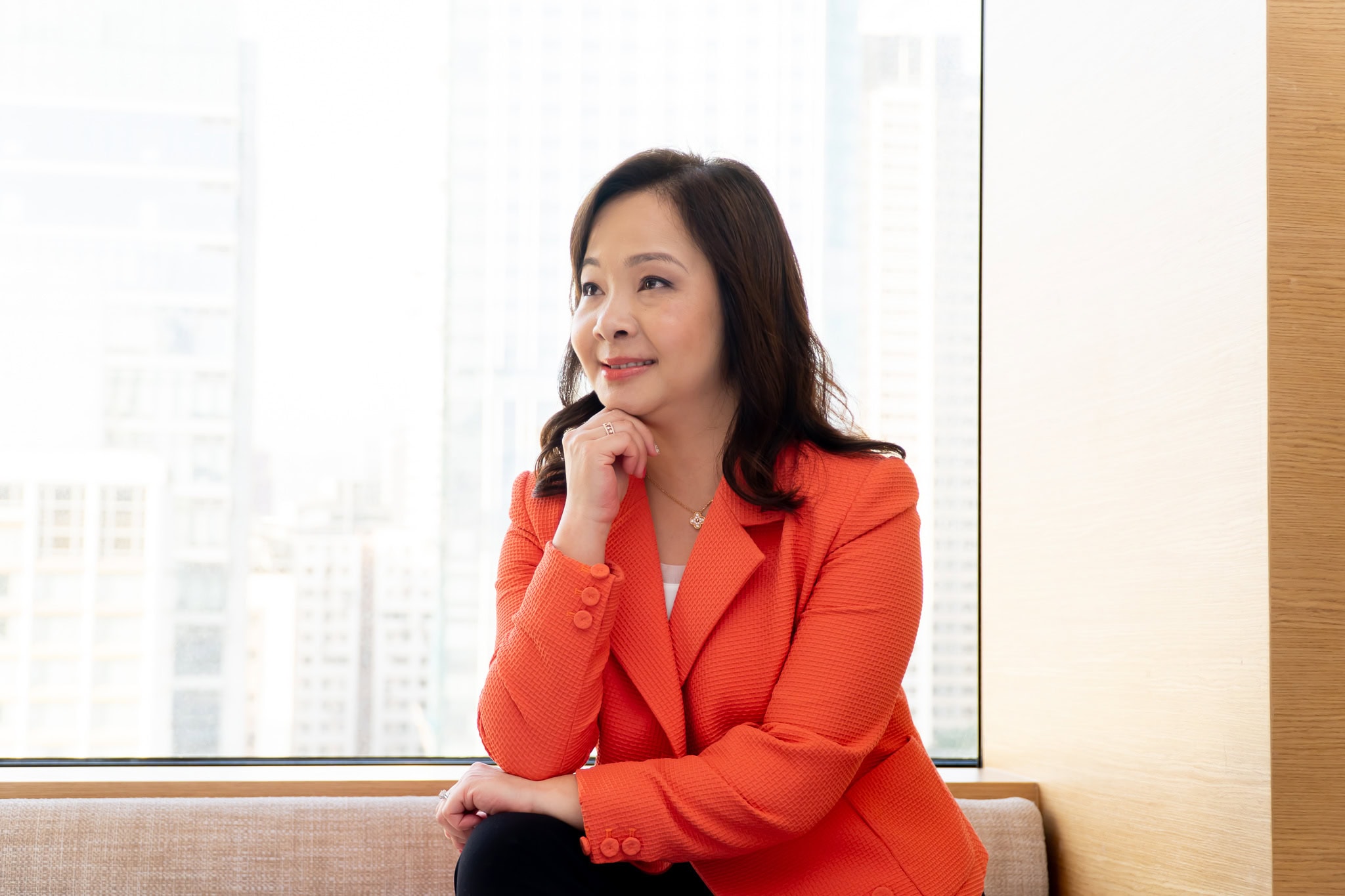
President of Starbucks Asia-Pacific since July 2022, Emmy Kan has been with the company for 22 years. Born and bred in Hong Kong, Kan leads the Asia-Pacific division of Starbucks (which excludes Japan and China), with 60,000 “partners” as the Seattle-based company calls both its employees and managers. 65% of those partners are women.
Here she talks with AmCham HK e-Magazine editor Edith Terry about her passion for working across the boundaries of gender and cultures to make Starbucks not only a more successful company, but a better, diverse and equitable environment for its workers, which it calls its “partners” and customers.
Q. Tell me about your childhood and the early part of your career.
A. Both my parents lived a very hard life for most of my childhood. We moved a few times, from the area around the former Whampoa dockyards, in Hung Hom, to Sha Tin for a few years, then back to Hung Hom, where I still live.
After I married, I wanted to stay somewhere close to my parents. When I was a child, my parents worked in a wet market, selling fresh fruit to support me and my older sister. They would leave at 5 am and come home around 8 pm, leaving us with a neighbor or relatives who would send us off to school. They never rested, working seven days a week, but were very protective of me and my sister.
My mother never asked us to do any housework, although as teenagers we began helping her voluntarily on weekends. We had no helper, unlike my son Max. My parents never put pressure on us academically. They had no formal education and had no idea how to advise us.
I was able to go to university first, because I was number one in my primary school, and was able to choose to go to one of the best girls’ secondary schools in Hong Kong, the Heep Yunn School, an Anglican institution founded in 1936. They started me at the bottom of Form One, and I worked my way up to the middle and then the top of Form Three.
My English was terrible to start out with, and I didn’t understand anything most of the time, but I became one of the top students. It was from my classmates that I learned that university could be a normal part of life. They talked about where they wanted to go, and I had no idea. Nobody in either of my parents’ families had gone to university.
Q. Why did you push yourself so hard?
A. My parents taught me to be disciplined, respectful and polite. If my parents put any pressure on me, it was not to study all the time. I have always had high expectations of myself. I chose to go to the University of Hong Kong because it was the best school at the time.
Initially I wanted to study psychology, but ended up transferring to economics, partly because in the years before 1997, when I graduated, there was huge concern with economic issues. I couldn’t see myself as a psychologist, so I thought I should do something more commercial, and that economics would be a good background for that.
But it was difficult to change. I was told I could do it if I took an extra year to finish. I didn’t want to do that, so I ended up taking 12 subjects per semester instead of the usual eight. But I had to do that twice before the university approved the transfer. In the second year, they told me that they had already reached capacity. That didn’t make sense to me and I appealed the decision, but I still had to double up my course load again, even though I had made straight As.

Q. Can you share how you started your career?
A. General Electric was among the companies that recruited students in year two and three. I applied to all the firms. I had no idea what I wanted to do. I really wanted to work at Marks and Spencer Group because I was very interested in retail. I failed that – they didn’t hire me. I didn’t know why GE hired me as a financial trainee because I hadn’t studied accounting. I thought finance was about math. But I thought, OK, if they have confidence in me, let me try.
In the trainee program, they taught us a lot in the classroom. I found that my peers were very diverse. One lady had even studied English literature. Now that I am in a leadership position, I can see that they didn’t choose people for what they were at the time, but for the potential.
After two years in the management trainee program, they sent me to GE Plastics for Greater China. I spent two years there as a financial planning leader, but they were about to move the position to Shanghai, and I didn’t want to move. My boss at the time suggested that I look around and see what’s next. “You’ve never written a CV,” he pointed out.
So I sent a CV to a few recruitment companies and Starbucks came back with an offer as a senior financial analyst. I thought Starbucks was a good company. I had become familiar with it during a six-month assignment in Singapore, when it wasn’t yet present in Hong Kong. At GE Plastics all my customers were corporations, like Apple, buying plastic parts. And I was interested in retail. So I thought I would like to try.
Q. Did you face any gender discrimination yourself in your career?
A. At GE Plastics, I felt I was in a very different culture, quite male-dominated, with a lot of engineers. I didn’t think of it as discrimination, just a different culture, very aggressive. Starbucks doesn’t have that kind of challenge. Working here has helped me. We don’t have a prescribed leadership style. When I have those kinds of doubts, that I need to be something different than myself, it’s OK, everyone can be their authentic self.
But I’m Asian, and I’m petite. I’ve been mistaken for the secretary in meetings when accompanied by tall, western colleagues. To people around the room, I was invisible. It’s hard to stand out in a global company with a lot of global people. When I was younger, I felt if I was taller, or more outgoing, I would be more successful.
Q. Did you have mentors helping with your journey at Starbucks?
A. Five years ago, when I was the regional CFO, Sara Trilling, the previous Asia-Pacific regional president, asked me “What do you want to do next?” That question struck me as Belinda Wong, Starbucks’ China chairwoman and CEO, had challenged me with the same question. Knowing that both these women, who I looked up to, saw potential in me and were eager to support me in unlocking it, gave me the confidence I needed to go back to Sara a week later and say: “I want to be you. I want to be the regional president for the AP region”.
Q. How would you describe your leadership style?
A. First, I’m inclusive. My leadership style is showing kindness, empathy and compassion. I’m approachable, and I can create collaborative and safe environments for the team. I have a unique skill – people come to me to seek guidance. I know something about how people think and feel across 15 markets. And it’s part of Starbucks’ mission and values – to create warmth and understanding.

Q. What have you done to support women across Starbucks Asia-Pacific?
A. In Hong Kong, women don’t have too much of a challenge as working mothers and leaders, although there are subtle societal messages that women are expected to have a role in the family. I set ambitious goals for equal gender representation, ensuring that women have a voice in the leadership level at the Asia-Pacific regional office in Hong Kong. The achievement of a 50/50 balance in the Asia Pacific Leadership Team over the past three years is a testament to my commitment to women’s empowerment and inclusion.
When we launched our first Empowering Women initiative in 2017, we identified a real need for change in India, where the team committed to increase female representation in the workforce from 20% in 2016 to 40% in 2022, which I am proud to say we achieved. When I relaunched the Empower Women initiative in 2020, I asked the team to do more analysis of the challenges and barriers facing women, especially in India and South Korea.
Q. What did you find out in these two country markets?
A. In India, what I found out was that our managers in India faced a broader problem of women in the workforce, where as a country there is only 24% participation. We also faced a legal requirement to provide transportation for women working night shifts. We implemented night-time transportation routes with additional security measures, such as GPS tracking, security guards and first aid. Starbucks India opened the first All Women store in the world in 2021.
Today we have nearly 30 all-women stores in India, about 8% of the total 400 stores, and we aim to keep the number at the same percentage. Starbucks Saudi Arabia was inspired to open its first All Women store in 2022. It may seem strange outside India to have a store operated by women and no men, but the gender stereotypes around women’s capability and role expectations, as well as the legal requirement for the company to provide night-time transportation, are roadblocks for women to participate in the workforce in India.
We invited the families of our women partners to visit them at their stores, understand the skills they learned, and show them the daily routine at Starbucks. This was to help increase the confidence of the women’s husbands or parents that they were in a safe space.
Q. What about South Korea?
A. If you look at the country, there is 50% participation by women in both the country and our stores. The challenge is that women drop out as they go higher in seniority, because the traditional culture is for women to drop out once they marry and have children. One way to address this was to allow stores to have more flexibility at the store level to work after they have had children.
Our Returning Mothers program offers women who have taken a career break, to work flexible hours while receiving full company benefits, bonuses, and incentives. They can also return to the position that they left. Just to give an example, we had a partner named Chacha, who worked for 10 years at Starbucks Korea before taking a career break. She came back three and a half years later as a “Returning Mother Barista”, and is now an assistant manager.
Q. What about inclusiveness for people with disabilities, beyond gender?
A. Every country has its unique challenges and barriers. You really need to understand these to unlock these barriers. The conversation too often stops at a high level. Starbucks Malaysia has been a pioneer in innovative store models. It was the first market globally to open a Signing Store in 2016, and now there are more than 20 Signing Stores globally in China, Indonesia, and Japan, as well as Malaysia.
The US has opened its first Signing Store in Washington, DC. The stores provide a space for the deaf and hard of hearing community to connect through sign language and celebrate deaf culture. From hiring to training this is a totally different program. They can prove to their families and to customer that they are no different. The starting point is that they are not equal, and you have to provide additional support. On that point, I feel very, very proud. We are the pioneers, and the US followed.
Q. What about serving lower-income and needy communities more broadly in APAC?
A. I just came back from a management meeting in Seoul. Starbucks Korea has eight Community Stores that create pathways to opportunities. These stores support a range of causes including a store designed as inclusive spaces for people with a wide range of disabilities, with wheelchair access and digital pads for communicating.
Another intention is to revitalize communities that might are marginal or going downhill. In 2022, we opened the Kyungdong 1960 Community Store in the historic Kyungdong Market in the Dongdaemon district of Seoul. For every item sold in the store, it will donate 300 Korean won (about 25 cents in US dollars) to help renovate the old market. With the Starbucks store, young people might get interested in seeing the market.
Otherwise, they might never go there. We have 46 Community Stores across APAC. Starbucks Korea has the second highest number of Community Stores after India.
One more example is a Community Store in Thailand that supports coffee farmers, like the farmers who grew the coffee beans for this bag of Muan Jai™, in Thailand. Five percent of every bag of Muan Jai™ Blend coffee beans sold goes to support coffee farming communities in Northern Thailand. In Asia-Pacific, we opened our first Farmer Support Center in Sumatra in 2015. We donate coffee tree seeds to coffee farming communities across Indonesia, with donations of 500,000 seeds since we began the program in 2017.
Q. Finally, how do you spend your free time?
A. I try to see my 13-year-old son as much as possible. Striking a balance is not easy. I don’t have a clear boundary between work and life, but I have a very good support network. My mother continues to live with me, and I have a helper. I have a very supportive husband. Max loves to travel. He loves Japan.
Last year, we went to London. I try to protect my quality time with him, on weekends and some evenings when I am not traveling. Other than thinking of my family, I need some me-time as well and I am more of an introvert. In January, I started pilates with a personal trainer, in a location opposite my home. If it wasn’t close by, it wouldn’t be sustainable.
Starbucks Asia-Pacific has a network of 5,500 stores across 15 market and is opening 400 stores per year across the region, which does not include China and Japan. It is a direct subsidiary of Starbucks Corporation (Nasdaq: SBUX), with a market capitalization of $103 billion and 381,000 employees globally.