

De Kai was born in St. Louis, Missouri, coming to Hong Kong to join the faculty of the Hong Kong University of Science and Technology (HKUST) in its founding year 1991-92. There, he built on his PhD thesis at the University of California, Berkeley. Its forbidding title was Automatic Inference: A Probabilistic Basis for Natural Language Interpretation, but its impact was revolutionary.
De Kai’s work at HKUST provided one of the earliest mathematical frameworks for using machine learning to translate English to Chinese and vice versa, which he developed in 1995 well before the launch of Google Translate for simplified Chinese in 2006 and traditional Chinese in 2007. He trained the model by having it read back copies of bilingual Hong Kong Legislative Council reports. In 2011, De Kai became one of the first 17 founding fellows appointed by the Association for Computational Linguistics (ACL), the natural language processing equivalent of the Nobel Prize.
Here he shares with AmCham HK e-Magazine his views on the ethics of Artificial Intelligence (AI) from his book, Raising AI, as well as the influence of his father on his career. De Kai is the son of the late Chia-Wei Woo, a Shanghai-born physicist, educator and the founding president of HKUST from 1991 to 2001.
Why De Kai grew up in the United States
The most important talk I am giving this year on Artificial Intelligence (AI) is at Georgetown College, a private Christian liberal arts college in Georgetown, Kentucky. After my father Chia-Wei Woo died last year, amidst the unopened mail in his university office we found a beautiful crystal plaque and magazine clippings commemorating that the college had added my father to its Hall of Fame. I was sad to let them know that we had lost my father about a year ago, and that I wanted to give a talk on my new book, Raising AI, to come full circle.
My father took his liberal arts education from Georgetown College and became an incredibly strong champion of liberal arts throughout his storied career and passed on those values to his children. Without that massive ripple effect of Georgetown College investing in 1955, investing in this obscure 17-year-old from the other side of the planet, a war refugee in Hong Kong, I don’t think I would have written a book like Raising AI.
I don’t think he knew anything about Georgetown College, but it was a full-ride scholarship, so he took it, sailed across the Pacific, and found his way from San Francisco to Kentucky, still speaking barely any words of English. He came from an educated family in Shanghai. My great grandfather was the third president of Fudan University.
My father got his Master of Science and Doctor of Philosophy degrees in physics at Washington University in St. Louis, which is why two of us were born there. He moved to Hong Kong in 1988, because he’d been asked to set up HKUST and recruit faculty when shantytowns still dotted Hong Kong. There was no Shenzhen. The Kowloon Walled City was still up. China was poorer than India. It was like a Peace Corps mission.

After developing your AI model, you said you had an ‘Oppenheimer moment,’ where you suddenly recognized it was an existential threat to humanity. What was the trigger event?
It was Cambridge Analytica. [Beginning in 2014, the data analytics firm worked with Donald Trump’s election team to harvest millions of profiles of US voters, using them to build a software program to predict and influence voting choices through social media]. Robert Mercer, who funded Cambridge Analytica, was one of the first ACL fellows in 2011, so I knew him and his work well from the 1990s. Back then there were only a handful of us pushing for machine learning AI, rather than trying to code AI in terms of logic rules.

That came on top of recognition of the filter bubble effect [where personalized Internet algorithms limit a user’s exposure to diverse viewpoints]. Eli Pariser, in The Filter Bubble, warned us how AI algorithms were siloing us into echo chambers that increasingly made us less capable of hearing other viewpoints and start demonizing each other.
I was working on several new, game changing AI algorithms and software infrastructure. I’m a lifetime builder, but I realized that none of this was going to do any good if we allowed tech that folks like me helped to pioneer to disconnect humans. Into viciously opposed blocs, trying to destroy each other and hating each other.
Why does that happen? Isn’t AI based on statistical models that in theory would give preference to the mean or center of data distribution rather than the tails?
It’s less about how many data points the AIs have, but more about what they do with the data. AIs just sit there, whether it’s your YouTube AI, or your Amazon AI, your Google AI, or Reddit, or ChatGPT. They are picking up very quickly what wins your approval. AIs are attention seeking. They learn to imitate. They behave kind of adoringly, some might say, sycophantically.
That’s obvious when you are dealing with chatbot AI, in a dialogue, but you have to realize that your YouTube AI is also being super sycophantic. It’s choosing only to put choices on your screen that are going to appeal to you. If you and I were to type the same prompt into even a regular Google search, you’d be amazed at how different the results are.
They will only show you things that they are confident will win your approval. And what does that do? It feeds your confirmation biases. It causes AI to pop things onto your screens that fit our many tribal biases. It tends to hide things that it feels will not agree with us, because then we won’t spend time on it and they can’t sell ads.
Can you give an example of how the filter bubble affects people?
I was in Beverly Hills giving a talk. They had set up the keynote stages as boxing rings, and they wanted a powerful example of the powerful, insidious influence of what I call algorithmic censorship.
I said, those AIs behind your social media feed, newsfeeds, YouTube recommendations — how many times a day does something pop up on your screen that mentions China in one way or another? And they’re like, a lot, a dozen, two dozen.
And OK, on a scale of one to 10, how strong an opinion would you say you formed? And they said, strong, 7, 8, 9. So I said, let’s talk about China. Let’s see, which of the current government leaders have you heard of, besides Xi Jinping. There was absolute silence in the big hall. Next, at the third-grade level, can you tell me how the Chinese government is organized? And there was complete silence. A newspaper CEO was sitting in the third row. Eventually, somebody says, uh, an emperor?
Once you had your Oppenheimer moment, what did you do about it?
It’s been 20 years and we’ve done nothing about algorithmic censorship. While we worry about rogue AIs destroying humanity or losing the AI arms race, we’re blindly walking off the cliff. Why have we done nothing? First, because we’re not seeing it, and if we do see it, we don’t believe it.

I started giving hundreds of talks about this. I started working with all the original AI policy and ethics think tanks. I was part of the Google’s inaugural AI ethics effort, officially the Advanced Technology External Advisory Council. It blew apart thanks to the same misinformation and information disorder that I was there to fight.
Tell us about your new Empathetic AI Institute.
This is a new organization that is doing everything it can do to achieve an outcome on this problem. What should be the criteria, values, principles and norms that AIs use when they decide what you and I should never know? What do we collectively believe should be the default settings, and what are our aspirational values for AI?
It will be built out in stages. This is the earliest inception right now. We’re doing the very first fundraising for it. We need to do the strategy, coordination, and logistics to drive public awareness and civic discourse. On the website, we say it focuses on consciously guiding AI’s evolution to benefit humanity, emphasizing compassion, ethics and the need to model empathy in AI systems rather than purely relying on regulation.
Can you share some of the themes from your book, Raising AI: An Essential Guide to Parenting Our Future? What does that even mean, if you’re not a software engineer?
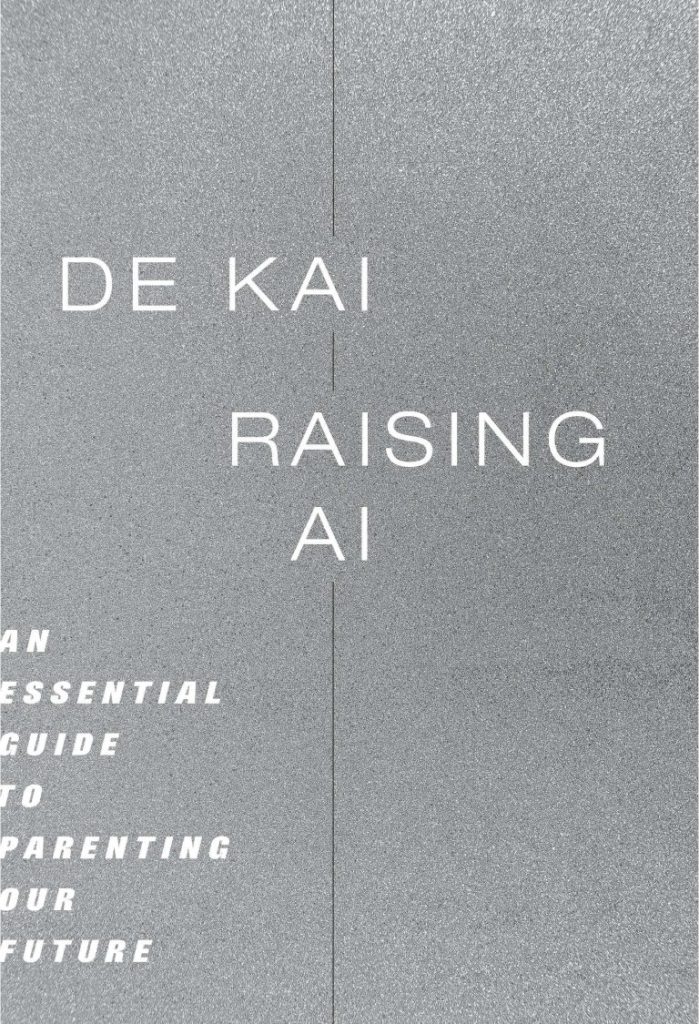
I’ve been doing AI research for over 40 years. Raising AI is the only book on AI that was awarded a place on J.P. Morgan’s legendary Summer Reading List in 2025. And there is a reason for that. It is not what everybody else is saying. As someone who has spent my entire life studying AI and human cognition, as well as social psychology and culture, I think we are having the wrong conversation. And having the wrong conversation presents a clear and present existential risk that is not the Hollywood one.
We need to refocus the public conversation and the media conversation worldwide as fast as possible. This is why I’ve shifted everything that I’ve been doing.
I want to reset our brains for a moment. You are an AI. All of us are AIs. Let’s think about what ‘artificial’ means. I think we could agree that we were made as rough copy of your parents genetically, but we are also behavioral copies of our parents. AIs are not mechanical hardware.
We talk about AIs as if they were toasters or steam engines or electric fans. And that is natural, because our cognitive biases are to try and pattern pattern-match the new things we encounter in terms of what seems most similar. We see AIs running on our computers or our phones, and we think they are machines. But they are psychological entities, and that makes all the difference in the world. Psychology is a combination of nature and nurture, and our public conversation today dangerously ignores the nurture part.
AIs are artificial children in the devices we all carry. Every single device has 100 or 200 AIs. Whether it’s Reddit, YouTube, Netflix, Amazon or Instagram, they are watching you adoringly and learning to imitate you. They just want your approval. Does that sound like a toaster to you?
Every time you are on your device, you have a cluster of artificial children looking over your shoulder at what you’re doing and learning how you behave, adapting their own behavior very quickly to win your approval, just like kids.
The largest influencers in the world are now unparented feral tweens. What happens to a society that is being raised by a trillion, unparented feral tweens. Look around. You see it in the increased polarization around the world, and the conflicts springing up.
Each one of you has a parenting responsibility, because at the end of the day, you are the training data. Parent with purpose and set a good example as you would in front of your human kids. Parenting is terrifying, but if you embrace that and pick yourself up after all the mistakes, it becomes one of life’s greatest rewards. With respect to AIs, even as I work on regulations and guardrails, we cannot ignore the third part, that we are the training data.

De Kai is the author of the award-winning book Raising AI: An Essential Guide to Parenting Our Future (MIT Press, June 2025) and recently founded the Empathetic AI Institute. He is a pioneering AI professor who built the web’s first global AI translator by inventing radical new language models, laying the groundwork for tools like Google Translate and Bing Translator.
De Kai was honored by the ACL as a Founding Fellow for his decades of breakthroughs, which lie at the intersection of language, AI, cognition, and ethics. De Kai is at HKUST (Hong Kong) and the International Computer Science Institute (Berkeley), served on Google’s inaugural AI ethics advisory council, and is an Independent Director at the AI ethics think tank The Future Society.