
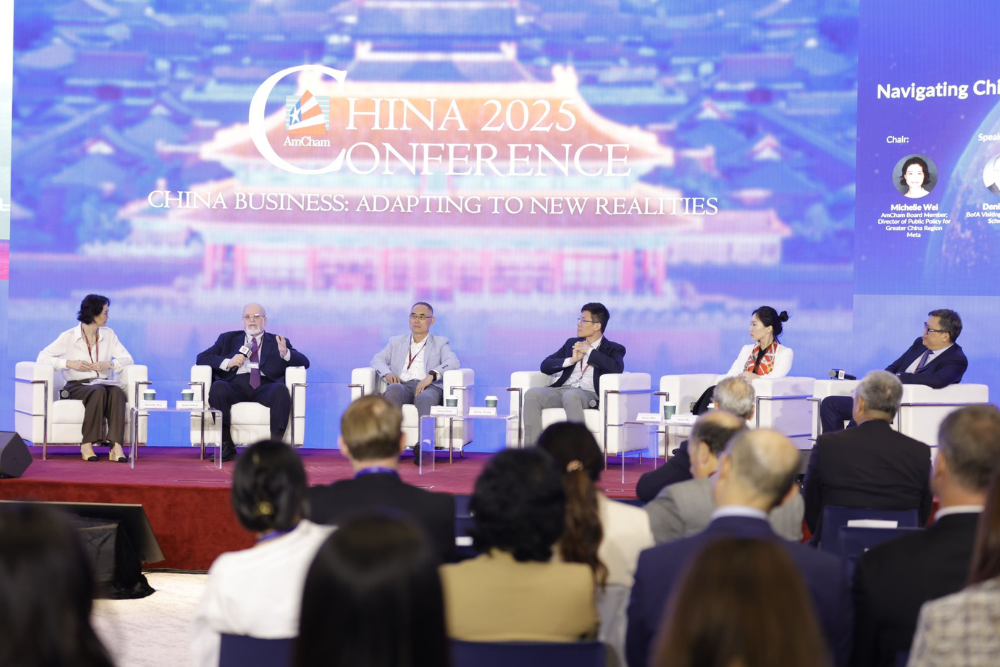
“Those of us conducting business in and with China are continuously adjusting our strategies and resetting our plans”
David Butts, chairman, AmCham Hong Kong
AmCham Hong Kong’s annual China conference is never routine, but this year it came shortly after one of the most disruptive chapters in US trade policy since the Smoot-Hawley Tariff Act of 1930. This began on April 2, “Liberation Day”, when President Trump declared “reciprocal tariffs” on some 90 countries and territories on top of new 10% tariffs across the board. By May 12, many of these tariffs were cancelled or suspended for 90 days, dropping tariffs on US imports from China from an aggregate 145% ad valorem to an aggregate 30%, with the de minimis tariff decreased from 120% to 54%. In response, China dropped its import tariffs from 125% to 10%. Reflecting the policy rollercoaster, AmCham’s conference was titled “China Business: Adapting to New Realities”.

The conference included some 18 speakers and an audience of 250 at the HKEX Connect Hall on the afternoon of April 24. Welcoming remarks were made by AmCham Chairman David Butts, US Consul General for Hong Kong & Macau Gregory May, and Cui Jianchun, Commissioner at China’s Ministry of Foreign Affairs in Hong Kong. Under Secretary Dr. Bernard Chan represented the Hong Kong government as acting secretary for commerce and economic development, and the Honorable Mrs. Regina Ip Lau Suk-yee, convenor of the Executive Council, attended the conference.
The Conference was made possible by Citi as prime presenting sponsor, AWS, Goldman Sachs and Meta as gold sponsors, Dorsey & Whitney as silver sponsor, Cathay Pacific and United Airlines as airline partners, Conrad Hong Kong as official hotel.
Keynote speech by Dr. Kurt Campbell – “It is absolutely essential to establish lines of communication right now”

Dr. Campbell, who has advised two presidents on the Indo-Pacific, and was the architect of President Obama’s “pivot to Asia” argued that the biggest risk in US-China relations is “inadvertence and miscalculation” and took the audience deep inside what he described as an almost total breakdown in lines of communication under the Trump administration.
A transcript of his remarks is in our cover story in this issue of AmChamHK e-Magazine, please click here to read.
Session 1: US-China outlook in the second Trump Administration
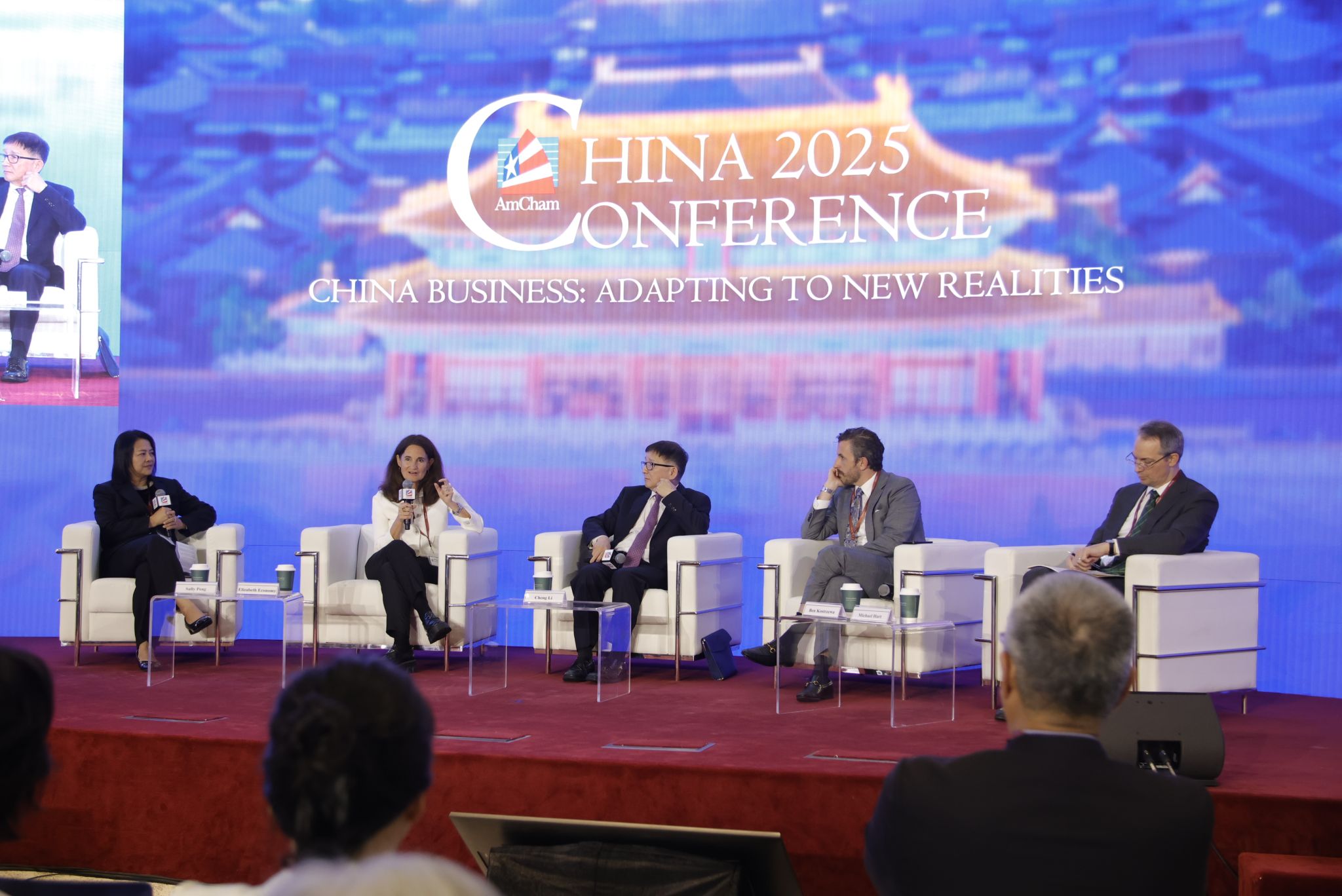
Not surprisingly, the audience was hungry for detail and perspective on whether, when and how the Trump Administration would strike a deal on tariffs [ed. The agreement that was reached in Geneva between May 10-12 has a timeline of 90 days and may not be final and continues to represent a tariff escalation above the status quo ante of the Biden Administration].
Moderated by AmCham Vice-Chairman Sally Peng, head of exports, sanctions and trade practice in Asia-Pacific with FTI Consulting, the first panel began with an overview by Ben Kostrzewa, partner at Hogan Lovells and a former assistant general counsel with the US Trade Representative office, who said that the global trading system was over, with no new set of rules in place in the transactional environment of the second Trump Administration. He described the US Administration’s policies on trade as part of a structural issue, where the voters are frustrated with the skewing of benefits over 40 years of globalization to producers, hurting consumers, who are often the same person.
Elizabeth Economy, Hargrove senior fellow at the Hoover Institution, and former policy advisor to Gina Raimondo, secretary of Commerce under the Biden Administration, focused on the continuities between the past three US Administrations, from Trump to Biden back to Trump. All three Administrations have looked at China as the chief strategic challenge to the US, and if the second Trump administration has been dismissive of allies in Europe, Canada and Mexico, it has eagerly courted countries in Indo-Pacific, with both Secretary of State Marco Rubio and Defense Secretary Peter Hegseth visiting the region. She looks at this as aligned with the Biden Administration’s focus on working with allies to isolate and contain China. The Biden Administration, she said, had framed its China policy as “invest [in the US], align and compete” together with a fourth pillar of cooperation, but accomplished little in terms of the latter. The Trump Administration shows no interest in cooperation, at least so far.
Both Cheng Li, founding director of the Center for Contemporary China and the World, and Michael Hart, president of AmCham China, agreed with Ms Economy. Cheng Li is former director of the John L. Thornton Center at Brookings.
Li argued that America feels a multi-layered challenge from China, unlike the Cold War’s Soviet threat. He also said that behind this perception lay historic shifts where China’s middle class had become the world’s largest, while the US middle class was shrinking.
Michael Hart is president of AmCham China, which represents 800 US companies. He agreed with Kostrzewa that the relationship had evolved over 40 years to one in which the dominant perception is that US consumers benefitted while producers lost. He added that the China market is still not fully open, and probably never will be.
Session 2: Navigating China’s technology sector amidst new restrictions
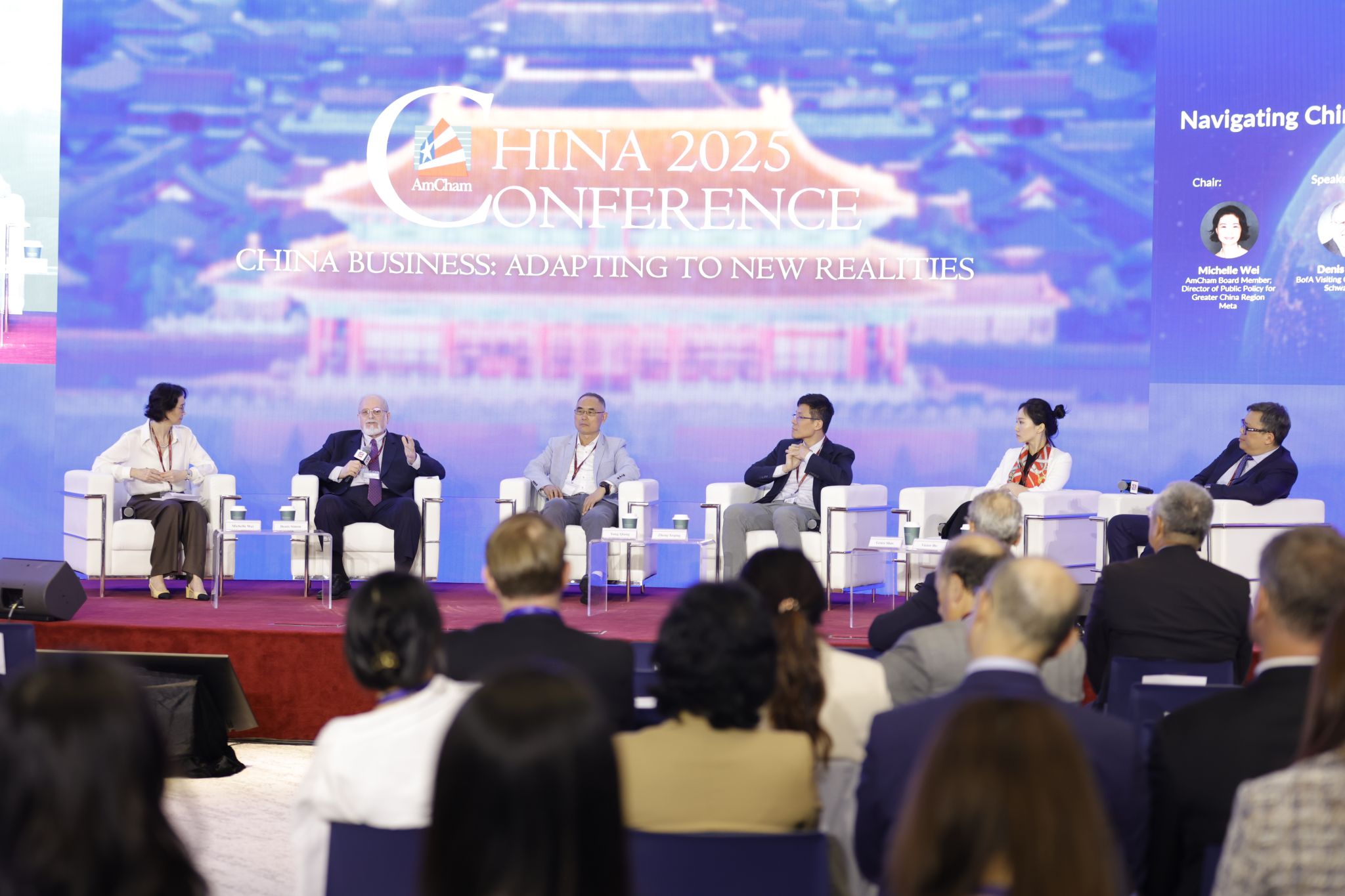
In contrast to the anxieties over tariffs and US-China policy, there was a consensus among those who joined the conversation on technology – China, they agreed, has become much more confident and self-reliant in terms of its capacity to innovate and to be a technological leader.
Michelle Wei, an AmCham board member and Meta’s director of public policy for the Greater China region, steered the session to focus on the impact of broad US technology controls and restrictions on China, which are set to expand under the Trump Administration. But virtually none of the five speakers felt that China would be unable to surmount the threat, and that ultimately the US would lose from a zero-sum approach to outbound export and import controls on technology that have not been seen since the height of the Cold War.
Victor Ho, the co-global head of technology and a partner at global law firm A&O Shearman, was optimistic that technology would enable China to leapfrog boundaries, even as the US broadens restrictions based on an end-user concept, such that if a US semiconductor company sells chips to a data center, it must require that Chinese users to not have access to train their models using its chips.
Yeqing Zheng, general counsel to electric vehicle (EV) maker XPeng Motors, quoted Charles Darwin on the adaptability of Chinese business: “It is not the strongest of the species that survive, nor the most intelligent, but the one most responsive to change,” he said. Because of restrictions on imports of Chinese EVs introduced in the Biden Administration, XPeng is left with three alternatives – to look elsewhere than the US market, localize production and to export services and technology. Out of an annual global sales production volume of 80 million vehicles, China accounts for 30 million and the US for about 15 million, while Chinese production of EVs is about eight times that of the US.
Grace Shao, founder of AI Proem, is a journalist who regularly interviews the heads of technology start-ups in China’s emerging technology hub in Hangzhou. Hangzhou’s ‘Six Little Dragons’ include DeepSeek, which stunned the world earlier this year with its open-source, cost-efficient AI models, robotics firm Unitree, game studio Game Science, the company that produced Black Myth: Wukong; brain-machine interface innovator BrainCo, 3D interior design software developer Manycore and by now the granddaddy of them all, Alibaba Group.
Many of the founders of the Six Dragons were graduates of Hangzhou’s Zhejiang University, Shao noted, not holders of foreign degrees, including DeepSeek’s Liang Wenfang, Manycore’s Huang Xiaohuang and Chen Hang, and Deep Robotics’ Li Chao and Zhu Qiuguo. There is no longer a sense that bright young Chinese need to go to the US to learn frontier technologies, she said, and unicorn founders like Liang are proud to be in “China’s team.” She described the current generation as confident and excited.
However, Yang Qiang, chief artificial intelligence (AI) advisor to WeBank, cautioned against hubris in the AI race. It will experience a natural slowdown as the growth of large language models (LLMs) begins to slow down due to a lack of data. Humans create data much slower than LLMs can consume.
And Denis Simon, visiting professor at the Schwarzman College at Tsinghua University, echoed this sentiment, and warned that arms races are never won, they just set up the next stage of another arms race.
Session 3: Business opportunities and challenges
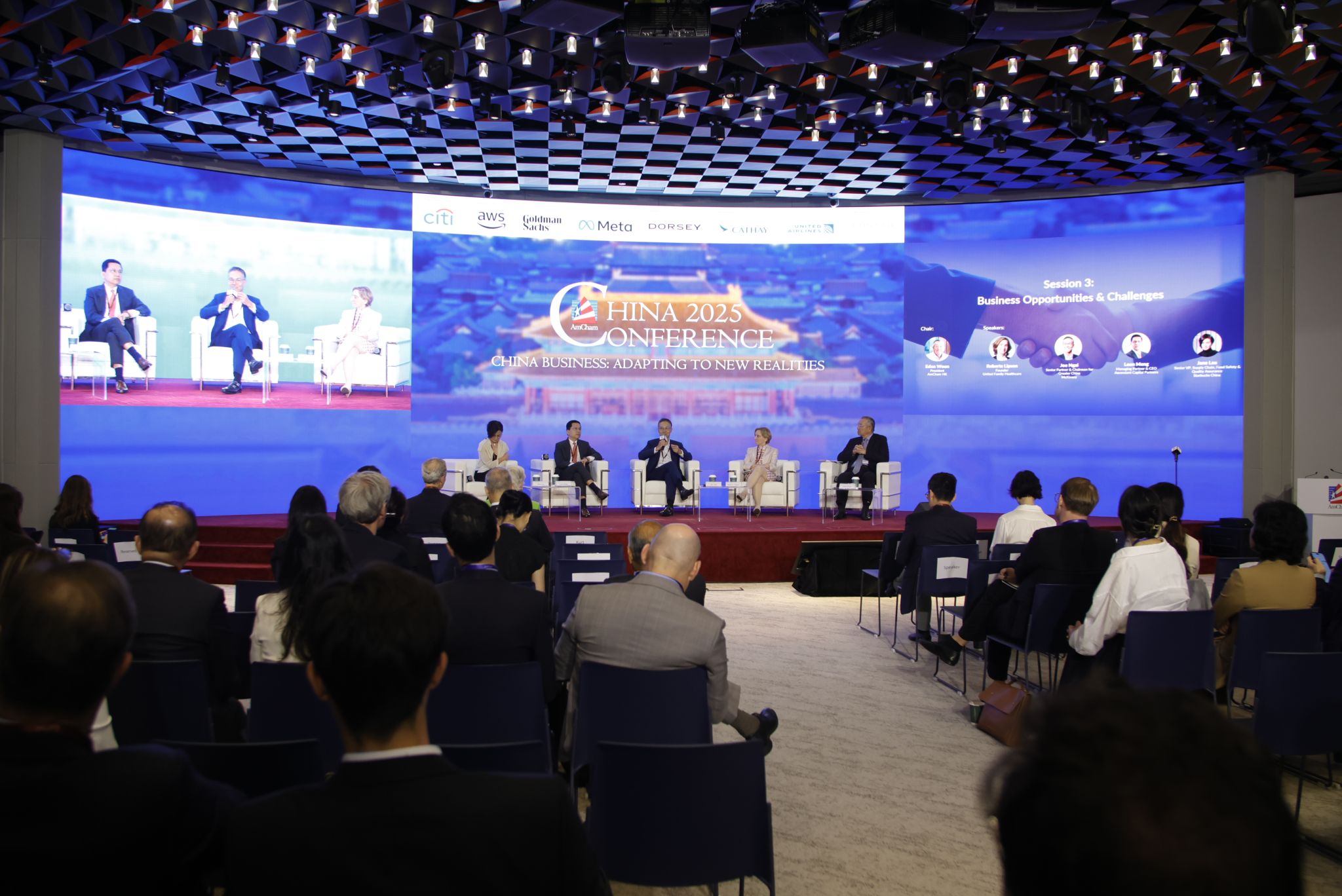
Eden Woon, president of AmCham, served as moderator to the last of the day’s panel sessions.
Joe Ngai, senior partner and chairman of McKinsey & Company Greater China, presented the pragmatic view that pivoting in this environment is crucial. Business needs to look beyond the “big numbers” in the China market, and focus instead on segments that are booming, for instance in the domestic tourism sector and self-driving vehicles.
One of those areas is healthcare, a $1.8 trillion market. Roberta Lipson, founder of United Family Healthcare, and a resident of Beijing for over 40 years, was among the first American businesspersons in China in 1979 and founded a chain of private hospitals.
From initially working as a supplier of healthcare technology, Lipson shifted to hospital management, opening her first hospital in 1997. Today she has a network of 11 general hospitals in major cities in China, some 20 clinics, 25 rehabilitation centers and an insurance platform. In terms of attitudes to foreign investment, she said that in the past year and a half, government has given them “nothing but a bear hug” in terms of welcome and support.
As an example, Lipson described a major project under development for an integrated teaching, research and clinical campus in Beijing. She was having trouble finding land, until the government helped them find land in the city center. Healthcare used to on the negative list for foreign investment, with a requirement for at least 30% local equity. After 25 years of lobbying for its removal, last December the requirement was dropped.
Jane Lau, senior vice president, supply chain, food safety and quality assurance for Starbucks China, shared Starbucks’ success story. Since January 1999, when Starbucks opened its first retail outlet in China, it has opened over 6,500 stores in more than 250 cities and 60,000 partners, as it calls its staff. China is the second largest market for Starbucks, after North America, and Shanghai was the first city in the world with more than 1,000 Starbucks in 2022, and it is the only country where it has a farm to store vertically integrated supply chain, including its new Coffee Innovation Park in Kunshan, in Jiangsu province, which opened in 2023. At 1.5 billion yuan, around $220 million, this was the biggest investment the company has ever made internationally, Lau added.
The day’s final speaker was Leon Meng, managing partner and CEO of Ascendant Capital Partners. He began his China career in 2002 when he was asked by J.P. Morgan & Chase to set up its China practice from Hong Kong. In 2007, he became founding director and CEO, Greater China, of the D.E. Shaw Group, and in 2011 split off from Shaw to become chairman of Ascendant Capital Partners, a private equity company focusing on China.
Meng agreed with Ngai that private equity and other investors needed to dig to find gems. Some of Meng’s examples included Asia’s largest ski resort and a Walmart competitor, both examples of drivers of domestic demand.
As a buyout firm, Ascendent Capital Partners also invests in non-Chinese companies with manufacturing both inside and outside China. They work with the management teams and serve local markets. In the private equity industry, Meng sees hints of a broader revival, with companies seeking to improve internally over a three-to-five-year time horizon. While it is difficult to ignore geopolitics, his approach is to hunker down and focus on good businesses that will have a life over the long term, bringing returns to investors.