
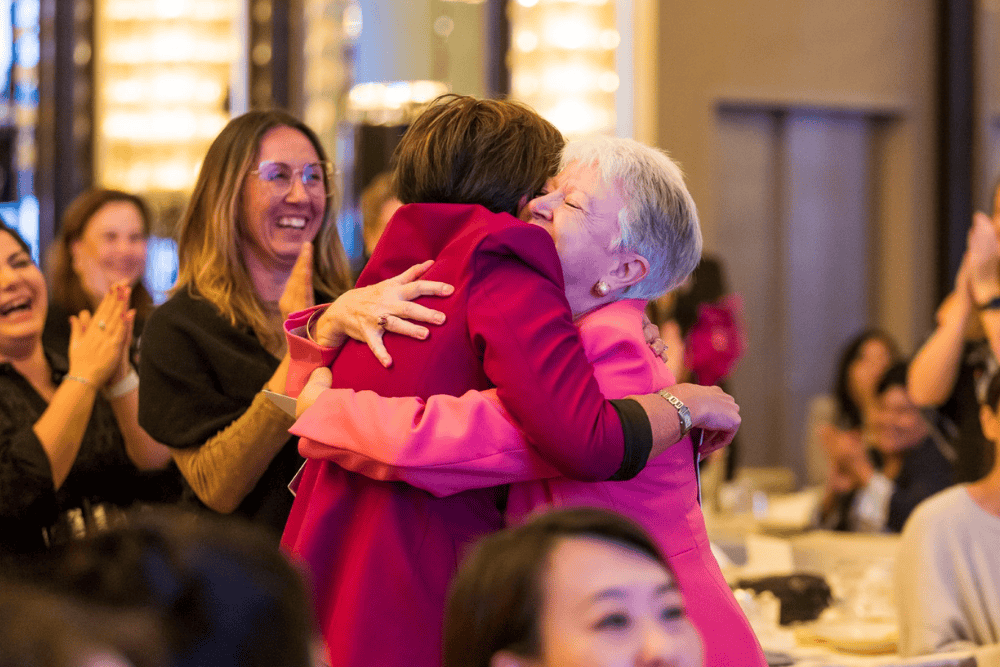
With the approach of the 2025 Women of Influence (WOI) Summit from March 3-7 and Awards Gala on March 14, we take a look back at a past winner of the Champion for Advancement of Women award, Felicity McRobb. Her career has spanned Japan, London, Hong Kong, Saudia Arabia and the United States, but most of all – 19 years – Hong Kong.
When she arrived in Hong Kong in 1993, she faced a new and completely unknown city. Her company offered transformational consulting and executive coaching services that were unknown in Hong Kong at the time. Along the way, she learned not only how to excel in business, but how to empathize with other women in a world that has marginalized and actively suppressed women, particularly in developing countries.
How Felicity McRobb discovered her passion for championing the rights of women and girls is a long and winding story, laced with drama. One could say it began in Hong Kong, as she met the challenge of setting up a new business in a new city. But the story also began in Japan, 10 years earlier, as she discovered her vocation in a culture that resisted the advancement of women.
One could also say it began after she left Hong Kong the first time and became a trailing spouse in Saudi Arabia, where women’s rights barely existed. In each of these beginnings McRobb’s feisty, no-limits personality took her to a new stage of self-awareness, as she learned lessons in flexibility and risk-taking that she now passes on to younger and disadvantaged women. More about that below.

Off the deep end in Hong Kong
In 1993, McRobb was working in London for a management consultancy when she was asked to go to Hong Kong to set up a regional practice. She has good memories. “Hong Kong was so kind to me,” she says. It “was a tonic, because it is so entrepreneurial, small and relational. People were willing to give us a chance.”
But those chances came hard-won. Among her first clients was a real estate company. She was able to get an introduction to the chairman, who asked her what she did. “He got it. But then he asked, what have you done in Hong Kong?”
McRobb was brand-new to the city, and admitted that her company had no clients in Hong Kong, but had done great things in the US and Europe. “All right, love, sounds great,” the executive said. “Come back when you’ve done something here.” Three months later, she was back in his office, with nothing to show.
She said to him, “Here’s the deal. I haven’t worked with any companies here because they all say the same thing as you do – come back when you’ve done something in Hong Kong. If you like me as much as you say, give me a chance, or I’ll be gone before I am able to do anything.” He laughed, and said he would talk to the other directors. And that was McRobb’s first opportunity in Hong Kong, but far from the last.
What they did for that first client was to develop a strategic frame, looking at the future of the company and the industry from multiple perspectives. One introduction led to another. “You know how Hong Kong works,” she says. “We did good work for them. And they were very, very generous with introductions and saying good things about us. We developed a super roster of clients all around the region.”
And then, after five years, that portion of her career came to an end. McRobb married her “rock,” Dennis Bishop, they adopted their son, Jonathan, and moved to Saudi Arabia for a significant career opportunity for Dennis. In 1998, they left Hong Kong for the oil suburb of Al-Khobar, near Aramco’s headquarters in Dhahran, an ancient port on the Gulf of Arabia.
In the fortress of Saudi culture, women were literally invisible, hidden behind abayas that hide the whole body and entire face except for the eyes.
Invisible woman
The experience became a turning point, says McRobb, both in not having a voice, and the experience of having to cover in black from head to toe in temperatures over 40 degrees centigrade. “It was the first time as an adult that when I spoke to people at a social event at my husband’s company, it was as though I hadn’t said anything, or that I was not even there.”
In Composing a Life, published in 1989, cultural anthropologist Mary Catherine Bateson, the daughter of Margaret Mead, profiles five women who achieved success despite not following a straight-line trajectory in their careers, as men have traditionally been able to do.
Felicity McRobb might have been a sixth profile. Bateson argued that women in the late 20th century were trying to do things that had long been considered impossible – combining careers, marriage and children – without role models. This radical shift has become the norm, but it is easy to forget the strength and flexibility it demanded. McRobb, a Welsh woman who graduated from university in 1978, was part of a generation that faced the full force of change.
Saudi Arabia was a culture shock, but not her first. In 1983, McRobb took a job teaching English in Japan. Her father had been a union leader at British Petroleum, and she learned that steady pressure to achieve worker’s rights can make a difference.
She applied that lesson in Japan, where she and her fellow English teachers were unhappy with school management. They were about to go on strike, giving up their right to be in Japan, because their visas depended on sponsorship by the school, when the school called in a human resources specialist.
“And this wonderful woman came to work with us for a day, did not give us the answers to our problems, but had us think through questions that we had forgotten were important, like why did you come to Japan? What is important to you about being here? Why are you a teacher, and what went wrong? At the end of the day, we had not resolved anything. What was remarkable was that we had the room to come together and have the conversations to resolve our own difficulties that we hadn’t been able to do before,” says McRobb.
Dr. Namiko Kominami became McRobb’s mentor. She accepted McRobb as a Japanese-style apprentice, meaning serving as her shadow, but only after McRobb was persistent. Initially, the door was firmly closed. “We’re only hiring people who speak Japanese and English fluently” Kominami said.
“After about four calls, I said to her, I don’t need a job. I have a job thanks to you. How do I apprentice myself to you? I’ll carry a bag, I’ll prepare the manuals, I’ll sit in the back of the room. I’ll do whatever you want me to do to develop myself, and if at the end of three months I can’t say anything useful, we’ll forget it. But at the end of three months, If I can say something useful, you’ll agree to have a conversation with me. So, she said, OK, and I wound up learning from her for the next three years.”
The Hunger Project
The union leader turned executive coach turned trailing spouse had time on her hands in Saudi Arabia. She used it to reconnect with the Hunger Project, a New York-based non-governmental organization founded by John Denver, among others, and whose board included Nobel Prize winner Amartya Sen and Queen Noor of Jordan. McRobb first learned about the Hunger Project in 1984, when she was in Japan, and began working with Bangladesh Country Director, Dr. Badiul Alam Majumdar in the 1990s. A recently published book, A Revolution: From Grassroots to Global Change, describes the life of the influential economist, activist and election expert, who was tasked to oversee reforms of the country’s electoral reforms in 2024.


“The global framework of thinking in the 1970s was that it’s not possible to end hunger,” McRobb says. “The Hunger Project was born of a commitment that it is possible to end hunger, and it’s possible when you come to a consideration of who those hungry people really are, that they are resourceful, creative, committed, intelligent and hard-working people who lack opportunity. What’s missing is partnership.”
Dr. Majumdar was looking for people who had a background in transformation, to help him build a movement of volunteer activists, and McRobb’s professional expertise fit the bill. “He was looking for women who could demonstrate a relationship between men and women in the front of the room that he wanted to ignite throughout the country, one of co-equal partnership between men and women. My name got thrown into the hat, and I always say, God made the phone ring.”
This was when McRobb’s initial awakening turned her into an advocate for women and girls. Bangladesh, pocketed between India, the northeastern Indian state of Assam and Myanmar, is a deeply Islamic country that emerged from Pakistan in 1971 after a bloody revolution. “We were 100 people in the room, in Dhaka, and they are doctors, dentists, local government officials, farmers. They are all walks of life, and they are all people who demonstrated some kind of commitment or capacity for mobilization. And there’s a lot of energy in the room.”
“There are 98 men and two women. Why only two women? Because it was incredibly difficult to have the women participate in that society. Their mother-in-law wouldn’t allow them to come. Their husband wouldn’t allow them to come. Their children wouldn’t allow them to come. They were supposed to be at home and invisible.”
“When one of these women stood up to speak, the 98 men acted like it was a break, or as if nobody was speaking. They all started to talk among themselves, and got up to make a cup of tea. They literally turned away and started chatting in groups. I had never witnessed something so obvious right before my eyes, a microcosm of our world where women count for nothing.”
“That was the moment where I profoundly got the imbalance between the status of men and women, with all its pernicious impacts. You know how they say, in a moment, your whole life flashes in front of you. In that moment, literally, my world changed. I witnessed something I could never unsee,” McRobb says.
Between Saudi Arabia and Bangladesh, McRobb learned “experientially” a new level of empathy with women living in conditions where they are overtly suppressed. Her work with the Hunger Project continues; but she has found new ways to champion women and girls, including Empower, a nine-month scholarship program by the Amber Foundation to help female, ethnically diverse university students in Hong Kong develop professional skills, networks, paid internships and career opportunities.
Now in its seventh year, Empower takes about 30 students per year for seven learning modules, each sponsored by a company. The companies offer workshop space, and each session lasts from 6 to 9 pm with five to 10 professional women who act as group monitors. McRobb is an Exco member of the organization, founded by Elizabeth Thomson, chairwoman of the Amber Foundation and a WOI finalist in 2025. “The commitment is to make these smart young women visible and attractive to employers.” McRobb says. “They are largely invisible.”
After Saudi
After the September 11, 2001, al-Qaeda terrorist attack on the World Trade Towers in New York, Saudi Arabia was no longer safe. In 2003, al-Qaeda struck western residential compounds in Riyadh, where McRobb and Bishop had been living, killing 39 and wounding 160.
They left for Portland, Oregon, to live near Bishop’s oldest daughter, and McRobb re-joined the consulting firm that had employed her in London and Hong Kong. McRobb built a practice primarily on the west coast of the US, until 2011, when the company asked her to relocate to Asia. She chose Hong Kong as her base to rebuild the Asia business. In 2018, she set up her own consultancy, McRobb Consulting, and continues her work as a consultant and executive coach serving high-tech, consumer goods, and luxury retail companies throughout the region.
“In 1993, when I came to Hong Kong, nobody had heard about executive coaching. Now everybody’s a coach, and nobody knows what it means any more. To me it means working with people who are already successful and committed to gaining an edge in their performance.”
“Effective coaching is when somebody has a new view of something they are dealing with. When this happens, new actions naturally become available and new actions produce new results. There’s an art in the science of helping people see something differently. No two situations or people are the same and it requires a willingness to do what works rather than being prescriptive.”
“When people start out in coaching I often hear that coaching is about asking the right questions and never about telling people what to do. My counter to that is if somebody asks you where’s the bathroom, what are you going to say? Let’s inquire into the architectural design of this building and where the architect might have placed the bathrooms? No, you’d say, go down the corridor and turn left. I’ve been very, very fortunate to have so many years of experience and learned from gifted people to learn my craft. While there are effective processes and methodologies it takes a willingness to engage every tool available to change behavior, mindset and world view.”
Women on boards
McRobb also lends her voice to the Mentoring Program and the 30% Club, organized by the Women’s Foundation. As a result of many people’s efforts, Hong Kong Exchanges and Clearing (HKEx) introduced a rule three years ago banning single-gender boards and requiring that by January 2025 all listed companies should have at least one woman as a director. At the time, the boards of about 800 firms or 40% of listed companies were all-male. At the beginning of this year, HKEx announced that all but 85 listed companies, or 3%, had complied.
“The needle has moved almost imperceptibly in the last fifteen years,” says McRobb. To quote Ursula Burns, the former CEO of Xerox, ‘Quotas are the punishment for having done nothing for 20 years.’ One lone woman’s voice on a board is a start, and I believe in the future of women’s leadership that our progress and impact will continue.”
McRobb is also on the board of the American Chamber of Commerce in Hong Kong, which she describes as a model for gender inclusion. “We have a real voice on the board,” she says.
“I think the bottom line for me is that I am very aware of having had a life of privilege given by the quality of experiences that have been made available to me through hard work, opportunities and all the luck I could get. It has been a privilege to partner with people all over the world including Bangladesh, India, Africa, Hong Kong, UK and the United States. It is my honor to contribute and make a difference for the generations to come.”

Felicity McRobb was awarded “Champion of Advancement for Women” at the American Chamber of Commerce Hong Kong’s 19th Women of Influence awards in 2023, together with Mary McHale. On the board of AmCham Hong Kong since January 2023, she is founder and senior consultant of McRobb Consulting. Prior to this she was a Partner at Insigniam, a management performance consultancy. She is a graduate of Anglia Ruskin University in Cambridge, England, with honors in French and Italian.