

Hong Kong Ballet Artistic Director Septime Webre has lit up the venerable institution, which turns 45 this year, with his ballet creations that dig deep into Hong Kong history, society and the extraordinary landscape. But he is also a businessman, looking to expand the audience for classical ballet beyond connoisseurs and the wealthy. He has been a pioneer in making ballet fun and accessible. Here he tells his story in conversation with AmCham HK e-Magazine editor Edith Terry.
“Hong Kong is the most creative and forward-looking of the major Asian ballet companies…and our goal? Nothing short of world domination.”
Q. What was your plan when you joined Hong Kong Ballet in July 2017?
A. I’m in my eighth season at Hong Kong Ballet, so it means I’ve lived here for seven years and in fact, I just got Permanent Residence status last week. I’m excited by that. I came with multiple goals, and one was generally to elevate the standards of Hong Kong Ballet and ensure we were at the highest of levels internationally, competing with the best of the best.
But I also wanted Hong Kong Ballet ‘s essence to be about Hong Kong, and that when the curtain goes up, audiences can see themselves on stage, and that the repertoire reflects the beautiful versions of the classics that will never not be part of what we do, but also reflects Hong Kong, the Hong Kong of today.
And since my arrival, we’ve approached that challenge in different kinds of ways. Are we succeeding? I’d say, I think so. All signs seem to point in that direction, but to really answer it fully, you must break it down, because there are so many layers to the relationship Hong Kong Ballet has with Hong Kong and the ways in which we’re part of the cultural and social fabric of the city.
On another level, we as an institution exist in the context of the global ballet community. We compare ourselves against our colleagues all around the world, and we also serve as a really important ambassador for Hong Kong. Hong Kong has had, a lot of misperceptions over the last five years and we’re some good news to come out of Hong Kong when we are touring, bringing a positive Hong Kong story all around the world.

Q. You have brought Hong Kong Ballet to a whole new level. How did you do it?
A. We look to three threads in our efforts to reclaim the Hong Kong in Hong Kong Ballet. One is about our brand. A lot of people don’t see themselves as ballet goers. We wanted everyone in Hong Kong to feel proud of the home team. We wanted Hong Kong Ballet to not feel like a generic ballet company that was the same as every other ballet company in other big cities. We wanted to be informed by the special qualities of Hong Kong.
Upon my arrival, we started to develop a series of brand campaigns that developed images of our dancers in the city in fun and unexpected ways. Some of them were witty, having fun with stereotypes of old Hong Kong. Some of them were quirky images of Hong Kong being invaded by space aliens and everything in between. And those brand campaigns were great for ticket sales, but they also were great for the Hong Kong Tourism Board to sell Hong Kong for tourism and social media around the world, to the followers of ballet images. Hong Kong Ballet quickly got a reputation for being able to capture the essence of Hong Kong through its branding.
A second effort was about accessibility. I wanted to ensure that the company was accessible to people who maybe couldn’t afford $600 for tickets for opening night. We developed a series of large-scale, free outdoor pop-up performances all around the city. Some of them were small, but most of them were quite large. The first one was in 2018 at Tai Kwun, the former Central Police Station that has become a major cultural site. About 30,000 people saw us over a weekend, in Hong Kong Ballet @ Tai Kwun. We did a big one at FreeSpace in the West Kowloon Art Park in 2021, in our first turn(it)out festival. We did a couple in the New Territories, collaborating with fashion designers in Hong Kong Cool: Ballet x Fashion.
When I first moved to Hong Kong, I could see very quickly one of the underserved populations was the Filipino domestic workers who hold the city together. In 2019, we scheduled a performance for a Sunday on Chater Road, where thousands of domestic workers gather on their day off. It was narrated in Tagalog, and masses of Filipino domestic workers saw Hong Kong ballet that day.
These were efforts to ensure that the everyday Hong Kong people could see ballet, but also in a kind of sneaky way, we wanted to make ballet goers of ordinary Hong Kong people. If someone were to pass by us and stop and say and watch us for say, 10 minutes, henceforth, they could consider themselves a ballet goer.
Q. Can you share how you developed the Hong Kong theme in terms of repertoire?
A. One of the most important efforts was developing a repertoire that reflects the stories of Hong Kong. I developed a trilogy of three full-length ballets set in various periods in Hong Kong.
The first was Romeo + Juliet, set in Hong Kong in the early 1960s to some degree, visually inspired by Wong Kar-wai’s 2000 film In the Mood for Love. The backstory is that Juliet’s father is a wealthy Shanghainese tycoon who’s emigrated to Hong Kong and wants to marry his daughter off to a wealthy Gweilo for social advancement. Juliet’s mother is a glamorous but cold tai tai who is entangled in a love affair with one of her husband’s business associates, an up from the gutter triad leader from Kowloon City. Mahjong games and martial arts street battles abound.
It’s a retelling of the Romeo and Juliet story, which is, of course, iconic, but also filled with hundreds of details of our collective nostalgic memories of Hong Kong during that era.

The second ballet in the trilogy was a full-length production of The Nutcracker, set in Hong Kong in 1915. The Nutcracker is a special ballet because the first 20 minutes or so is set in the real world. And after 20 minutes, little Clara, the heroine, goes to sleep and she dreams. In the rest of the ballet, she dreams.
I set the first party scene in the mansion that is now the Dr. Sun Yat-sen Museum on Castle Road in Mid-Levels. I live in Mid-Levels myself, and I pass it every day. It’s a stunning mansion built in 1914 and is important because it was the first mansion that a Eurasian was allowed to build. Mid-Levels was segregated at that time, and Chinese people were not allowed to build houses there. So there was a kind of integration story behind it, and it was built by Sir Robert Ho Tung’s younger brother, Ho Kom-tong. So the party scene was filled with historical elements and real people, like Dr. Sun, Yat-sen and his second wife, Soong Ching-ling, one of the very glamorous Soong sisters, who are party guests.
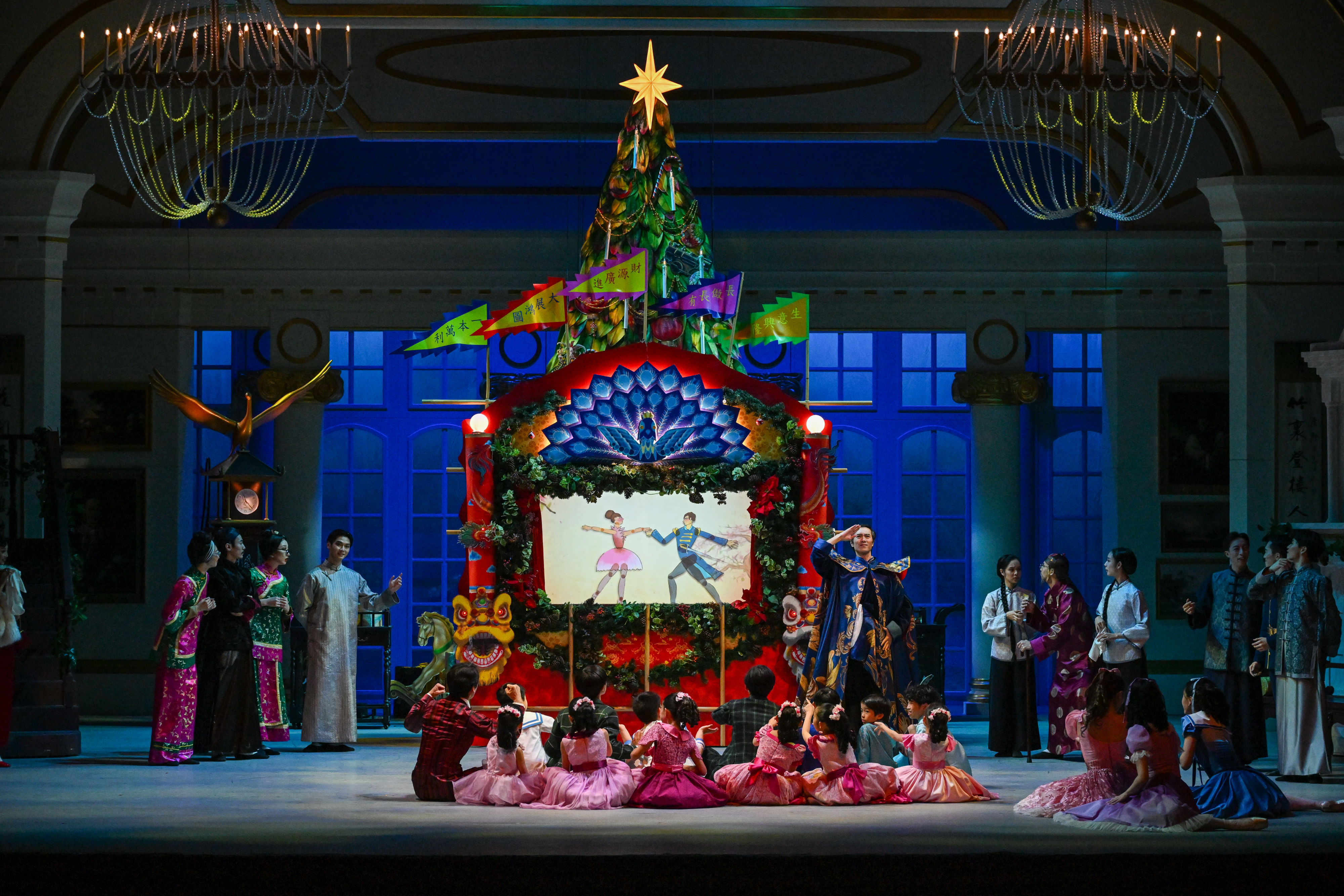
Then Clara dreams through time, and the Rat King is based on the famous Hong Kong pirate Cheung Po Tsai, who arrives in a big pirate ship that looks like one of the Aqua Luna tourist junk that is so popular in Victoria Harbor. Act Two is set among Hong Kong bauhinia blossoms in full bloom. Hundreds of details of Hong Kong are woven through the production. I was a history major as an undergraduate, so I read a lot about history, and had a lot of fun researching The Nutcracker for five years.

The third in the trilogy was a ballet I did last year called Sam and Her Amazing Book of Dinosaurs. It was set in contemporary Hong Kong and 65 million years ago. A young girl in a local neighborhood of Hong Kong receives a special book about dinosaurs that becomes a kind of portal to the past. It’s both work for young audiences about dinosaurs, but also about Hong Kong culture in and the experience of a Hong Kong kid going to school today in a public school in Hong Kong.

I’m working on a fourth work that will be announced in a few months. I won’t give away any secrets, but it’ll be exciting, and I think hopefully we’ll capture the imagination of Hong Kong people. We’re also experimenting with Chinese themes, and in October, we premiered a new full-length ballet based The Butterfly Lovers, based on the great Chinese legend with a beautiful score, new regional score, and costume and set designs by Tim Yip, who won the Academy Award for Crouching Tiger, Hidden Dragon.

Q. Your partnership with Hong Kong Disneyland was something very new. What were you trying to say with it?
A. People think that ballet is really about princes and swans and girls in Bavaria that wear dirndl and die of broken hearts. Ballet is so much more than that. Ballet is a language that that can, like English or Chinese, express a lot of different things in different kinds of ways. I always wanted to open new avenues.
When the opportunity to partner with Hong Kong Disneyland, I thought that was a place where, hundreds of thousands of people could see Hong Kong Ballet in a few weeks and be exposed to classical ballet. So I created a charming work for young audiences based on the lovable rabbit character, StellaLou with her friends, Duffy, LinaBell and Gelatoni, in StellaLou’s Wonderful Wishes Ballet. Stella Lou is a sweet bunny rabbit who wants to be a ballerina on Broadway. We developed a storyline based on rags to riches, to achieve StellaLou’s dream. Technically, it’s quite challenging. There are pirouettes and fouettés and other technical challenges for the dancers, so audiences that would come just to enjoy Disneyland and see their favorite character, StellaLou, were exposed to proper classical ballet. I feel that in a way, it was really important outreach for the art form.
Q. You have also pushed the boundaries of classical ballet with productions like La Bayadère. Can you share some of your successes with the classical idiom?
A. Not everything we do has a Hong Kong backstory. We’re also a ballet company that is committed to beautiful interpretations of the classics. Next year, we will premiere a brand-new production of Giselle, which will be the third in a trilogy of new interpretations of the classics. These don’t seek to reinvent the classics, just provide a fresh new version.
In June of 2023 we produced a new version of La Bayadère, with beautiful sets and costumes, gorgeous design, and beautifully danced with some major international stars dancing alongside Hong Kong Ballet. We premiered a brand-new production of Swan Lake, similarly, with international-class sets and costumes with beautiful music played by the Hong Kong Philharmonic Orchestra and international stars joining our principal dancers on stage. All these premiered at the end of May in 2023 and 2024 and at the end of May 2025 I will stage a new production of Giselle with brand-new sets and costumes by Jerome Kaplan. Some of the greatest names in ballet today will dance with us as guest artists – Marianela Nuñez and Matthew Ball, both principal dancers with the Royal Ballet, London, Victor Caixeta, former principal dancer with the Dutch National Ballet and the Mariinsky Ballet, and Hugo Marchand from the Paris Opera Ballet. It will be a stunning production.
Classical works are our lingua franca. They are an important part of what we do, and we’re committed to the evolving language of ballet. So, for example, this past March, we premiered a program called The Rule Breakers, which followed the history of the avant-garde in classical ballet. It started with the George Balanchine, the great modernist of the 20th century. Then William Forsythe, the firebrand dancer and choreographer, a postmodern classicist using the ballet language in new ways. One of the bad boys of ballet, Andonis Foniadakis, premiered his ballet inspired by the 1980s pop pioneers Depeche Mode.
Q. You have also developed ballets with strong women, like Coco Chanel, that seem antithetical to the classical delicate ballerina. What is your thinking?
A. In addition to wanting to develop a new repertoire that reflects Hong Kong culture, we also have sought to develop new works that present women in a contemporary way. The heroines in classical ballet are generally presented as vulnerable women whose lives are lived in relation to men. Ballets like The Sleeping Beauty, Giselle and Swan Lake are achingly beautiful, but their heroines are two-dimensional characters, whose lives are lived largely in relation to men.
Many of our new works have sought to present women in more complex and flawed and complex ways. That means women who are strong, independent and perhaps flawed. An example is last year’s Coco Chanel: The Life of a Fashion Icon production. It presented Coco as a genuine, independent, successful but flawed woman. Next year’s production of Frida Kahlo is very much in that vein. It seeks to speak to an important, iconic part of our culture of the last 100 years. The work of the surrealist paintings is influential and and important, but her life speaks to the more complex and complete depiction of what women can be, something that is somewhat absent from the 19th century canon.
Q. Tell us about HK Ballet’s 45th anniversary and what you were trying to convey with Tutu Academy?
A. Tutu Academy is a short marketing film for our 45th anniversary this year. We work on and off with the design studio Design Army and my dear friend, its co-founder and chief creative officer, Pum Lefebure, in Washington, DC. Her quirky visual sensibility, and the strong colors are iconic. Her art direction is finely refined and honed and quite strict. I bring a quirky sense of humor to the table, and my tongue is often firmly planted in my cheek. And the 45th anniversary is one of those anniversaries you want to celebrate, but it’s kind of an off-year celebration. I didn’t want us to take ourselves too seriously. I felt like, post-pandemic, at 45, we could take some risks and express joy in an unexpected way.
In the end, I wanted to make a video that would describe the unifying qualities of dance. I had this space alien, a green Martian, arrive in Hong Kong, unable to communicate until he learns how to dance ballet, and then he can celebrate. Then he brings it to his own planet. It’s just quirky and fun and fresh and about joy.
And we wanted Hong Kong to look really beautiful. So there are three very iconic places, the beautiful, original building of Hong Kong University in Pokfulam, Tai Kwun, and the High Island Reservoir, that’s so iconic that people know it from photos but rarely trek out there.
Q. What are you doing to train the dancers of the future
A. Hong Kong Ballet has never had its own ballet school. In 1979, it grew out of visionary women who had commercial ballet schools and came together to form a professional ballet company. The original name of the institution was the Hong Kong Academy of Ballet but in fact, it has always been a company and not a school. There are many high-quality private ballet schools in Hong Kong, but no professional schools of the sort that you find in Beijing, in London, in Paris, or in St Petersburg. The most serious ballet students in Hong Kong, who want to become professional ballet dancers leave Hong Kong to study in North America or Europe or in Australia by the time they are 13 or 14 years old, because by the time you’re a teenager, you are training five or six days a week, multiple hours a day.
It’s been hard to hire Hong Kong dancers who are ready for professional life. During the pandemic, we very quietly renovated some small studios just so our dancers could have a place to train while they were social distancing. And while our theater was closed, and as the pandemic ended, we had these two small studios. We started to develop classes largely for young children, and it’s grown very quickly. We recently renamed the training program the Hong Kong Academy of Ballet, and opened a new facility in Wang Chuk Hang. We have approaching 350 students now, and it’s a professionally oriented school with professionally oriented training.
Our emphasis has been to train kids from the bottom up. So about 70% of our kids are eight years old and younger. And you know, it’ll take 10 years for those eight-year olds to become 18, and for us to have a fully functioning, professionally oriented school, oriented for the long haul. We think a lot of those 350 kids came to us via our StellaLou experience at Disneyland, and also works like The Nutcracker. We do the Nutcracker every year, and about 30,000 people come to see that show alone. And that’s a really important point of entry for young people into the world of ballet.
Q. Can you share what you are doing with the ballet community in Mainland China?
A. The Hong Kong Academy of Ballet is part of the Greater Bay Area Ballet Incubation Center and Initiative. There’s always been a strong connection to Mainland China, but over the last four years, we’ve made it stronger.
Most of our best dancers have been trained in the mainland. The ballet schools in Beijing and Shanghai are the best schools in Asia. We are an international company with dancers from all around the world. But to some degree, we’re a company with a Chinese Hong Kong and Chinese soul. The influence of mainland dancers has been very strong through the years. Our Choreographer-in-Residence is Hu Song Wei Ricky, who choreographed The Butterfly Lovers. Three or four years ago, we had a ballet mistress who was Chinese and was retiring, so we engaged her as our representative in China to ensure that we maintain really good relationships with all of the companies in China, and all of the ballet companies with which maintain an active touring schedule in China.
We are considered the most international of the Chinese companies, and hopefully the most forward looking. We won’t necessarily be the biggest, because the budget size of the companies in Shanghai and Beijing are quite large, but we can be creative. We have an international profile. We’re committed to presenting in China, and we’re touring to Beijing this November, with my ALICE (in wonderland). We will be at the Beijing Egg, the China National Center for the Performing Arts designed by French architect Paul Andreu. And we are working on a tour to Shanghai for 2025
We have all sorts of dialogues for ongoing touring to the Greater Bay area. And we have this Greater Bay Area training initiative that seeks to provide access to professional dance experience to the most serious ballet students in the Greater Bay area. It’s a way we can support Hong Kong kids and kids in Shenzhen and Guangzhou and Zhuhai, and Macau, to come together, to feel the commonality of the of their pursuits, to be inspired by access to professional companies and get to know what it’s like to be professional dancer.
They come to see performances, take workshops from ballet masters and generally see themselves as professional dancers. We take students from, for example, Beijing Dance Academy. This is a vocational school where the kids move into the school at age nine. Their academics are in the school and they live in the dorm. This is a vocational school oriented towards delivering children to the profession.
In Hong Kong, we have larger schools that are largely avocational, so we’re trying to support those kids who might self-select to want a professional path, and try to help them, even though they may not be in a school where they’re in a dormitory and training six days a week. The Incubation Center seeks to support professional aspirations on the part of young ballet students, kids and youth, children and teens throughout the Greater Bay Area area, so they don’t have to be resident in Hong Kong.
The academy itself is at early stages. It has a school two locations in Happy Valley and Wong Chuk Hang. We have a few kids that commute from Shenzhen and Macau on the weekends, but it’s primarily for Hong Kong kids. The Incubation Center is an initiative with multiple partners that brings all of these kids that are training in Guangzhou and Shenzhen in Hong Kong or Macau together for special events, special master classes, to see performances, get to know each other, and to share and to learn. It augments their daily training.
Q. How has it been living and working these past seven years in Hong Kong, after 17 years in Washington?
A. As an American who’s directed at ballet companies in the United States and in Hong Kong, one big difference is that in the US we have no significant governmental support, and in Hong Kong, we have lots of governmental support financially. You know, the annual budget sizes of the Washington Ballet and Hong Kong ballet are comparable, but 50% of our annual budget comes from a single check from the government here in Hong Kong. Of its annual revenue of HK$106.5 million in 2023/2024, 58.4% was from government grants and other funding, 12% from fundraising, and 19.1% from ticket sales. Generally, in the US, it was just completely different.
The government is very supportive of Hong Kong Ballet and the arts in general. They put their money where their mouth is, which I think is great. I came to Hong Kong with a goal of making Hong Kong Ballet more about Hong Kong. I’m a contextualist in lots of ways. In Washington, DC, for example, where I was artistic director of the Washington Ballet, I developed a 10-year project called the American Experience that developed full length ballets based on great works of American literature. We did F. Scott Fitzgerald, Ernest Hemingway and Washington Irving. That was a really serious commitment to the community I was serving.
In Hong Kong, I brought a commitment to thinking globally and acting locally, to use a bumper sticker phrase. Before the pandemic, when I first got here, my goal was to develop what Hong Kong is all about. And I think that’s very much in keeping with the goals of Hong Kong right now. We want to tell great Hong Kong stories. We want the world to know what a great and special place Hong Kong is. That is a path I set out, seven years ago.

Septime Webre has been in Hong Kong since 2017, and is currently in discussions with Hong Kong Ballet to renew his contract for another three years after the current contract expires in 2025. The seventh son of a large Cuban-American family, he grew up in the Bahamas until the age of 12, when the family moved to South Texas and he began ballet classes. A graduate of the University of Texas at Austin, before coming to Hong Kong, he was artistic director of the Washington Ballet for 17 years. He married his partner, Richard Marc Cipullo, in 2017. They live in Hong Kong with their four-year-old.