

In Hong Kong, the line between commercial art and “pure” art is often very thin. Hong Kong’s biggest names in art and design, like Stanley “Another Mountain Man” Wong, got their start melding eastern and western visual techniques in advertising before making the leap into studio art. Often they are active in both, much like Andy Warhol before he became a super-star. Victor Wong operates in the emerging space of “ART-TECH-TAINMENT” and is unabashedly both commercial and creative. AmCham took a look inside the headquarters of his special effects company, vfxNova, in Hung Hom.

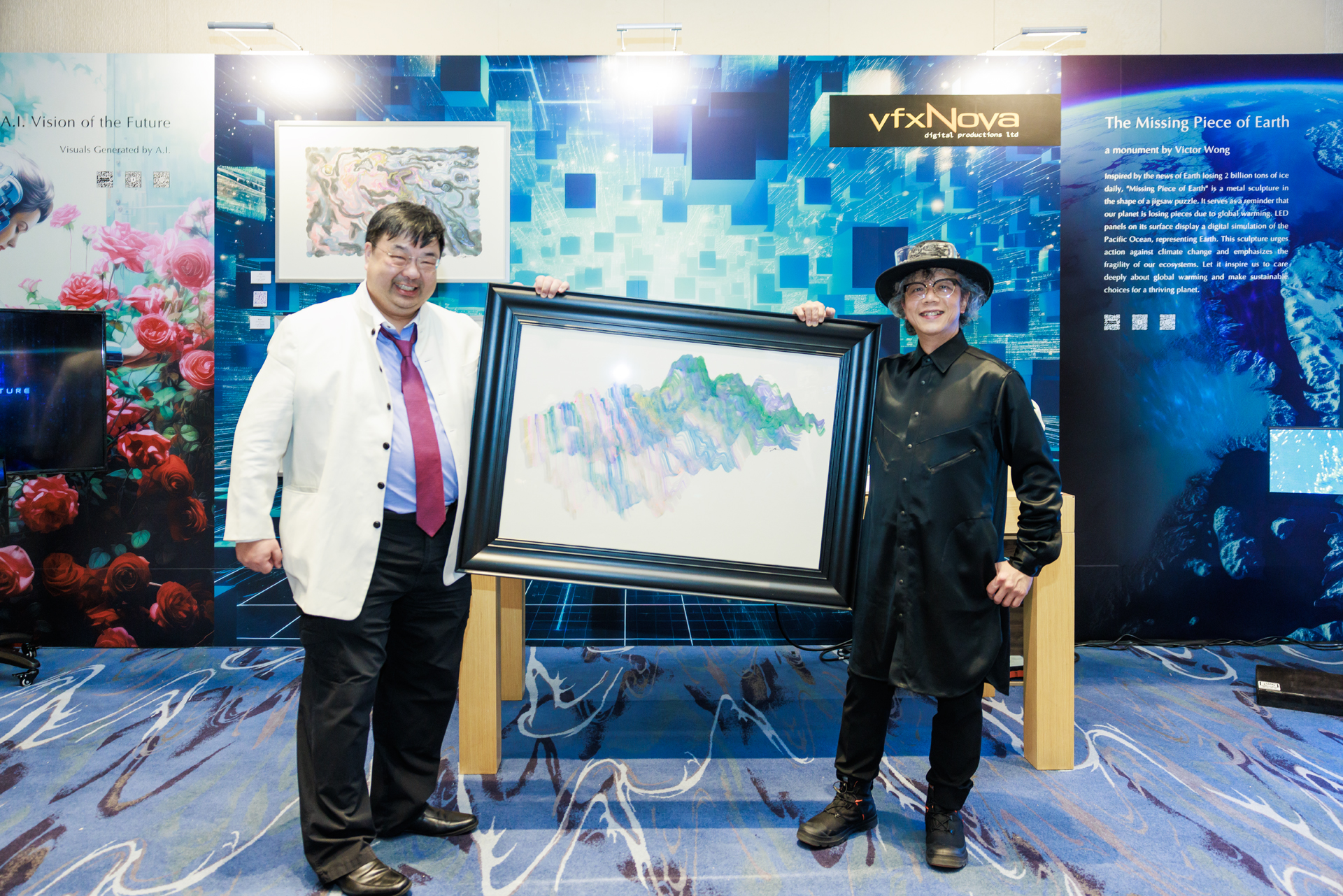
Anyone who joined AmCham’s glittering “The Future is Now” gala last October, with its glowing 3D installations and special effects, might have noticed Victor Wong aside his orange robot arm, A.I. Gemini. While A.I. Gemini painted misty scenes of mountains and water in the Chinese xieyi, or impressionist style, Wong bounced around introducing himself to guests and obviously enjoying the party.
Not everyone might have realized he was the producer of the gala event. He was having too much fun. The creator not only of A.I Gemini but of the sculptures, lighting and other immersive accessories at the AmCham ball, reminiscent of Salvador Dali’s melting figures of clocks, Wong is Hong Kong’s foremost master of special effects.
His creative output seems boundless, whether for events like this one, or for films, gaming animations or commercials, where he started his visual effects (VFX) production company, vfxNova in 1989. For the 25th anniversary of Hong Kong’s return to Chinese sovereignty in 2022, he created a sprawling purple and green turtle based on fractal mathematics and engineering software on the lawn in front of Hong Kong’s government office buildings in Tamar.
Called “Loving Home,” he says the turtle symbolized the people of Hong Kong, who will always come home, as turtles to lay their eggs. In 2014, using more conventional imagery, Wong directed a 60-minute commercial for the Hong Kong Jockey Club that brought the prancing horses of Chinese ink artist Xu Beihong into galloping, snorting, 3-D life. And he has used motion capture to showcase martial arts as well an animation installation to visualize dreams of the 17th century emperor Qianlong. He has also done special effects for over 100 Hollywood films, including Iron Man, Fantastic Four, The Nightmare Before Christmas 3D, and Rise of the Legend, and 800 television commercials. His production is done across the border, in Fosun, Guangdong, with 15 creatives and management in Hong Kong.
A visit to Wong’s atelier in Hung Hom is an adventure. There are bits and pieces of past productions scattered on shelves and tables – 3D lamps from the AmCham gala, a rubber duck and overhead lights from an event in Wanchai. A.I. Gemini is quietly painting in a corner. The weight and density of A.I.’s ink is programmed to change with the humidity. 3D printing machines are waiting for the next task. Currently Wong is compiling images from his past, which he has up on a screen.

Wong grew up in Yaumatei in Hong Kong, where his parents ran a shop making funeral objects made of bamboo and paper, from houses to motorcycles, to burn to accompany the deceased in the afterlife, according to Chinese tradition. At four years old, he had big round eyes and natural wavy hair. “I was kind of a naughty boy,” he says. But he helped his parents build imposing constructions for their clients including an elaborate phoenix that was part of a “banquet in heaven” for the Tin Hau festival, all painted by hand. A photo shows him standing beside it in his teens, the backdrop a bold pink and the green phoenix flying against a backdrop of bearded sages and elegant ladies.
Wong was born on June 6, 1966, at 6:00 pm and jokes that when he goes through Customs in the United States, the officers examine his passport “to see if it’s real.” He adds: “I always felt a little bit special and that I was different.” He describes his education in electrical engineering at the University of Washington in Seattle as not so much a vocation as an accident.
Friends convinced him to apply for college and one dropped the UW application on the ground, and he picked it up. Although he was interested in math and psychology, he followed the lead of a roommate with a 4.0 grade point and went into electrical engineering with a 3.96 grade average. In 2022, the UW College of Engineering recognized him with a Diamond Award for entrepreneurial excellence and significant contributions to engineering, but you would never know it from the self-effacing way he describes his career.
He went straight back to Hong Kong after graduating in 1989 with no intention of looking for a job. His curiosity took him to a computer fair where he was mesmerized by Silicon Graphics, Inc., a high-performance computer manufacturer that made 3D graphics workstations. He sat and played with the machines for five days until on the last day of the exhibition, the salesman noticed him and invited him to the Silicon Graphics office. The system including software cost HK$600,000 – way over Wong’s budget – but the salesman had a friend who wanted to develop a computer graphics ad for his new product, a pager in the shape of a pen.
A few steps later, including a HK$300,000 lease on the Silicon Graphics system, a guarantee from his father, and a contract, Wong had his first project. He spent six weeks developing the models, animation and programming, with one of his friends providing a guitar backup and an RTHK presenter doing the voiceover. With a follow-up from the same client, Wong hired illustrators to show him how to do story boards. In 1994, he put together a video and catalog for the SIGGRAPH Exhibition, the largest event in computer graphics, and was noticed by a Japanese advertising director who was looking for alternatives to the expensive, time-consuming producers he had hired from the US, who would take 6-8 weeks to do a commercial.
The million-dollar assignment was to create a figure that showed the water content of the human body to demonstrate the impact of water pollution. When Wong looked at the story board, he realized that the only way to realize the image would be through motion capture, then a relatively new technique. He looked up a company in a magazine that charged $1 million and offered $400,000. Once he found a performer in Hong Kong, he found ways to put water into the moving form of a human body. It became a critical turning point for Wong and vfxNova, leading to several hundred commercial assignments from Japan and its Grand Prize for international advertising.
Wong’s entrepreneurial instincts took over and he branched into video games including the Final Fantasy series and film. His break into special effects for film came in 1998 with a call from Jacky Chan, who wanted help on a film called Gorgeous with Taiwanese actress Shu Qi. While the initial assignment was straightforward, unexpectedly Chan broke part of a set with a leap, and Wong was asked to create a virtual set. He was found to have a knack for working with difficult directors. “I grew up in a shop,” says Wong. “I always talked to customers and learned how to explain complex concepts in simple language.”
For 10 years, Wong focused mainly on films. The China film industry grew rapidly through the 2000s – by 2023 China had an annual output of over 600 films and was the second largest film market with a box office of $2.7 billion. Film budgets also grew, along with a taste for epic and patriotic films where special effects were needed to capture visual effects of specific times and places. Then the entrepreneurial bug hit again, and Wong began using film special effects to create immersive worlds for customers like MGM Cotai, in its exhibition last July “To Infinity and Beyond,” based on the concept of “ART-TECH-TAINMENT” to illustrate the artistic universe of abstract artist Hsiao Chin. “Now people go to museums expecting visuals, something wow,” he says.
That turned out to be A.I. Gemini. In 2018, about the time Non-Fungible Tokens (NFTs) hit the art world, Wong started thinking about using Artificial Intelligence (AI) to generate art work, after reading that Christie’s had auctioned an AI-generated printout for $400,000. He used 10 equations to set up a “moon scape” of water and mountains, and taught a robot arm how to use traditional Chinese brush and ink. The robot arm took an average of 50 hours per painting, and at its launch in London the average price per piece was $13,000. Randomness is written into the algorithm, so Wong never knows how each new painting will turn out. He argues that they are collectible because each painting is different. On rainy days, A.I. uses more water on the brush; on sunny days less water. “We are affected by the weather. Why not AI?” he asks.
“I think to be creative means that you create something out of thin air that nobody has done before,” Wong says. “That is me.”
Edith Terry was writer and editor of Hong Kong: Creative Ecologies – The Shaping of a Design Culture (Hong Kong Design Center, 2010)