

Techtronic Industries (0669.HK) (TTI, Techtronic) is a Hang Seng Index benchmark company with a market cap of HK$174.5 billion (US$22.3 billion) and a healthy top and bottom line. Co-founded in Hong Kong in 1985 by German engineer Horst Julius Pudwill and Roy Chi Ping Chung, it began as a successful manufacturer of cordless power tools in Hong Kong and China creating products to order for big brands and retailers. In the late 1990s and for several years that followed, it began acquiring and managing its own brands, investing in some of the world’s leading power tool brands, including Ryobi DIY and Milwaukee Industrial Tools and Hoover Floor Care products to name a few. The transition began about the time that David Butts joined the company in 1998. Now president for Asia, Butts chats with AmCham HK e-magazine about how Techtronic became the leading global manufacturing company in its industry and his own journey.
Q. Techtronic Industries really defies the idea that Hong Kong has lost its mojo in manufacturing. How did it become a global leader in power tools?
A. It was around 2000, and we were very big in our world of making private label power tools for the large US and European brands and retailers. But I used to get a bit frustrated not being able to define our own product road map as we relied on our customers’ vision. But we stayed very focused on cordless power tools, developing product and manufacturing expertise. I would go to competitor showrooms, and they had every kind of product you could imagine. And I’m thinking, what do you make, what is the strategy? TTI has been very clear on its strategy from the beginning. You need focus. TTI always did cordless, cordless, cordless. That set TTI apart from everybody else, that and the fact that we were operating our own factory, and building a big engineering team in China where we had a speed and cost advantage in R&D. That was big. And we still have a lot of that today.
We could have just stayed a private label supplier. We would have been very successful. But it’s the fact that we were able to onboard the acquisitions of brands and the companies, and build a high-performance management team, that drove us to where we are today. Today we have the leading brands of both consumer tools and professional tools. It’s a great story, a big Hong Kong success story. And I don’t think it could have been done anywhere but Hong Kong, honestly, because of the connection to China and the international markets. That gave us the capability, the flexibility, engineering, cost position and supply chain to make us competitive with the rest of the world.
And then it was the environment of Hong Kong where we could get the top people and these people could flourish because there were other top people they could connect with. Back then, people were coming to Hong Kong in droves, and they prospered in Hong Kong. Hong Kong offered great hotels, shopping, hiking, beaches, and restaurants, that we always had visitors. Many business deals were done in Hong Kong. That wouldn’t have happened many places besides Hong Kong. And it can happen again today, as long as Hong Kong keeps stepping up to a changing world.
Q. You’ve been an active member of AmCham HK. Can you share how it’s helped your business?

I wake up every day and I’m excited to be here, and working across Asia, because I see such possibilities. That’s why I got involved with AmCham. Because we need Hong Kong. It’s a great place. We recruit a lot of people here for leadership development. We need to stay connected with the Hong Kong government, because we need to make sure that they understand business. TTI is a publicly listed business and one of the 50 companies in the Hang Seng benchmark index [which means it is above the 90th percentile of companies on the Hong Kong Stock Exchange in terms of its market capitalization and turnover].
AmCham is a great place to grow and create business relationships. Five years ago, I was involved with the Innovation & Technology Committee, and I had no idea there were so many start-ups in Hong Kong. I had no idea what was happening below the surface. I was never exposed to it as part of my job or in my career. But now that I’m involved, I’m like, wow, this is exciting. We need this. And we’ve been able to take advantage of some of the good knowledge that Hong Kong start-ups have for our own TTI business.
We’re using AmCham to connect TTI employees into the community and into the business around Hong Kong and even beyond. We’ve used the American Chamber in other Asian markets. It’s a big resource. And like I said, we need the Hong Kong government to continue to support business and make this not only a great place to be from but to bring people to, and to keep the education system at a high level as well as the infrastructure, which Hong Kong does a great job at.
Q. What does Hong Kong mean to you?
A. I came to Hong Kong for three years in 1995 and I’m still here. I think that says it all. I love it. It’s been a great place. I raised my kids here, some of whom left and now they want to come back. I’m on the board of the English Schools Foundation (ESF) schools and found it quite exciting to see how they’re approaching, not just education, but how they fit into the fabric of Hong Kong. I have a lot of respect for Hong Kong, because it’s evolved over the years and survived and even prospered. And I think that will continue. I think some of the government initiatives need to focus on that side of the business, how do we build a great lifestyle, a great economy for Hong Kong. And I think it’s slowly getting there. My outlook is positive.
I think the Greater Bay Area and Hong Kong’s engagement with it can be extremely positive. I do think it needs to be looked at in an aggressive way, so Hong Kong can be a leader, not just a participant. We can help to define it, help open trade and education across the borders. It’s 85 million people, highly educated, with a lot of GDP. It’s a big opportunity.
I’ve seen Hong Kong rise to the occasion in my 29 years and I’m thinking, they can do it again. Where can you find a city with a lot of top executives, smart people like the American Chamber board and members of the American Chamber, in such a small space? I run into people all the time and have meetings with amazing CEOs of businesses in Hong Kong, some highly successful Hong Kong businesses like Gammon [Construction Limited], others that are internationally or regionally-focused.
Q. Do you have any concerns about Hong Kong, given the economic slowdown in both China and Hong Kong as well as political fall-out from US-China tensions?
A. I was just up in Shanghai and met with the Vice-Mayor [as leader of AmCham’s Shanghai delegation from May 15 to 17]. One of their initiatives was to develop more of a partnership with Hong Kong. The mayor had been to Hong Kong, and I saw the presentation and thought it was quite encouraging for Hong Kong. They are going to be aggressive and want to make things happen. And I think Hong Kong needs to jump on board here and make something happen with them. We need to ramp-up the initiative to go for it.
I hope the secondary and university education system continues to stay highly international, focused and open. For business, we need that kind of development for talent. We need to keep feeding students through the system to help build the talent. We have to keep Hong Kong open and desirable for international businesses not just to come and stay at our nice hotels and use our restaurants and spend money. That’s great, but for talent, for our needs as an international business, we need to bring people from different countries with different skill sets and languages and cultures. It must be easy for them to get in, and it has to be desirable.
Our offices are walking distance to the Kwai Hing MTR. It’s easy to get in and out. Hong Kong works, right? That’s one of the special things about it. But working today doesn’t mean it will work in the future. We need to keep developing an exciting vision for the Hong Kong of the future. Hong Kong is strong and resilient, with a solid financial base and great geographic location within Asia, which we can building on. We are working on how to get there.
Q. How have US-China trade tensions affected your business?
A. We’ve established a large manufacturing footprint in China, while sourcing globally for materials and components. But in China, costs were going up over the years, and we were looking for alternatives. We decided to expand in Vietnam to take advantage of better labor costs while building capacity for our growth. So, we were an early mover there. When Trump took over [in January 2017] we had the duties put on China, and that impacted quite a bit of our business. We had no choice but to shift production for products going to the US to Vietnam, but we were already set up to do that. And at the same time, we established a factory in Mexico to improve our supply chain efficiency.
It wasn’t easy. It cost us time and effort and people to do that. We were very fortunate, because we could move quickly. And during Covid-19, demand for our business boomed. Coming out of Covid, we were a significantly larger company. Our production in China remained high, and we picked up incremental business scale by having the factories in Vietnam and Mexico. As we look at it today, China has never been more buoyant. But then we have all the other factories that are doing extremely well. We kept our commitment to China to have a factory and we have a great relationship with the Dongguan government [where TTI has its manufacturing and R&D center]. They really helped us during the Covid period. They helped us understand the Covid restrictions and we worked with them to keep the factory open.
It would be a lot easier, if the US government was more openly supportive of Hong Kong, and more interested in the business side of the relations between China and Hong Kong. Because we’re tied together, right? The future of Hong Kong is going to be linked to international business in China. And the US is a big part of that. We’re all in this world together. And the US and China are the biggest economies. We’re going to have to figure out how to make it work.
Q. What happened to your business during Covid-19?
A. Before Covid, we had been systematically growing our DIY Ryobi business by expanding the product range. You take the battery platform, and you can put different tools on the same battery. Once you get the system you need and you’re in the network, then you buy tools and can put them on the battery. That resonates well with do-it-yourself (DIY), because they can buy one system like the Ryobi. We call it the One+ battery system. That’s gone well. And then Covid hit.
Fortunately for us, our customers like The Home Depot and Bunnings in Australia were designated to stay open because they provided essential services. People like you or I were staying home, but we could go to Home Depot and we could go to Bunnings. People were fixing up their houses like crazy. Our DIY tools sales went crazy during Covid. Our challenge was having enough inventory so we could satisfy demand. After Covid, the DIY market settled down and we’re on the same track as pre-Covid.
On the professional tools side, Milwaukee is completely dedicated to users who need the best tools they can buy. Most of these users rely on our tools in their everyday jobs, in construction, electrical distribution, hanging power lines. They need our heavy-duty tools for productivity and safety as well as durability and performance. For example, a big use for Milwaukee tools is repairing equipment in the mining industry that is all about safety and no down time. And they need the tools whether it’s night or day, raining or sunny, or the economy is up or down.
Coming out of Covid, with the professional side, it’s been business as usual. We’ve been seeing great growth coming across Europe, North America and Asia. We’ve been powering forward. I don’t want to think about Covid anymore. It was an unbelievable time, but it was a big boost for our business.
Q. Can you talk about the sustainability side of TTI?
A. We’re a multinational corporation, and our biggest customers are in North America, Australia, and Europe, where they have set high bars for everything environmental, social and governance (ESG) all the way through our supply chain. We’re world class in what’s out there today. We have initiatives in tangible things like sustainable, reduced packaging which are ongoing. We’ve worked hard at supply chain transparency and alignment with our initiatives.
But when you look at TTI and you look at our products, we’re producing cordless power tools and outdoor products like lawn mowers and chain saws. And the fact that they are cordless lithium-ion battery powered means there is none of the polluting petrol legacy power sources. They are not powered by generators, because a lot of the time on construction sites, you bring in generators and you use diesel fuel or petrol and it pollutes like crazy, and the same for pneumatic or air-powered tools, which need compressors plugged into generators run by some version of diesel or petrol.
The cordless tools are a much more sustainable power source for doing the job. Everything that’s been going on in the electric vehicle (EV) world, we’re doing the same thing. We’re on the cutting edge for development of batteries for our type of products. We’re on the cutting edge of materials used in our type of products, so they are recyclable. We have recycling programs for collecting our battery cells in key markets.
We’re doing those things, but at the heart of it is how we are running the factories and the waste output. The same for our suppliers. We’re getting deeper into the supply chain, to make sure that they’re compliant with their workforce and compliant with their materials and how they run their factories.
Our customers have a lot of focus on the ESG responsibility that is required to be their supplier. We work hard on fulfilling and surpassing their standards. I think if you ask our people involved with quality systems, they’ll tell you that the TTI standard for suppliers, when it comes to supply chain and quality-related performance, is higher than what you’ll see from any of our competitors and customers. We work hard to be world-class with our own factories and make sure that we’re setting a precedent for everybody.
Q. Can you talk about the evolution of the company, from OEM and ODM to brand giant?
A. When I joined TTI, it was an ODM, because we were in Original Design and Manufacturing, with a big R&D engineering team. We had two founders, Horst Pudwill and Roy Chi Ping Chung, who was a very balanced partner to Horst, the charismatic, externally focussed visionary. They both had a real passion and dedication to our customers and growing TTI. Basically, we bought our largest customer, the Ryobi power tools license rights and operations over a period between 2001 to 2004, and that got us into developing our own brand. That was the big shift from when I joined the company in 1998, when we were driving the ODM business. We acquired Ryobi in North America, then in Europe, Australia and New Zealand. That’s when we started our journey of creating our own products, developing our own distribution and nurturing our own brands.
Today, Ryobi is the largest DIY power tool brand in the world. We’re dominant in the big three global markets for DIY – Western Europe, North America and Australia. We moved production to our facilities in China, and basically went after developing the cordless side of the business, which was the growing side of the business.
Next, we realized there was a large market for professional tools, and we needed both the brand and technology to compete in the professional tools segment. That led us to acquire Milwaukee Tools in 2005, which gave us the technology for lithium-ion cordless batteries. We were the first power tool brand to market with lithium. We followed the same cookbook operational strategy as with Ryobi and moved a lot of the production to our facilities in China and leveraged the supply chain. But today, we have a global Milwaukee manufacturing footprint in Asia, North America, Mexico and Europe.
We had enough insight and vision to develop the cordless market with lithium-ion batteries, which is the cutting edge of the tool market today, with the same basic type of batteries that are in EVs. Now we have the leading brand of professional power tools with Milwaukee and it’s a global brand, sold across the world. We’re growing rapidly in Europe and Eastern Europe, and everywhere we put it, focussed on professional users and distribution. These are not consumer products, but high technology, and the best tools we can make.
Q. Can you share how and why you joined TTI?
A. That’s a whole book! I was given a start with Emerson Electric Co. (EMR.NYSE) and joined their management training program in the US. I ended up in product development and product marketing and was traveling to Asia quite a bit because we had factories in Asia. And there was an opportunity for a joint venture company that Emerson had with Bosch Limited (BOSCHLT.NS) in a profit and loss position based in Hong Kong, for power tool accessories – drill bits and cutting blades and things like that.
P&L positions are very attractive for a corporate guy. The opportunity to live in a dynamic place like Hong Kong was a big draw, so I jumped on it. One of my customers was TTI.
Horst Pudwill, the chairman and CEO of TTI was an entrepreneur with a big vision of how cordless power tools would take over the world. And he was going to lead the charge. I was in a corporate world where there were a lot of meetings, but nobody ever talked about the customer, and it was getting a little boring. When I have a founder, who’s talking about the customer, and products, going global, it really got my heart going. And one day, I asked him, why don’t you retire? You have a big business. You should just sell it. And he turns to me, and puts his hand on my shoulder, and says, David, my customers need me. So that kind of drew me in right there.
You had cordless power tools and an exciting Asian environment. TTI was the first western-oriented. exporter of power tools out of China. They had their own factory and a big engineering department. And I thought, we could really make a difference. So, I jumped on board. It was a bold move on my part, because I was in a very good position with the companies I was working with. There were a lot of fun moments in the journey with TTI. It was quite small compared to where I had been working. I was used to having a strategic plan and goals and budgets and then I walk into TTI. And let’s just say they didn’t have anything as developed as that, but they had great products, a huge market, and amazing people. It was like a breath of fresh air.
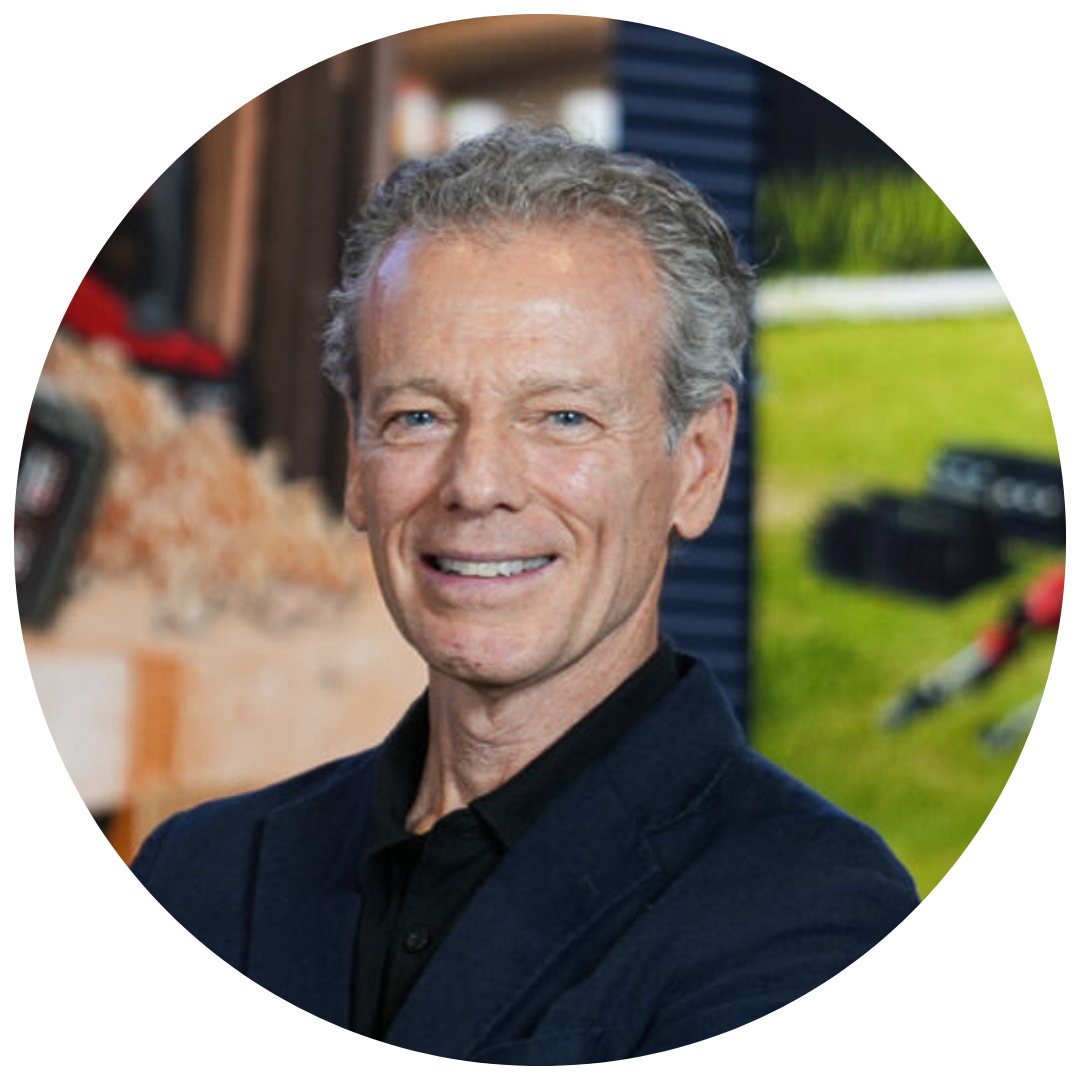
David Butts is President Asia Pacific & Group Executive Vice President of the multinational, Hong Kong listed Techtronic Industries Co. Ltd, the fastest-growing and largest cordless battery powered tool and equipment business with a world-class portfolio of brands including Milwaukee, Ryobi, AEG, and Hoover. He has held a progression of leadership roles working for TTI, Emerson Electric and Emerson’s Hong Kong-based joint venture with Bosch across North America, Europe and Asia Pacific. He is a graduate of Georgetown University, where he earned a Master of Business Administration, concentrating on International Business. Prior to attending Georgetown, he earned a Master of Engineering and Bachelor of Engineering in Operations Research and Industrial Engineering at Cornell University.