

by Edith Terry
Former CIA analyst and presidential advisor Dennis Wilder has a mission – reviving person-to-person US-China dialogue after the Covid-19 blackout. His niche is with the elite students who will help shape the next generation of policy makers. And Hong Kong is playing a crucial role in the tripartite program between US and mainland China universities.
In 1975, a young Dennis Wilder stepped off the plane at Kai Tak Airport and into the adventure of his life. The son of a Methodist missionary, Wilder was born in Singapore and grew up in Singapore, Penang and Kuala Lumpur, in the overseas Chinese communities where his father preached.
It was not his first time in Hong Kong – that was 1962. But it was his first time fully immersed in the many contradictions and excitement of the Hong Kong experience. He was based at the Chinese University of Hong Kong, as part of its Yale-in-Asia program, during a gap year from Kalamazoo College. One roommate was from Guangzhou and had a brother who was a Red Guard, the other was the son of a Hong Kong civil servant.

Protestors put up big character posters against the foreign students who were taking up space in the dormitory. Zhou Enlai would die while he was there, and in the unsettled atmosphere at the tail end of the Cultural Revolution, American students were still barred from studying in China. “I would stand at the top of the dormitory looking at China, realizing that unbelievable things were happening across that border,” he says.
Meanwhile, in the Confucian atmosphere that prevailed on campus at the time, men were not allowed in the women’s side of the dorm at New Asia College, and dating a Chinese woman was frowned upon. On Saturday mornings, he would go with his roommates for dimsum and read the International Herald Tribune while they would read Chinese newspapers. On Sundays, they would go to listen to jazz at Ned Kelly’s Last Stand in Tsim Sha Tsui, a venerable club that is still itself standing.
And whether by accident or design, Wilder checked out a book from the University Services Center at CUHK that would change his life – The Chinese High Command: A History of Chinese Military Politics (Praeger, 1973), by William Whitson. The youthful Wilder took Chinese military politics as the subject of his master’s degree, under the legendary Father Joseph Sebes, who founded Georgetown University’s program in East Asian Studies, and was later cherry picked by another legend, Director of Central Intelligence William Colby.
For the next 37 years, Wilder was among the top US intelligence analysts on China at the Central Intelligence Agency and National Security Council, serving as a special assistant on East Asia to President George W. Bush, as well as senior editor of the president’s daily brief for President Barack Obama. From 1992 to 1995, he was assigned to the US Consulate General in Hong Kong. “I owe that experience to Hong Kong,” he says, summing up his career. “You know, my future.”
A Georgetown University program in the tradition of Jesuit scholar Matteo Ricci
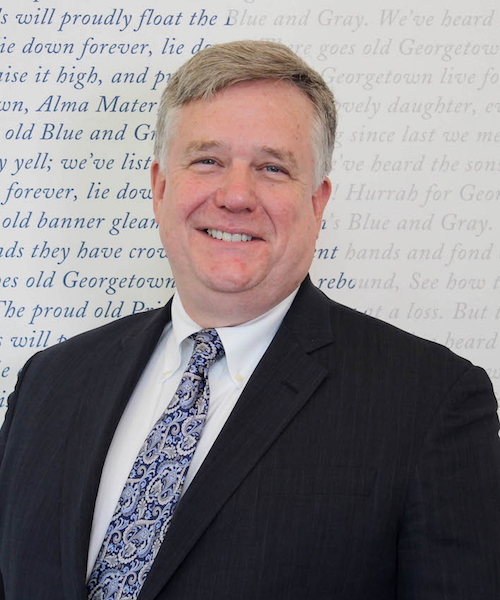
Wilder’s present job, as professor of practice at his alma mater, Georgetown University, gives him an influential platform to comment on US-China relations through social media, with a viewpoint that makes China hawks uncomfortable with its emphasis on diplomacy and dialogue. His signature achievement at Georgetown has been as managing director and senior fellow of its Initiative for US-China Dialogue on Global Issues, whose mission is to promote “engagement among scholars, students and practitioners to advance dialogue and promote solutions to global challenges.”
“We like to say that all of this is in the Jesuit tradition [Georgetown was the first Roman Catholic college in the US, founded by the Jesuit order in 1789],” says Wilder. “We are the biggest, oldest Jesuit institution in America. And of course, we cannot help but talk about Matteo Ricci – it’s in our DNA – and his very successful missionary work in China from 1583 to 1610. We see ourselves as, if you will, the children of Matteo Ricci in some ways. What we are trying to do is continue dialogue, and we stress the word ‘dialogue’. We are not trying to solve all the world’s problems here. What we’re trying to do is make both sides a little more understanding of the other’s positions.”
Putting Hong Kong on the map as a platform for US-China dialogue
Hong Kong was not part of the Georgetown program to start out with, which was principally between Georgetown University and students at two mainland China universities, Fudan University and Peking University. The person-to-person part of the program lapsed during Covid-19, but now that direct contacts have resumed, Hong Kong and CUHK are playing a key role. Among the decisive factors has been logistical support from the China-US Exchange Foundation (CUSEF), which was founded in 2008 by former Hong Kong Chief Executive Tung Chee-hwa.
CUHK’s debut was in May 2024. Six students each from Peking University, Fudan, University of California at San Diego and CUHK came to the CUHK campus for three days of seminars. The group included students from India and Thailand. Wilder tried out an exercise with the American and Chinese students which was to form two groups and ask them to think about pivotal events in the lives of their grandparents, as well as in their own lives.

“What came through was just an amazing mosaic on both sides,” Wilder said. “With the Chinese students, you get a picture of the chaos their grandparents went through in the Civil War in China, the great famine, the Cultural Revolution, the end of Sino-Soviet relations, and the beginning of US-China relations. As my Chinese students said to me, some of them handled it, and some of them didn’t. Some of them believed that Deng Xiaoping was a traitor to their cause, and others embraced ‘to get rich is glorious’ [an adage attributed to Deng].”
“And then you look at the American students and their grandparents were in totally different worlds, one where the United States was in a struggle with the Soviet Union, the Cuban missile crisis, and then counterterrorism after 9/11 [the September 2001 attacks on the World Trade Center and Pentagon].”
“And [the two groups] were different, but the same on technology, where they are very similar. They are addicted to social media. They wouldn’t be able to live without it. They stream information and music constantly, in both camps.”
“The Chinese students say the difference between themselves, and earlier generations is that we’re confident that we’re the new Chinese. We feel that we can stand up in the world in a way that our grandparents didn’t believe they could. The American students are more, I would have to say, are more humbled by history. They’re worried about their culture, and they’re worried about America. One of the events they said was pivotal was the school shootings in the US, and the fact that they all had to learn how to duck and cover.”
“What comes through is, it’s just fascinating to see the different worlds that American and Chinese young people come from. The DNA that they share with their families are so different. In some ways, you can see why we struggle with each other, and why the two value systems collide, because our histories, our values, our cultures, our political systems, create young people that are very different. But they are also very similar when it comes to technology. And that’s the interesting intersection that I found.”
Why it matters
Wilder argues that the hurdles are significant to getting US college students to return in numbers to China for extended study abroad experiences. In this context, the Georgetown program with Hong Kong as a partner can be part of a reset. China’s President Xi Jinping said on the sidelines of the Asia Pacific Economic Cooperation meetings in San Francisco last November that he would welcome 50,000 US students coming to China.
For many reasons, that has not happened yet, and is not likely to happen soon. In April, US Secretary of State Antony Blinken said that only 900 Americans were studying in China, versus 15,000 a decade earlier. While 290,000 Chinese students are in the US, young Americans and businesspeople alike are reluctant to live with social media and Internet restrictions in China.
“There are very few [students] who are even remotely interesting in living behind that kind of firewall,” says Wilder. “And you hear more and more from businesspeople who use VPNs [Virtual Private Networks]. The VPNs are getting restricted more heavily than before. And I don’t think Beijing understands how negative the influence of just that one area is on the perception of China today.”
Hong Kong’s Internet freedom is among the assets that keeps Hong Kong open and vibrant – and provides a neutral platform for the kind of student dialogue that Blinken says is important for US interests. “We have an interest in this, because if our future leaders – whether it’s in government, whether it’s in business, civil society, climate, tech, and other fields – if they’re going to be able to collaborate, if they want to be able to solve big problems, if they’re going to be able to work through our differences, they’ll need to know and understand each other’s language, culture and history.”[1]
A scorecard for Hong Kong
When Wilder was at the US Consulate General in Hong Kong in the mid-1990s, he took a cut in rank to work with Jeffrey Bader, then deputy principal officer and later President Obama’s senior director on East Asian Affairs at the National Security Council from 2009 to 2011.
“It was a perfect time to be in Hong Kong,” Wilder says. “You had Governor Chris Patten and the US Hong Kong Relations Act [which allowed Hong Kong to be treated separately from mainland China in trade and export controls after 1997]. Everybody thought they knew what the United States government should be doing in this situation. Every other day, we had congressmen and senators showing up telling us what we should be doing. It was utterly fascinating to be part of this, both as a bystander, but also as the country that all sides felt they needed to in some ways influence.”
Today, Wilder maintains strong views about Hong Kong. Soon after returning to Washington, DC, he wrote an opinion article for the South China Morning Post, “Don’t write off Hongkongers just yet,” that dismissed criticisms that Hong Kong has become just another mainland China city.[2]
In it, he wrote, “My regret is that Hongkongers have not adequately explained the continued vibrancy and uniqueness of the city to the world,” and made recommendations that local leaders outside the government do more to both speak on the world stage and defend Hong Kong’s “relative” autonomy in Beijing. “Instead of focusing on the ways Beijing has damaged Hong Kong, it is time to defend the people of Hong Kong by acknowledging and supporting the unique role they still play in East Asia.”
Wilder’s personal scorecard on Hong Kong is influenced by his own early encounters with the city. “I could not be more impressed with a group of people,” he says. “Whether it was back in 1975, as I watched the people of Hong Kong deal with the Cultural Revolution across the border, and deal with their British masters. And then, the whole period of transition as Hong Kongers came to terms with the fact that they would have new masters, and that these new masters would have very different requirements from the old masters. And the whole history of British rule, then Japanese rule, back to British rule and now Chinese rule.”
“The adaptability of the Hong Kong people, their ability to roll with these punches, is a story that hasn’t been told. The first time I came to Hong Kong [in 1962] and saw the refugees on the hillsides, I never forgot [the image]. And to see those people come off the hillsides and figure out how to be tailors and how to be entrepreneurs and build toys and make suits and create this vibrant city. And then to move on from that to shipping to import-export for China, to now working across the border. I just think that there is so much that’s rich in the Hong Kong experience that the world doesn’t understand. And the story has not been told well at all, because it always gets diverted into political questions, into questions of Chinese rule.”
China keeps “an eagle eye” on Hong Kong for evidence that the West will use Hong Kong against it; in the US, the perception is that “Hong Kong is just another part of China’s campaign against us.” Hong Kong, he says, together with American business, gets stuck in the middle.
“What I’ve tried to do is look at it in a different way,” he adds. “When people get hung up on what Beijing is doing, you overlook the people of Hong Kong, and kind of dismiss them. I think we need to do the opposite. I think we need to focus less on what Beijing is doing and focus more on what we can do to support the people of Hong Kong to help them keep what has made Hong Kong so dynamic?”
Wilder sees some low-hanging fruit in renewing the West’s former love affair with Hong Kong, starting with reviving the fortunes of Cathay Pacific. “An airline can do a tremendous amount for a city’s reputation. If you made sure the airline had great dimsum, Hong Kong cuisine, a Hong Kong flavor, and best-in-class service, it would be an easy win for Hong Kong, he argues.
Some of the recommendations he made in his South China Morning Post article may not be as easy, such as finding individuals outside government who can speak comfortably to both their Chinese and western counterparts, as Tung Chee-hwa once did. The costs and risks are obvious. Even so, “If someone or a group of individuals were to step forward, I think the international community could do a tremendous amount to support those people” he says. “It’s no longer about Hong Kong being a middleman in import-export. Those roles are receding for Hong Kong. But as a world financial center, it can still be very powerful.”
The Hong Kong enthusiast
And, as a Hong Kong enthusiast, what is Wilder’s elevator pitch for Hong Kong? He doesn’t have to think long. “My elevator pitch is this,” he says. “The remarkable thing about Hong Kong is that it is still truly an international city. When you go to Tokyo, you do not get that feeling. In Tokyo, you get the feeling of a Japanese city. Similarly, in Seoul, it is a Korean city. The level of English spoken in those two cities is still basic. In Hong Kong, when I get in with an Uber, the driver speaks good English and can communicate with me. When I talk to service workers in the hotels, they have a level of English that is impressive. And it is a friendly city in that regard. It’s not that Tokyo or Seoul don’t want to be welcoming, but the language barrier makes a real difference.”
“Singapore is too staid as a city. Whereas in Hong Kong, you have entrepreneurship that is doing interesting things. I think that positioning Hong Kong as the true international city of Asia makes some sense. It’s far more sophisticated a place than Manila or Hanoi. And it’s central in terms of international travel.”
Hong Kong has taken body blows in the last few years in real and reputational terms, in the context of a slowing economy in China, a deep chill in US-China relations that shows few signs of warming, and legislative and electoral changes aligned with Beijing’s fears of foreign influence. It is still finding its way. One of those pathways could be to reinforce its role as the city in China where not just Internet freedoms, but freedom of expression more broadly, demonstrably helps to move the dial on the world’s most important bilateral relationship.
[1] Remarks, Antony J. Blinken, Secretary of State, Beijing, People’s Republic of China, April 26, 2024, US Department of State, Press Release, https://www.state.gov/secretary-antony-j-blinken-at-a-press-availability-48/
[2] Dennis Wilder, “Don’t write off Hongkongers just yet,” https://www.scmp.com/opinion/hong-kong-opinion/article/3265429/dont-write-hongkongers-just-yet, South China Morning Post, June 8, 2024.