
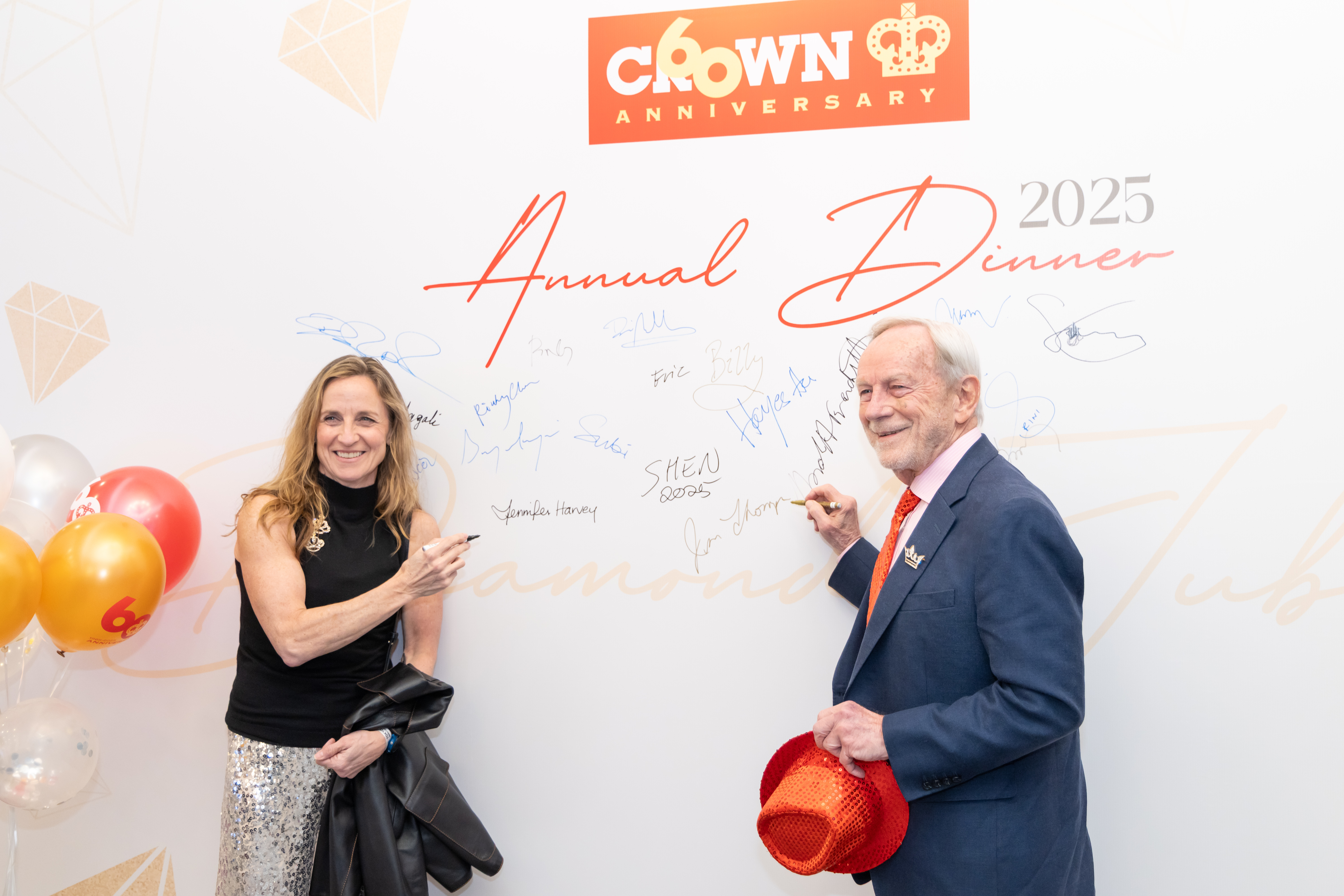
Crown Worldwide is a company that many of Hong Kong’s expat population know before they even arrive, as the relocation company of choice for many multinationals. They are also likely to have met, and be on a first-name basis, with its founder and Chairman Emeritus, Jim Thompson. Now celebrating its 60th anniversary, Thompson started
Crown Worldwide in Yokohama, Japan in 1965, when he was just 25, with less than $1,000 in capital, moving US military personnel in and out of Japan. In 1970, he opened an office in Hong Kong and decided to move the company’s headquarters there the same year. In August 2023, his daughter Jennifer Harvey became CEO, after the untimely death of her predecessor, Ken Madrid.
Today, Crown Worldwide has offices in 45 countries and over 28,100 corporate clients. It has 3,088 employees, representing 78 nationalities and speaking 56 languages. Here CEO Harvey chats with AmChamHK e-Magazine editor Edith Terry about what it was like growing up in a family business and how it has evolved under her management.

Q. What was it like growing up in a family business, and as a third-culture kid, first in Yokohoma, then Hong Kong?
A. You only have one childhood, and so that’s all you know. When I was growing up, it was a much smaller company, and very much all-encompassing. It was an inextricable part of our lives. My parents were both working around the clock, and we were a part of that, to the extent that the employees were almost an extension of our family. As kids, we knew them, they’d come over for meals, and we’d go to the office. It just surrounded us.
There was never any pressure for me to join the company. I remember a meal before leaving for college, I think we were having tonkatsu in Causeway Bay and it was just dad and me. He said, “There’s no pressure for you to join, but if you want to, we’d love to have you”. And he left it at that. I had no idea what I wanted to do, but I just fell into finance [with Shearson Lehman Brothers] because I was going to college in New York [at Columbia University]. It was extremely competitive to get a financial analyst position, even though they work you to death! I learned so much that I still find useful today, because they had high standards about how you conduct yourself, how you communicate, and the quality and quantity of work you put in. And as a young person without any connections, I had to learn fast and earn respect on the job which is a valuable way for anyone to start their career.
Especially back in the 90s, when I entered the workforce, there were no rules about how many hours you worked. It was exhausting to work seven days a week, for weeks on end. And when I came to the end of my commitment to the bank, I thought I would like to try something different, where I had better work-life balance. At that point I reached out to dad. He sent me to work in Japan because I speak Japanese. When I moved to Japan in 1993, its economy was thriving, and there was tremendous opportunity for our business there to grow.
Q. Crown Worldwide is a unique global business based in Hong Kong. How did Hong Kong’s entrepreneurial spirit shape the company’s evolution?
A. Hong Kong as our head office location has influenced Crown’s global culture in many positive ways.
First, Hong Kong is such a can-do place. Whenever our Hong Kong team is faced with a challenge, the first answer is never “no, we can’t do that.” It is more likely “Let us take that away and figure out how we can do it.” This has created an expectation across the organization that we try to find a way, be it a way to take care of a change in a customer’s need, or how to steer a business line to better succeed.
Second, Hong Kong is such a business-friendly environment. From a tax, regulatory and legal perspective, it’s an easier place to do business than many others. This has created a company mindset of keeping things simple. We do operate in some countries where it’s more complicated and the rules aren’t as easy to navigate. But we aim to keep things as simple as possible, because we have the Hong Kong example. It’s even become part of our purpose statement which is “Making it simpler to live, work and do business anywhere in the world.”
Third, a big impact of Hong Kong’s entrepreneurial spirit is that it’s helping the company to innovate. We’ve had great service evolutions around the world including in Hong Kong where our customer market there has changed a lot, particularly in our corporate relocation business. Fewer companies are putting large numbers of expats in Hong Kong, or anywhere, and instead hiring locally. As a result, we have needed to pivot to other business lines. Hong Kong’s entrepreneurial mindset has helped us be openminded to evolving needs and grow our other businesses in those areas. We have done some really interesting things in Hong Kong which presents some good proofs of concept for other Crown countries who are thinking we could do that, too. That’s a really good idea.
One example in Hong Kong, is a recently developed sub-brand called “ExXtra” for valet storage. Since residences are a bit smaller, people can have a valet service where they put things that they want to keep but don’t want in their homes or offices all the time, like off-season clothing and books. It’s also used for office assets when companies don’t want to store all their computers in the office, for example. This is a brand that grew up in Hong Kong and is now being marketed in other countries.
Another example is Crown Wine Cellars, with its clubhouse in a Shouson Hill World War II bunker that gets a lot of attention. What people may not realize is that the most valuable wines are stored in our own warehouse facilities with a very high level of security. That enhancement was driven by existing high-end Crown storage facilities used for other valuable assets like fine art and sensitive documents. Today we are actively pursuing new areas of focus around what we call hospitality logistics – storing, transporting, fitting out and restocking supplies for hotels, luxury retail and institutional spaces. All of those are directions of travel for Hong Kong.
Q. Many of the legacy companies on the Hong Kong stock exchange are family businesses, and for ethnic Chinese and Asian family businesses, a huge value is placed on harmony within the family. What kind of value does Crown put on family, per se?
A. The Crown organization is a family with over 3000 people, many who have worked for the company for decades. So, we put the company first, rather than thinking about catering to the founders’ family specifically. As for working for my father, firstly he’s just a wonderful human being and I’m proud to work for him. In my career at Crown, I always put our father-daughter relationship first. We don’t talk about work every time we speak. In fact, for many years I went out of my way not to talk to him about work, because I wanted a dad. He just happens to be the founder of the company I work for. And to this day, I care more about him as my father than his career achievements, though I am tremendously proud of him. Having said that, particularly in the role I’m in now, I do turn to him for advice. When I do that and now that I’m settling more into the CEO role, I make the decision on my own first and then ask for his perspective on what I have decided to do.

And he’s incredibly generous with his time to share his experience. He’s a wealth of knowledge. How could he not be? He’s also kind, encouraging and incredibly supportive. If he expresses concern about something happening at the company, our executive team takes it very seriously because of our respect for him and also because his instincts are incredible. One thing I enjoy is that in my current role, I need to look at the company more holistically which enables me to see things more from his perspective since he had that role for many years. I really enjoy hearing what he has to say because – in addition to his vast experience – he’s got a growth mindset and he’s also highly creative, which is fun to witness.
Q. Your father has frequently said Crown would never go public. Is that your view as well, and why or why not?
A. Many people I know work for companies that are either publicly held or owned by private equity. As a result, they are under pressure to deliver short-term growth. Most of the investors, whether they are major shareholders or financial investors want to see returns quickly. That’s why they invested, right?
Crown’s various logistics businesses are resilient, slow-growing businesses and require more patience. So, I think that the idea of a logistics business being publicly traded is a mismatch in a way. From that perspective, as a privately held company, we’ve been able to make decisions even when we know that it’s going to take years to get a payback. For Crown, it’s worthwhile, because it allows us to invest in our property portfolio, which is the greatest source of value in the organization. In general, we are not property prospectors but rather owner-operators seeking to retain our properties and add to them. This model would be a hard sell, if you had investors that weren’t thinking about the long term.
Conversely, we have to deal with the pressures of funding ourselves and making sure we’re getting returns on our businesses such that we can continue to invest and grow. But I don’t feel any differently about not wanting to go public. It wouldn’t match us very well.
With people I know at public or PE-owned companies, I see how much time they spend managing their outside investors. I’m grateful I don’t have that burden and can focus on managing the business itself.
Q. How is your executive team structured?
A. The untimely passing of [former CEO] Ken was a shock to our organization. [Ken Madrid] was my father’s trusted lieutenant for decades. Up to the time he passed, he was my boss and there are many people at Crown who worked even more closely with him and considered him their mentor. He had an astuteness and a financial acumen that was quite unique.
I don’t have the same CFO experience he had, but I’ve worked in multiple of parts of the business and have strengths in customer, communications, and people-oriented roles. I’m not Ken, but there are different kinds of CEOs, and a successful one plays to their own strengths and then builds a diverse leadership team around them to balance where they may not be as strong.
When I first took on the role, I had to figure out what Ken had been doing, then build my team a little differently. One example is that under Ken, we didn’t have a global chief financial officer. We had regional CFOs, and in some ways, he played the global CFO role, because he had been in that role previously. When I took over, I put a group CFO in place, because it wasn’t appropriate for me to try to wear that second hat. My guiding principle is to be authentic and open about what I know and what I don’t. I let people know where I need their help. To the best of my ability, I seek to communicate clearly so that everybody understands what’s expected of them.
Q. Can you sketch out how Crown evolved to its current structure, on its 60th anniversary?
A. We started out being a global mover, specializing in employees of multinational companies at a time when organizations were sending people all over the world. Over time we evolved into owning properties to store their household goods, because there was a real benefit to owning safe and secure facilities and control the associated costs. And then, because we owned these properties we evolved into document storage, and some relocation services like immigration, home finding and school selection. These are still our two largest businesses; however, the business mix is shifting.
More recently, we diversified into specialized logistics, like fine art and what we call Workspace, which is all things around office assets, office furniture, fixtures, and equipment. We provide design, fit-out and decommissioning of offices and institutional spaces from hospitals through to hotels. Our growth areas tend to be domestic businesses, things like document and information management, hospitality, workspace and fine arts. Fine arts may move globally, with exhibits going from country to country, but the other businesses are predominantly delivered locally with a local supply chain.
We see a real trend of our clients to make decisions locally. If the global Request for Proposals (RFP) is diminishing, I can only guess that might have something to do with our clients reducing their own corporate overheads, so they don’t necessarily have the same resources that they once did to manage global engagements.
In our case, we’ve pivoted to businesses that are more domestic. And with some of the policies of the US government and the uncertainty around tariffs, I think it’s fortunate that we’ve moved that way before the tariff conversation started. It protects us somewhat, because we’re sourcing services locally and more decisions are being made within countries which helps fuel local innovation.
One thing we’re doing in honor of our 60th anniversary is hosting an internal competition to drive innovation. We’re calling it the Pioneer Challenge, as a nod to my father who was a pioneer in our industry. And we’ve invited business plans from our employees and a few of our most innovative managers to be on the judging panel. I’m confident that this competition will produce great new ideas.
Q. You’ve mentioned your property portfolio. Can you share something about its scale and importance to the company?
A. As a private company, we don’t typically share financial information, but we have almost 10 million square meters of warehouse space, and the value of our properties at this point is about $1.2 billion. We have over 250 warehouse properties all over the world, with several in Hong Kong that have appreciated dramatically since we acquired them back in the 1980s. Because we’re not interested in going public, that’s an appreciating asset against which we can borrow, and that funds our growth.
The other thing it does is that we’re owner-operators, not just investors, so the cost of whatever facility we’re in, whether it is leased or owned, impacts directly on our margins. And by owning, we have a lot more control over the cost of the facility we’re operating out of, because in some rapidly growing markets, particularly in Asia, overnight the landlord can say, I’m going to double your rent. Owning properties helps us avoid that type of uncertainty.
Property is central to our strategy. In fact, you could say that our property portfolio is the most valuable thing about the company at this point. For that reason, in our 60th year we’ve made a deliberate shift towards prioritizing that aspect in our strategic decisions. When we’re considering whether to invest in a new business or acquisition, we look at, how well does it support our property strategy? Does it drive any type of storage business or business that will help get a return from those facilities? What are the ways we can grow those businesses, since those businesses will allow us to invest in other properties as well?
Q. You publish a sustainability report on your corporate website. As a privately held company, this is not for compliance reasons, obviously. Can you share why you think sustainability reporting adds value to the business?
A. I started it in 2008 after I had a couple of kids and I needed, just for a period of time, a less demanding role. Ken said, it doesn’t matter if we’re public or not, a lot of our clients are public companies and they need to demonstrate that they are not integrating sustainable practices within their own operations but also in their supply chains. We were finding in some cases, if we couldn’t answer certain questions and demonstrate that we were making improvements, we were not going to win or retain business.
That’s how it started. It was something we had to do. And I took that role. We called the first report a CSR (corporate social responsibility) report, but it was an ESG (environment, social and governance) report.
We had the social component, because in our culture, we work to give back to communities, but we wanted to have a positive impact on the environment as well, starting with our clients expecting it of us, but it grew and took on a life of its own.
In the early months of taking on the role, I wanted to document all the wonderful things that were happening on the community side, the charitable side, and created a database. I sent a message out to country managers and said, sometime in the next month, could you enter the activities you’re doing in the areas of ESG (environment, society and governance)? The next day, I went into the database just to see if anyone had added anything and there were so many activities there, and many of them were environmental. It was one of those moments where I recognized the uniquely committed people that work at the company, and how much they cared.
The environmental aspect may have started with leadership, but it’s taken on a life of its own because people in our different markets embraced it. They want to do this. And as time passed, sustainability became more technical and science-based, so we appointed a seasoned Director of Sustainability, Joy Lam, who is from Hong Kong but lives in the UK. Before Crown, she was Circular Economy Director at the LEGO Group, and before that, head of the sustainability office at the University of Hong Kong.
She has helped us measure for the first time our carbon footprint globally in 45 countries, a huge undertaking. She even looks at how dirty the electricity is in one country versus another and helps us calculate what that means for us. It’s allowed us to prioritize some countries over others, for example, by investing in solar panels where it will have greater positive impact. Now she is the author of our sustainability report, which is a tremendous document available on our website.
With our clients, it’s not even that they like that we have a sustainability program. They expect it. There are also opportunities for us to be more efficient. And you can’t understate the impact on our employees. It helps them want to stay because they believe in the company, because we’re trying to have a positive impact on the communities that we’re in. And it motivates me, too.
Q. How have you been affected by geopolitics in the second Trump Administration?
A. We’re not very much impacted, because less of our business today is about crossing borders, and more about services being delivered in-country. With the relocation business, which is still a significant part of our business, used household items don’t have commercial value, so if handled correctly they are not subject to tariffs because they’re not for resale.
We’re watching very closely to see what freight rates do, and there is some expectation that on some routes, they may actually go down because of lower demand caused by the tariffs. That doesn’t benefit us, because freight is just a disbursement.
The biggest risk is that there is so much uncertainty that our clients in some cases are delaying decision-making. For example, if a big multinational with a presence in Hong Kong was going to move their office and refurbish all their furniture and ask us to help them design a new space, uncertainty over the impact of tariffs on their business might make them decide to delay the project for a few months. These potential delays caused by tariff uncertainty is likely the biggest risk to Crown at the moment. It’s similar to an election year in any given country; we often see a slowdown in decisions because the market is waiting to see what the outcome will be.
Q. The head office of Crown is in Hong Kong, but you are based in New York. Please explain.
A. I think I could be based anywhere. Hong Kong is the head office, but we have large operations in New Zealand, Singapore, India, the UK, and other places. New York is not one of our bigger markets, but it happens to be where I live. I have a dual-career household and three adult kids in the US, so for now I do not want to move.
What it means is that I am on calls early and on calls late, but it’s a choice, and I am grateful to be able to make it. There is something to be said for just that little bit of distance that allows you not to get caught up in the minutiae and think more strategically sometimes. I do travel and get to see the team regularly. Our Executive board has members based in London, Hong Kong, Sydney, and I’m in New York. So, we have the world really covered.


Jennifer Harvey, CEO of Crown Worldwide, joined the company in 1993 after
working with Shearson Lehman Brothers as a financial analyst from 1990 to 1993.
With Crown for 32 years, she has worked in Tokyo, Singapore, and New York. A graduate of Columbia University and Hong Kong International School, she has three children – a 26-year-old daughter who works for a major consulting firm, a 24-year-old son on ski patrol saving lives, and a 21-year-old son finishing his sophomore year at the University of Chicago.
Harvey is a marathon runner and is aiming to complete the last of the six original
marathons – Tokyo, Boston, London, Berlin, Chicago and New York. She is now
figuring out how to get a place for the 2026 London marathon, which will make her eligible for the Six Star medal. Over 1 million people have applied for approximately 60,000 ballot places available.