

The 28-hectare Kai Tak Sports Park overlooking Victoria Harbour (Courtesy Populous/Photographer Ben Marans)
By Edith Terry
From a distance across Victoria Harbour, the main stadium looks much like its nickname, “The Pearl of the Orient”, its color changing with the light, bluish-green to a sheeny grey. While sports stadiums have had the same basic shape since the Greeks and Romans, a circular amphitheater with pitched seats, the 50,000-seat Kai Tak Stadium, Kai Tak Sports Park (KTSP) with its acoustically sealed, retractable roof are to the Coliseum what a luxury timepiece is to a basic sundial. It was designed by the world’s leading sports and entertainment design firm Populous, This HK$31.9 billion (US$4 billion) stadium is a masterpiece of design thinking.
Like the much larger, 80,000-seat London Stadium in Stratford, also designed by Populous, and the chief stadium for the 2012 Summer Olympics and Paralympics, one of the aims was to revitalize its neighborhood. London Stadium was in the rundown Stratford district, while Kai Tak Sports Park is on the north end of the former Kai Tak airport, adjacent to Kowloon City.
And it is beginning to attract not only crowds for events in the Kai Tak Stadium, Kai Tak Arena and Kai Tak Youth Sports Ground, but to its restaurants, marketplace, and sitting out areas, covering 28 hectares (280,000 square meters). In this tour of Hong Kong’s new icon, lead architect Richard Breslin takes AmChamHK e-Magazine through some of its highlights.
How to make a people’s park
When Richard Breslin first visited the site of Kai Tak Sports Park, it was little more than rubble from the former air terminal and runway that operated until 1998, when Chek Lap Kok International Airport replaced it. At the far end of the runway was the Norman Foster-designed Kai Tak Cruise Terminal, which opened in 2013.
The future building site was four kilometers away on Shing Fung Road. Beyond were the aging apartment blocks of Kowloon City, Kowloon Bay and the Kowloon Walled City Park, where the once forbidding “walled city” had stood, technically under Qing dynasty jurisdiction, until 1994. Despite the cruise terminal, and a spate of new high-rise residential towers midway down the old runway, the scene was unpromising.
“I remember going out there, when we first looked at this project, and looked at the site, and it was mostly all the old tarmac from the old Kai Tak airport,” says Breslin. “There was literally nothing there, not just on our site, but on any site in the area. So there was this sort of forgotten piece of land that was prime for revitalisation. We knew that the government wasn’t just planning the Kai Tak Sports Park, but were also looking at quite a bit of housing around the site as well, both private-sector and government housing. I knew there would be a lot of new people who would be calling the Kai Tak precinct home.”
No fences
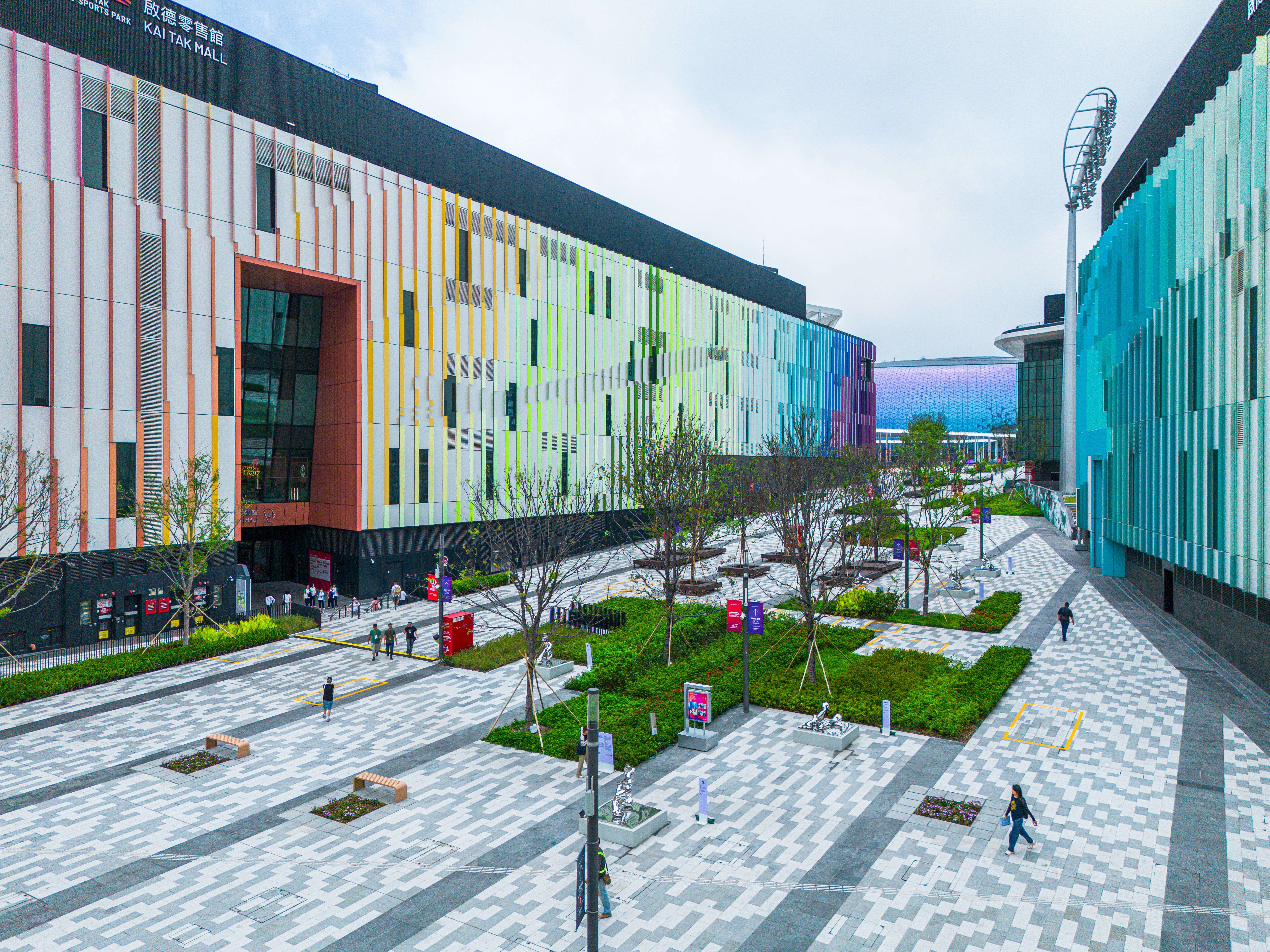
That perception led to one of the first design decisions for the park, which was not to put a fence around it, but to open up the connections on all sides – north, south, east and west “so that it would become the heartbeat of Kowloon City and Kowloon Bay,” Breslin says. “We wanted this to be a place Hong Kongers could be proud of, where they could come to enjoy, not just when there’s a major event, but if they wanted to come along with their friends, go to the shops, walk in the park, or play on the grass.”
The ambition was to create a neighborhood, a far more difficult task than a standalone site surrounded by parking lots, like many international sports stadiums. There would be no asphalt moat around this Stadium, or the indoor, 10,000 seat Kai Tak Arena and outdoor, 5,000 seat Kai Tak Youth Sports Ground. “It was really critical for us to understand what this precinct needed to be, not what it could be,” Breslin says.
What it needed, Breslin says, was to be a good neighbor to the residential areas to the north of the park complex. Nearby was a monument to the boy Song emperor, who ended his life on Lantau Island, but briefly ruled over Kowloon. A memorial stone to the boy king became the centerpiece for a new subway station, opened in 2021 as part of the new Sha Tin to Central Link, and phase two of the Tuen Ma Mass Transit Rail line.
Not far away was Kai Tak Station, also on the Tuen Ma line, which opened a year earlier in 2020. Both were part of the master plan for Kai Tak and had begun to give a new spark to the areas nearby. The easy way out for the architects was to let the public figure out for themselves how to get to the site on foot, through construction hoardings and a maze of roadways in between. Instead, Populous created a “hierarchy of spaces”, looking at the north front of the park differently from the south, where it opened up onto Victoria Harbour and the Kowloon Bay typhoon shelter.
A key issue was how to balance an entry and exit plan for up to 50,000 people, and the typical footprint on days without events. “What we did was to define primary spaces which are the big, the big, the big avenues and so forth that we need to move large numbers of people around,” Breslin says.
“But what was really exciting about this project was then really digging in and looking at the secondary spaces, so there are secondary travel routes, then going into the finer detail and looking at the tertiary level, those little pockets, where, yes, if you are a family of five, you can just sort of peel off to the side and you’ve got a semi-private space where you’re not surrounded by masses of other people, or massive buildings. It’s really coming down to that ability to be able to engage and feel comfortable within some of those spaces.”
North and south
At the northern end, “We really tried to break the building mass down, so it wasn’t confronting and oppressive,” says Breslin. “We didn’t want these big shiny towers, these big stainless steel and glass things, and then have people trying to have a nice picnic in the middle of all that. These are big, massive buildings, and the scale and bulk of them is huge.”
To do that, Populous created room for eight hectares of recreational space including the largest children’s playground in Hong Kong, using landscaping to create interesting spaces where people could stop and sit on benches, catch up with their friends and have picnics, or take part in the arts and cultural programming in the precinct. The design includes cycling paths, jogging tracks, sports pitches and lawns, although it is still a work in progress. The idea was to respond to the urban grain with something more human in scale, that would draw people into the space regardless of whether the venue was host to mega-events or not.
A 13-kilometer GreenWay – still under construction – will be used by pedestrians and cyclists, connecting to open spaces including the Sung Wong Toi Park, Kai Tak River, and the promenades along both sides of the area. It starts from Station Square and is designed for people in the neighborhood. “It’s a totally different way of looking at the park and using it,” says Breslin.
“As people get to know the precinct, they will learn how to engage with it and how to use it. That’s a part of exploring and understanding what their Sports Park is, because it is a people’s park, and finding these experiences and different little gems, you don’t want to present it all at once, you want to give them a chance to get out there and own it for themselves.”
Anchoring the master plan is the Sports Avenue, a 700-meter covered walkway connecting Station Square to the north with the Kai Tak Arena, retail area, Central Square and Kai Tak Stadium at the other end. “We felt we really needed to have a strong link through the heart of the precinct that takes them to the water’s edge,” says Breslin. “It’s definitely not the same experience when you enter the avenue from Station Square to when you pop out at the other end. You’ve actually travelled and connected to all of the venues along the way,” with the exception of the Youth Sports Ground.

events (Courtesy Populous/Photographer Ben Marans)
“Pearl of the Orient”

to sport and entertainment in Hong Kong (Courtesy Kai Tak Sport Park Limited)
The great mass of the Stadium sitting on the southern end of the site is, for this observer, a thing of beauty, as close as a sports stadium can come to an art object, from its subtly bulging shape to its extraordinary opalescent skin. “This Hong Kong image, sitting on the edge of the harbor, adds to the overall impression that people have of Hong Kong as a city, with wonderful shots across the harbor, with all the architecture, the towers and so forth, and Lion Rock behind it,” says Breslin.

(Courtesy Populous/Photographer Ben Marans)
“We came to the notion of the design concept of it being the ‘Pearl of the Orient’ early on. It’s one of those rare moments in what we do where we were sitting around and talking about it and thinking about the Pearl River Delta and came up with this idea. It came up very quickly, and led us to that simple, elegant form.”
The bulging shape, like Baroque, slightly indented pearl, is a design solution to the mechanicals for raising the roof panels and air-conditioning plant. The structures are hidden behind the façade, so that you have to get high up within the stadium to even see them. The light, floating appearance of the Stadium is based on a cantilevered, steel-reinforced concrete structure, with ventilation louvers concealed in a trench surrounding the roof.
The roof consists of one of the largest sets of sliding roof panels in the world, operating with over 4,800 tons of steel on silent mechanisms, while the outer shell consists of over 27,000 specially coated, self-cleaning aluminum panels.
The Fluropon Kamelon Lightning Mist coating “is basically an auto paint. It’s a multi-layered paint finish which gives you that different shading based on the angle,” says Breslin. “I remember in the early days, when we started trying to explain it to the clients and then to the government, we were very nervous, because it’s hugely technically challenging to try and map that many panels in an accurate way. Because it depends on the angle you are looking from, the amount of light, whether it’s evening, or cloudy or sunny, and different angles of the sun”.
Dealing with 50,000 individuals
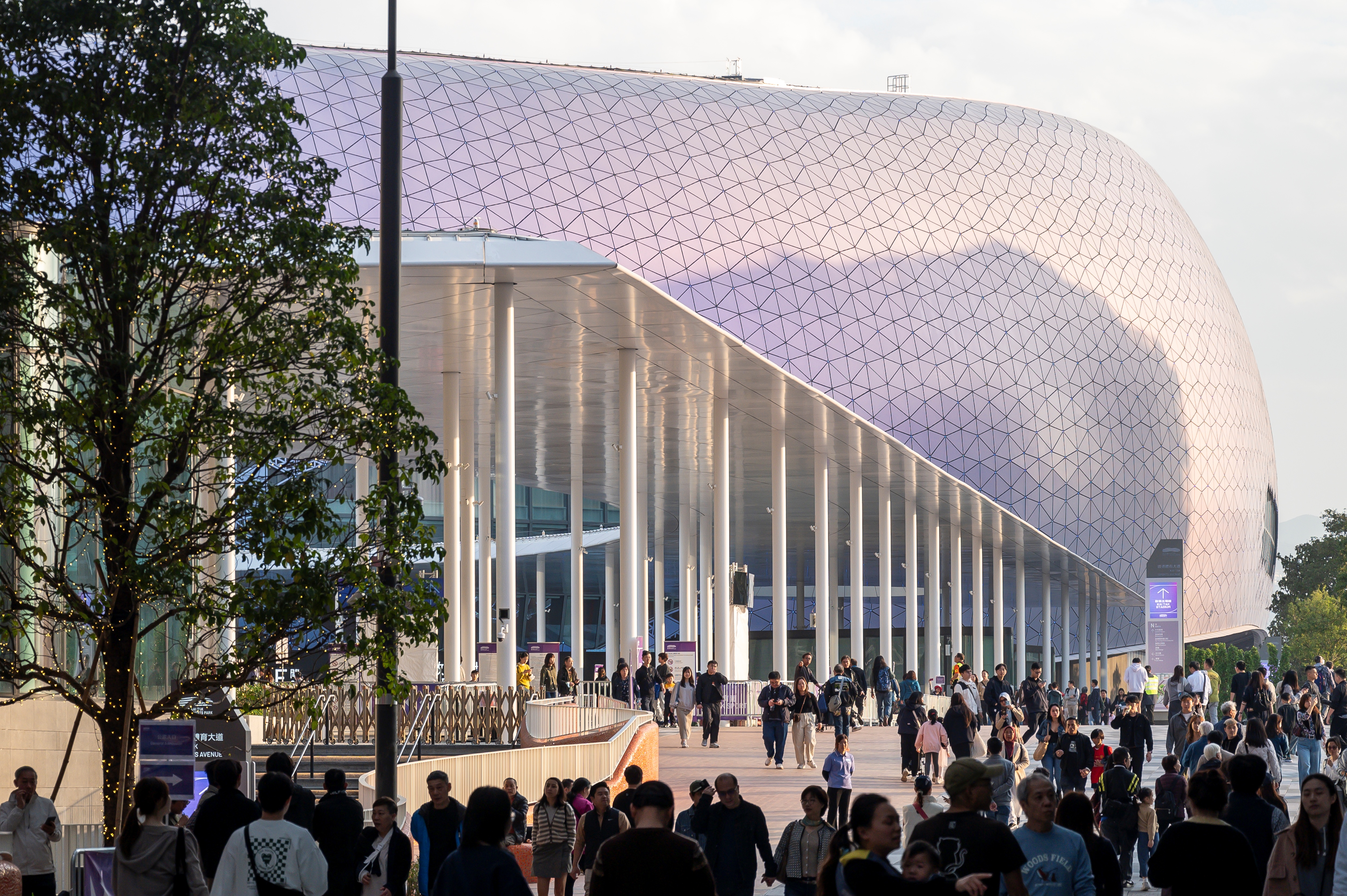
such as the Hong Kong Sevens and Coldplay (Courtesy Populous & Getty Images)
There were plenty of other design challenges with the main stadium. One was to put the access for service vehicles beneath the public areas, so that service trucks aren’t dropping off snacks and drinks on the same levels as pedestrians. “When we’re talking to clients about these things, you can get very lost in the fact that you’re dealing with 50,000 people, but what you’re actually dealing with is a single person. There just tends to be lots and lots of them”.
Another design challenge was replicating the famous South Stand of Hong Kong Stadium, traditional home of the Hong Kong Sevens, which has now moved across the harbor to KTSP. The South Stand has traditionally been the beating heart of the Sevens, where attendees in fancy dress strut for selfies, carouse, and serve as the life of the party. The design team made sure that the South Stand, now called the South Terrace, had a new life at KTSP, with the same number of seats and similar entryways. Behind it is the best view in the house – of Victoria Harbour towards Hong Kong Island, through a 30-meter tall, glass wall.
There is something else special about the South Stand, or South Terrace. The entire South Terrace hinges up to create a stage pocket, so that more people can fit into the arena for events like concerts or the stage can be extended for performers. Populous did something similar at Wembley Stadium, and it means creating more flat space within the seating bowl, so that the stage can be extended further. The stage pocket system is a first for Hong Kong and one of the largest globally.
Maximizing comfort levels
With the stadium itself, the main goal was to get the spectators as close as possible to the action. “Most people would think that if you look at a seating bowl profile that they’re all pretty much the same from one arena to the next,” says Breslin. “But in fact we’ve got designers in our studios all over the world looking at seating bowl profiles and what the content and usage profiles are, how often they will be used and what sort of events will be hosted there. We work really, really hard to get everyone in as tightly as we possibly can, and make sure that everyone has a premium view as well.”
At Kai Tak, the team realized early on that there was going to be more demand for non-turf-based events, like concerts, and developed a turf system where the turf doesn’t grow in the stadium but is rolled up and sent to Zhuhai. Most of the time, the base is concrete, and the arena can be used for many different purposes.
Populous also designed Hong Kong Stadium in 1994, in So Kon Po, a very different location with hills and semi-tropical forest rising 92 feet above the surface of the pitch. It won multiple prizes at the time, but, as Breslin acknowledges, times have changed. “The biggest change is probably people’s expectations for comfort,” he says.
“People are now absolutely spoiled when they sit and watch any type of content at home, whether it’s sports or concerts, their ability to be able to get high-quality images and high-quality sound. Especially when it comes to sport, it’s a challenge that people have an expectation that their seats are going to be comfortable, they’re going to be nice and wide, they’re not going to be squashed in there, and that if they need to go to the toilet, they can easily get access, and if they want food and beverage, they can easily get that. They’ve got the content, and access to wi-fi. If it’s raining outside, they’re not going to get wet.”
To address the now-standard comfort zone of audiences, the retractable roof, which uses flangeless wheels on rails that allows it to open or close silently within 30 minutes, protects audiences from rain, and the seating bowl features individual cooling outlets beneath each seat, with pitch cooling for players.
The roar of the crowd, the flashing of LED lights

world (Courtesy Kai Tak Sport Park Limited)
Breslin’s own experience at one of the Coldplay concerts in April was positive. The audience had LED wrist bands, and even if Breslin’s wrist band failed to work, he felt the vibe. “I had a great old time,” he says. “When Chris Martin [Coldplay’s lead singer] said put your hands up, that ability to engage both ways with the crowd, to be able to add something to the event, is an incredibly powerful thing.”
“When you are there at the Sevens, you can hear the crowd roaring, you’re actually part of the crowd, and you feel the hairs standing up on the back of your neck when something amazing is about to happen. There’s that notion of being able to say, I was there when this amazing thing happened, that everyone’s talking about, that everyone’s sending messages around. It’s still important to us, isn’t it? It’s not just about sitting there watching it on TV and putting it on pause when you get another slice of pizza or something? It’s live as it happens. It’s very, real”.
So is it a people’s park after all? Breslin thinks so. He likes to spend time walking around the concourses, looking at how people are engaging with the buildings, and listening to what people are saying. He says: “It’s been a very humbling thing to be part of something which has people loving it. I’ve had messages from friends, even people who didn’t know that I was involved in this project, and they are all saying this is going to change Hong Kong. And they’re really excited about the future of the city.”

Richard Breslin, Senior Principal and Asia Pacific Managing Director of global architectural firm Populous, led a team of 150 staff based in nine offices and six time zones on the Kai Tak Sports Park project, including 25 people based in the city. A veteran in the industry having worked on arenas and events including London’s Wembley Stadium, the London Olympics and New Zealand’s Eden Park, Breslin has been with Populous, formerly HOK Sport, since 1999. His architecture degree is from the University of Canberra.