

How an ‘under-the-radar’ project is putting Hong Kong on the map in next generation textiles and fashion supply chains
In a time of constant discussion about the reputation and future of Hong Kong, it is refreshing to see a bright spot of innovation that really showcases where the city’s future lies. In a remote part of Tsuen Kwan O in Kowloon, sits the state-of-the-art Advanced Manufacturing Center, part of the Science and Technology Parks, and within that lies the Open Lab, with aspirations to put Hong Kong on the global map.

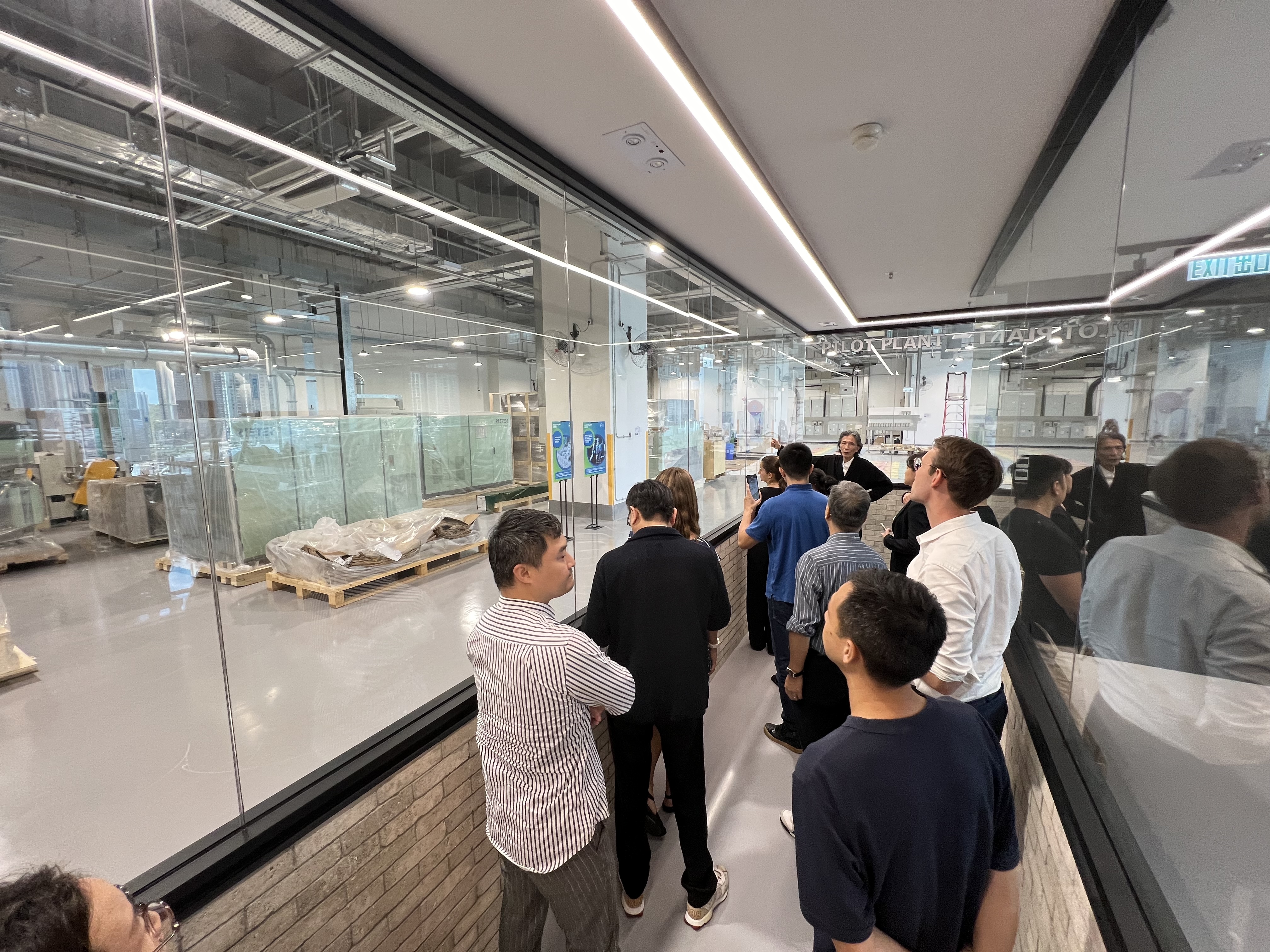
On July 9, the Apparel, Footwear and Supply Chain Committee got a sneak preview of the 20,000-square-foot site and an introduction to this innovation hub and “pilot plant,” with its sleek, high-ceilinged factory floor and floor-to-ceiling windows looking out at Lohas Park and the lush green slopes of High Junk Peak. The tour was led by the refreshingly humble CEO of the Hong Kong Research Institute of Textile and Apparel (HKRITA), Edwin Keh. The group of 20 from AmCham all agreed the visit was fascinating, eye-opening and inspiring.
The Open Lab is the latest initiative of HKRITA, which was established in 2006 as an applied research center for the textile, apparel and fashion industries. Open Lab was set up to be a working factory and platform for industry partnerships that encourage “multidiscipline, multipronged problem-solving.”
This is already evident in its partnerships, which include major multinationals and the H&M Foundation, privately funded by the Persson family of H&M Hennes & Mauritz (HM-B.ST), as well as universities across Hong Kong that lend their research expertise and tap into experimental pilots. Marco Chen, tour participant and General Manager of Innovation for the Fung Group, pointed out how collaboration appears to be their key message: “The concept of open innovation at Open Lab is needed to drive ecosystem-based collaboration projects, as well as to further bolster a community around sustainability here in Hong Kong and beyond.”
Keh provided an overview of HKRITA’s more than 300 projects carried out since it was established and pointed out those that the Open Lab plans to showcase. The projects range from fibers created from food waste to carbon-capturing garments and absorbents able to hold three times their weight in moisture.
From Hong Kong’s firemen to its Olympic squad
HKRITA has also created high performance and innovative workwear for much of Hong Kong’s public service, including fire service uniforms that are attractive, fully functional in 38 degrees Celsius and able to be put on in six seconds or less. In the upcoming Olympics, every Hong Kong athlete will be wearing at least one piece of kit designed by HKRITA. The list of accomplishments and innovation is impressive but largely unknown from this organization that has so far enjoyed flying under the radar. Keh explained, most of their experimentation is still in the pilot phase and they are always looking for companies to test and commercialize research output. He extended an open invitation for brands, companies and researchers to come work with HKRITA on experiments and pilot projects.
Open Lab is all about open IP, just as its name hints. HKRITA has about 70 completed projects with IP and plans to have 100 by the time it opens in September. The success of this experiment will be determined by companies and individuals stepping up to collaborate with Open Lab or utilize the platform. Some of the local partners include Cathay Pacific and the Peninsula Hotels, where HKRITA is piloting programs to recycle uniforms with their textile-separating technology that sorts garments by color, weight and weave using robotics and then breaks them down into fibers through a mechanical process before turning them into new garments.
An 80-foot long supply chain from cotton to garment
Beyond the innovations in materials used in apparel and textile applications, HKRITA is also tackling the bigger problems of complex industry supply chains, especially ones that require a lot of natural resources. A prime example of this is growing cotton, a challenge because of the amount of land, sunshine and water that it requires. At the heart of the Open Lab Pilot Plant is a demonstration of the world’s shortest supply chain from cotton to garment. The full line is the equivalent of two 40-foot containers and is meant to be mobile, able to set up in any environment as it is fully self-contained. On one side is hydroponically growing cotton, with solar-powered lights. On the other side are several stations for handling the fresh-picked cotton and turning it into fibers that is then woven into fabric.
“Where else has that special combination of expertise, infrastructure, capital and industrial clustering to test and prod at ideas as big as how we scale distributed manufacturing? Where else would you even be able to see a working apparel value chain—from farming to ginning, spinning and then production—in one place? Few places can do so, but Open Lab can,” commented JP Stevenson, tour participant and director of ESG analytics at LRQA, a global assurance specialist owned by the Goldman Sachs Group, Inc (GS.NYSE).
Hong Kong’s role in the global textile supply chain, past and future
Keh gave the group a quick history lesson and explained how important apparel manufacturing has been to the development of Hong Kong. The city’s deep history in apparel manufacturing goes back to the early days of the industrialists from Shanghai setting up textile factories. In the 1970’s, the textile industry made up 50% of Hong Kong’s GDP, and the city was the world’s largest exporter of garments. This transitioned in the 1980’s to Hong Kong being the industry’s logistics and service provider and the bridge between China’s manufacturing and the world. The last garment factory in Hong Kong was shuttered in 1990. There is no better place for Open Lab to be located, sitting in the heart of Asia—still the world’s manufacturing powerhouse—and leveraging the deep know-how that exists in the region.
A US clothing brand representative in attendance said that she found it personally motivating to see how much HKRITA and Open Lab are doing to drive the industry forward and for Hong Kong. Katherine Cheung, partner with the US law firm, Dorsey & Whitney, said, “Open Lab is a hidden gem in Hong Kong. The dedication and passion of the scientists here is admirable and inspiring. Their cutting-edge research is simply remarkable. I am proud to be a Hong Konger, knowing that this is the level of excellence we can offer the world.”
Open Lab plans to rotate the functioning parts of the factory floor regularly. The vision for Open Lab is that it puts Hong Kong on the map as an instigator of industry change to solve climate change problems. In just under two months, the official opening of Open Lab is scheduled complete with fanfare and government dignitaries. The launch is long awaited after Covid-19 threw a wrench into things – construction delays then complicated matters.
Open Lab proves Hong Kong’s continued value in the global apparel industry, as well as its role in seeding innovation. When referring to today’s geopolitical tensions and global supply-chain challenges, Keh says, “If there is something we can all agree on, it’s sustainability. And if we can solve world peace at Open Lab, that’s great, too.”

Catherine Cole is Co-Chair of the AmChamHK Apparel, Footwear and Supply Chain Committee. She is a global strategist with experience working across Asia in operational and consulting roles for companies in diverse sectors such as apparel, consumer electronics and aviation. She is also a sustainability growth catalyst with B Purpose Bureau, a boutique impact consultancy firm helping companies become purpose-driven, impact-aware and stakeholder-focused.