
Did you know? Nearly 30% of the National Basketball Association’s players were born outside the US, Hong Kong has its own prospect, David Muoka, and the Greater Bay Area has four NBA Hoop Parks, NBA-themed community basketball courts.
The NBA has an office in Hong Kong for a reason – because of its business-friendly environment, it goes without saying, but also for its concentration of international sports business brands from Nike to Lululemon and Legends, the sports entertainment giant that owns ASM Global, the world’s premium live events company. ASM Global is the lead operator of the brand-new Kai Tak Sports Park, supporting its design, programming and construction. The NBA has its own “merch” of course, but the proximity of major sports retail brands, sponsors, legal and professional services firms, media and the sheer marketing power of Hong Kong’s sports business community amplifies everything it does.
Here AmCham HK e-Magazine editor Edith Terry has a chance to find out from Wayne Chang, Managing Director of NBA Asia who is based in Hong Kong, what the world’s foremost basketball league is up to in Asia-Pacific.
“The NBA transcends sports”, says Wayne Chang, who runs the Asia business of the world’s premier basketball league from his office in Causeway Bay in Hong Kong. He then proceeds to prove it, by listing all the ways that the NBA intersects with fashion and entertainment and its investment in building hoops culture from the ground up.
It has its own branded merchandise, is about to launch a basketball and music festival in NBA House in Macau, and has built 24 “NBA Hoop Parks” across mainland China that introduce youngsters to the sport and host so-called “Legends” – retired players – and active ones to bring the game to the younger generation.

Not that basketball is new to Asia. It is still one of Asia-Pacific’s fastest growing sports, according to NBA research. In countries like the Philippines, basketball courts are found in every rural village, and Tim Cone, coach to the Philippine men’s team, is a national hero. Two years ago, the Philippines hosted the International Basketball Federation (FIBA) World Cup together with Indonesia and Japan, and just hosted local qualifiers for the NBA’s brand new regional high-school competition taking place in Singapore in June.
Chang also cites collaborations with brands as varied as Tissot, the luxury Swiss watch subsidiary of the Swatch Group, and K-pop bands Suga and Le Sserafim. The latter serve as NBA ambassadors and are part of the Friends of the NBA program. They attend games in the US and the NBA works with them to develop exclusive content it puts out on social media channels that allow the NBA to tap into its fan base. “It’s a type of cross-pollination,” says Chang.
The allure for both fans and collaborators is not just the excitement of association with incredible players at the top of their game, like Nikola Jokic of the Denver Nuggets, Shai Gilgeous-Alexander of Oklahoma City Thunder, or Giannis Antetokounmpo of the Milwaukee Bucks, aka “the Greek Freak” for winning the NBA Finals and twice being named the league’s Most Valuable Player.
It is also its enormous 2.5 billion-person social media following, ahead of Instagram’s and WhatsApp’s 2 billion monthly active users as well as TikTok’s 1.6 billion users. On Instagram alone, according to Statista, a data aggregator, the NBA has 90.6 million followers. Predictably, LeBron James has the most followers – 213 million – of any individual player, although he is well behind Portugal football icon Cristiano Rinaldo with 1 billion followers.
This means, among other things, that the old way of measuring brand appeal, through television ratings, has almost completely collapsed. The NBA’s new audience is global, with 70% of its social media following outside the US and half of the total audience under the age of 25, according to virtual magazine SportsEpreneur.
“We are going to continue to focus our efforts on developing basketball and engaging our fans with events, grassroots activities, and broadcast,” says Chang. “We broadcast our games across Asia through various partners, and that reaches all our fans, because a lot of them are on mobile and able to watch the games in the morning in Asia”.
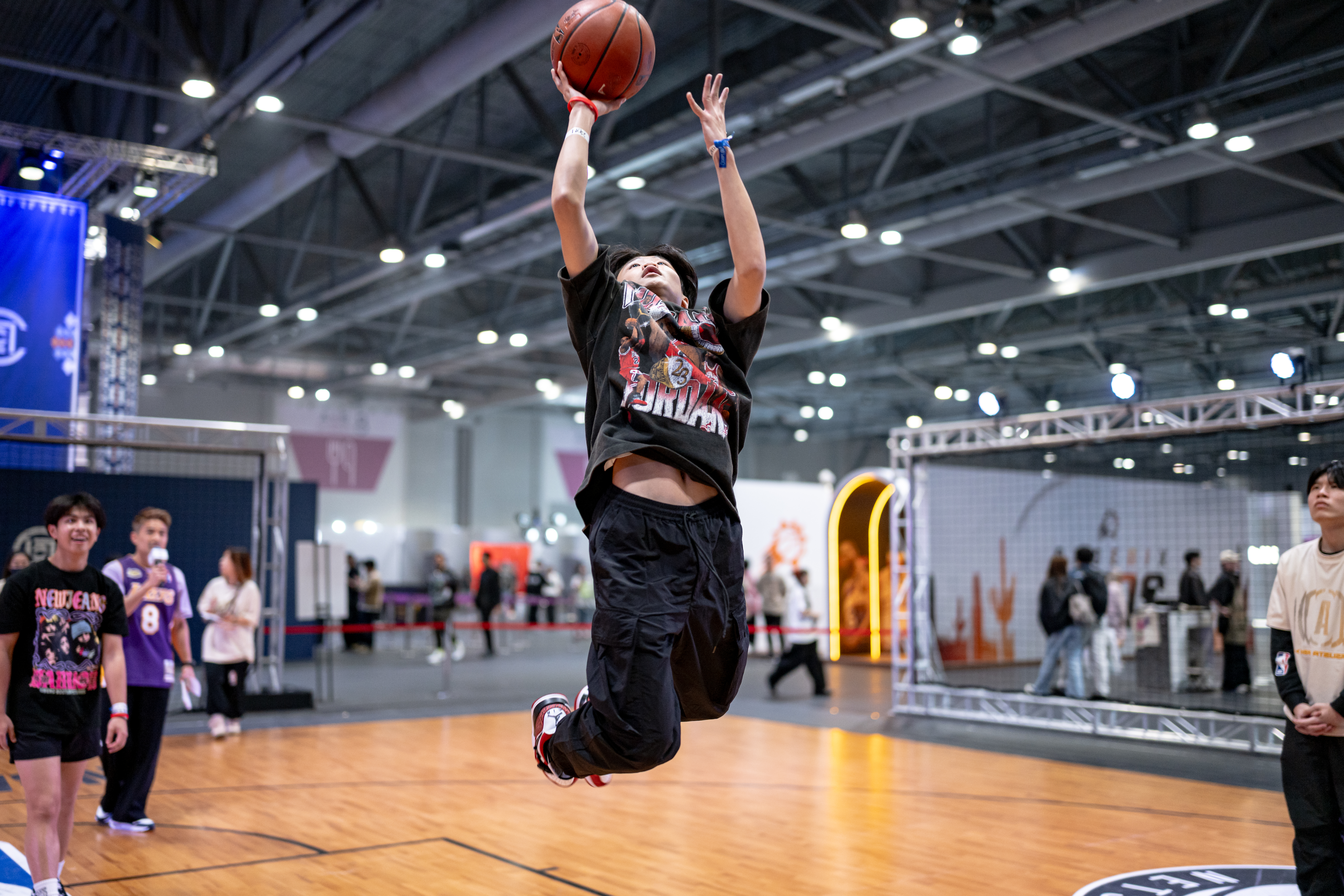
The NBA has not only been alert to the trend but ahead of it. In Hong Kong in March, it joined ComplexCon, a festival and exhibition that brings together music, fashion, especially sneaker fashion, pop culture, art and food. Hong Kong’s second edition of ComplexCon, at AsiaWorld-Expo, featured panel talks on the culture of figurines and collectibles, the fashion world for athletes, footwear, the globalization of street culture, and a marketplace with limited-edition drops from an array of fashion brands – and the NBA.
The “NBA Zone” featured a basketball court, an NBA China Games showcase with interactive booths by the Brooklyn Nets and Phoenix Suns, and retail merchandise from NBA Atelier. Three-time NBA champion Bruce Bowen – one of the “Legends” – hung out with fans and local pop celebrities including 193 from boy band ERROR and Candy from girl group Collar, organized by NBA media partner ViuTV.

The NBA in Asia – raising its game
The NBA has had a presence in Hong Kong since the 1990s, albeit less extensive compared to its footprint in China, which has its own offices in Shanghai and Beijing, which Chang was part of until last September.
Later this year, the league will be hosting games in China – the first in China in six years. “We’re bringing NBA global games to Macau,” says Chang. “We have a huge basketball fan base in the Greater Bay Area (GBA) and that’s why we’re promoting a global game. But we are also going to be more active in Hong Kong because it is the foundational city in the GBA.”
The games are pre-season exhibitions on October 10 and 12 featuring the Brooklyn Nets and Phoenix Suns. Sands China, a subsidiary of Las Vegas Sand Corp., announced its five-year deal with the NBA last December, and its newly renovated 14,000-seat Venetian arena at the Sands Resort Macao offers not only state of the art LED screens and acoustics but a steep seating well that keeps attendees close to the action.
“From a marketing perspective, we have two and a half billion followers on our social media accounts,” says Chang. “That will be part of our partners’ activation, to be able to reach those fans. That’s the online piece. The offline piece is that we will be doing a lot of activations as we promote the Macau games, with Sands China as our partner. There will be a lot of opportunities with their hospitality element on the ground, whether we do that with Legends or with current players to promote our partners, products and services”.
He adds: “With the Macau games, we will build what we call an NBA House, a free immersive basketball experience and fan event, basically a basketball festival for the entire week. You’ll have partner activations in the House as well as musical performances and Legend appearances”.
“The best way to describe it is that it is like the basketball version of a music festival. This is what we’re trying to do because we feel it will attract more of a general population versus just a basketball following population. We want to have the casual fans as well as the hardcore fans”.
The inevitable question for Chang, is ‘why these two teams in particular? The answer, he says, has as much to do with the owners as the venue. “Every team has their own aspirations in terms of growing their fans”, Chang says. “The Brooklyn Nets are owned by Joe Tsai, chairman of the Alibaba Group. They are very global in thinking so that played a part in them wanting to play the game in Macau. For the Phoenix Suns, they have aspirations to be a global brand, in terms of having fans outside the US and especially in Asia. I think they’ve targeted Asia because that’s a big part of being a global brand. The Suns and the Nets both have global aspirations, so Asia made sense for them”.
The Suns are owned by Mat Ishbia, a former basketball player for Michigan State University who also owns the Phoenix Mercury of the new Women’s National Basketball Association, together with his brother Justin. Ishbia made his fortune after his United Wholesale Mortgage went public in 2021.
The NBA is running a series of “activations” or events with sponsors and collaborators in advance of the Macau games, including the recent ComplexCon event. “We’re more than just basketball, because we are also so present across culture, fashion and music,” says Chang. “ComplexCon is a very, very unique show. We set up a booth there and it was very successful to have a different fan base that goes to ComplexCon versus those that go to a basketball game. But there is a crossover there. We did that to promote awareness of the Macau game, but there will be many, many more. We’re planning an event a month in Hong Kong to promote the Macau game that’s coming in October”.
Beyond Macau
While the games in Macau are naturally absorbing bandwidth, the NBA is looking well ahead to the development of local players and deepening basketball culture across Asia-Pacific. Chang’s mandate includes Japan, South Korea, Australia, the Philippines, Indonesia and Singapore, all with keen basketball fan bases. He is working to extend that in a variety of ones.
Among the most endearing, from an American perspective, is an experiment with “NBA Hoop Parks”. The concept is based on the runaway success of the Entertainer’s Basketball Classic at Greg Marius Court in Rucker Park in Harlem in New York City, where superstars like Kobe Bryant, Allen Iverson, Stephon Marbury, LeBron James and Shaquille O’Neal shoot hoops with local players and entertainers like Rihanna and Beyoncé drop by to charge the festival even more. It was started by a rag tag group of hip hoppers but changed the culture of basketball in New York City.
While not as elaborate as the Rucker Park’s Entertainer’s Basketball Classic, while Chang was in Beijing he began work on Hoop Parks across China. Now there are 24, mostly double courts, and the latest one was opened by Hong Kong’s K11 Group in Shenzhen in April. Chang says he would like to put together an NBA Hoop Park in Hong Kong, part of an effort to promote basketball locally.
“An NBA Hoop Park is a community space where you can go to play basketball, says Chang. “It’s either ticketed or free, depending on the model, but it’s a full-sized basketball court and built to NBA standards. You can play pick-up basketball or organized basketball at these facilities. We bring basketball legends that are in town, former players to these parks, and bring NBA elements to the parks. It allows us to have facilities that are across China that allow folks to engage with the NBA as well as play the sport”.
Chang is also working hard to bring youth-based tournaments to Asia, as a way of growing the sport from the ground up. “The FIBA World Cup in Indonesia, Japan and the Philippines was a very, very successful event and has helped to grow the game by bringing a major competition to Asia. It helped to increase fandom, as well as people playing the game. It has really helped us to continue to find ways to work with partners and bring more basketball-related activities to these countries.”
Now the NBA has designed its own youth tournament with the NBA Rising Stars Invitational, as part of a multi-year collaboration with Sport Singapore and the Singapore Tourism Board. Boys’ and girls’ teams from 10 countries and territories across Asia-Pacific will compete in a regional tournament within a “multiday immersive basketball and entertainment festival” at the Kallang Alive Precinct in Singapore from June 25-29. The first annual NBA Rising Stars International will be headlined by a lineup of current and former NBA and WNBA players, as yet to be announced, and include skills development, social responsibility programming and cultural exchange among the players.
“Our goal with the NBA Rising Stars Invitational is to build on that momentum and provide a stage for top players to compete alongside and against their peers from across the region. The NBA Rising Stars Invitational will help accelerate and elevate the basketball eco-system in Asia-Pacific while serving as a viable pathway for players to receive additional training.”
He adds in the interview: “One of our key goals for the NBA is to create opportunities for boys and girls to play basketball year-round and to engage our fans. The quickest way you become a fan is to play or to have played the game in some fashion when you were young. Which is why we’re so excited about NBA Rising Stars Invitational”.
And what about that next generation of players?
Nearly 30% of current NBA players were born outside the US. Chang says that having NBA players from the Asia-Pacific region is great for the NBA’s overall business because they drive interest to the league and affiliate leagues by fans’ association with their home country.
“It’s a priority for us to develop pathways and therefore opportunities for players to get to the highest level of the NBA,” says Chang. “We’ve seen more success coming out of Australia and Japan lately, with players such as Josh Giddey and Dyson Daniels, who are in the starting line-up for NBA teams now. That’s great to see. Also, Rui Hachimura, with the Los Angeles Lakers, coming out of Japan who is immensely popular. We’re continuing to push in Hong Kong”.
Hong Kong has its own rising star, David Muoka, who was born and grew up in Hong Kong. A graduate of the West Island School, the six-foot ten-inch (2.08 meters) Muoka has a Nigerian father and English mother. Currently playing in the NBA’s developmental G League, he is having visa issues confronting his desire to play for Hong Kong in the FIBA games, but the 24-year-old was the first Hong Konger to sign with the NBA in 2024 before being traded to the Windy City Bulls in Austin, Texas.
It’s an exciting time for the NBA in Asia, and from Hong Kong’s perspective, this is just the beginning. If anything, the social media revolution in sports and the crossovers with fashion and entertainment mean that fans will be close to the action – together with the growing sports business community in the city and a long list of allied professions and service providers.

Wayne Chang, managing director of NBA Asia since May 2024, was formerly based in Shanghai with NBA China as chief financial officer and chief commercial officer from 2013 to 2024. He has lived in Asia since 1999, as a senior executive with General Electric Company. He has a bachelor of arts degree in economics from Indiana University Bloomington.