

As excitement builds towards the launch of Hong Kong’s new HK$30 billion Kai Tak Sports Park, with its centerpiece 50,000-seat stadium nicknamed “The Pearl”, Hong Kong’s athletes are on a trajectory to make their own history. Trisha Leahy stepped down as CEO of Hong Kong Sports Institute last years after 15 years running Hong Kong’s premier laboratory for world-class athletes. Here she talks about the grueling process of becoming a funded Olympian and the importance of collaboration across government, sports institutions, business and the public, in conversation with AmCham HK e-Magazine editor Edith Terry. “Given the size of our population, the number of high-performance results that the athletes have achieved, not just at the Olympics, but also at the World Championships and Asian Games is quite extraordinary for a city the size of Hong Kong,” Dr. Leahy says.
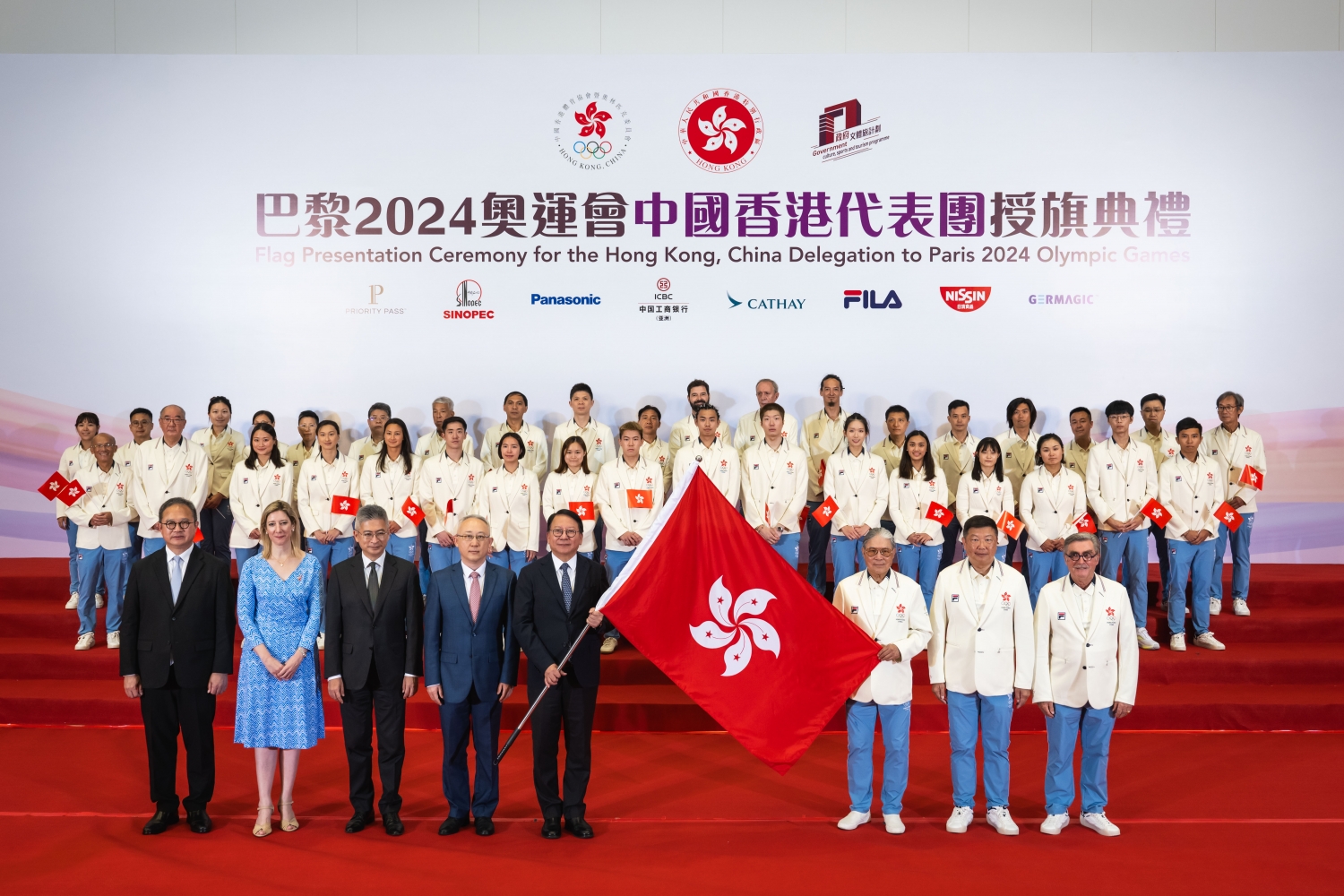
Were you surprised by the results of the Tokyo and Paris Olympic Summer Games?
At the Paris Olympics, all athletes performed well, and there were some close calls. In table tennis, the mixed doubles had a fantastic run. And the medal winners, as usual, were absolutely spectacular.
It was great to see the athletes performing, outperforming others, outperforming themselves, and achieving their goals. After the Tokyo Olympics in 2021, when the Hong Kong athletes won six medals, some people were saying, ‘Wow, this is such a surprise.’ But of course, among the insiders, we were not surprised. You could see the trajectory, understand the data, the probabilities, and who was on the top and who was likely to be out.
This was the product of a whole series of developments and significant amount of teamwork across the various agencies in Hong Kong, including government, the sports associations, the Hong Kong Sports Institute (HKSI), the Sports Federation and Olympic Committee of Hong Kong, China (the SF&OC) and the China Hong Kong Paralympic Committee. Without that collaboration, you don’t get results like that.
For the development of high-performance in sports, the timeline is about 10 years for a talented athlete, to develop that athlete’s talent up to a point where they are able to compete internationally and then start winning internationally. When we look at the athletes who are performing now and who performed well in Tokyo, if you look back at their careers, you can see that many of the athletes were world champions. At the junior level, they were consistently in the world top eight or world top three. These are important markers to indicate an athlete’s development is going in the right direction.
Where do Hong Kong’s athletes come from?
The Hong Kong Sports Institute works closely with the national sports associations (NSAs). They develop the athletes from the grassroots level up to a certain point. When the NSAs meet the policy criteria, their candidates enter the Sports Institute. And the Sports Institute’s job is to take their athletes from where they are to world level.
HKSI’s job is to provide a system of high-performance training. To be able to do that properly, first we collaborate with the NSAs to make sure we’re all in agreement about the athletes coming in and that they meet the criteria.
There are different tiers in sports, and each tier gets different levels of support. The system is structured around a set of critical success factors, which must be appropriately funded. These, of course, include coaching, facilities, science, technology, medicine, research and athlete lifestyle support, such as accommodation, education, nutrition and all the aspects of their lives that go into keeping the athletes on the right track, to be a high-performance athlete, and at the same time keeping them on a positive path of personal and social development.
All these collaborations are ongoing. We are very fortunate that the government has been very supportive that we have our own facilities. Most of the sports train at HKSI. Sailing, windsurfing, gymnastics, and cycling train partially off-site. The Leisure and Cultural Services Department (LCSD) is very accommodating in allowing us to have specific access to venues for those sports, including the Velodrome.
Is there a hierarchy of sports rankings in the process of building world-class athletes?
There is a ranking among the different sports, based on their results and Olympic potential. These categorizations are set by the Hong Kong Sports Commission, which is chaired by the Secretary for Culture, Sports and Tourism. The categorizations have been developed by the government in consultation with the stakeholders.
Tier A* sports have Olympic medal potential in the next four to eight years, demonstrated by their previous results. That would be fencing, swimming, windsurfing, table tennis, cycling and badminton. Tier A sports have met specific criteria for the Asian Games or Olympic Games. That would be all the others – gymnastics, squash, athletics, rowing, triathlon and so on. There are 26 of them, including Paralympic sports.

Tier B sports are sports that are not necessarily Asian Games or Olympic Games sports, like cricket or lawn bowls, but they are sports that are developing very well and meet Tier B criteria. They receive primarily financial support through HKSI. There’s another program for team sports, which was a pilot program set up a few years ago by the government to try and generate more opportunities for team sports to develop.
The criteria are very specific and sports are evaluated every two years. The Sports Commission, based on the review and the evaluation, will then make a recommendation about which sports that can enter, or leave the system if they fall off the benchmarks. There are some up and coming sports that are close to the benchmark, and hopefully in the next few years, will come closer.
With the Tier A sports, if the athletes are training full time, they can live at the Institute full time. They get all their competition, training, clothing, equipment, medical coverage, travel, coaching, science, medicine, fitness training, everything that they need, and they also get access to education.
How do you provide for the athletes’ education, seeing as they are mostly in their teens if not younger?
One of the major sea changes in Hong Kong in recent years has been the increased collaboration with educational institutions. We’ve been very fortunate in HKSI to have chairmen of the board like Eric Li, Carlson Tong and Lam Tai-fai, who were able to assist us in the education piece. Eric Li was instrumental in highlighting the need for flexible education for athletes to the government and Legco. Around 2013 when Carlson was the chairman, one of his initiatives was to collaborate with the Education University of Hong Kong and its then-president, Stephen Cheung, to allow admission for the athletes to flexible programs that allowed them to train full-time at the same time as having access to a flexible education degree.
Following that, The Chinese University of Hong Kong came on board, and Hong Kong Polytechnic University came on board, offering similar programs to athletes. The other universities followed suit. In 2022 when Carlson Tong was chair of the University Grants Council (UGC), a systematic program was set up across all the universities funded by UGC to allow athletes access to university based on their sports results, even if they didn’t meet the minimum academic requirements of the university. Funding and scholarships were made available, and HKSI was also able to provide support.
These were major, major changes, because all along, in Hong Kong, the education piece was the primary barrier to athletes training full-time. When I became chief executive of HKSI, there were fewer than 150 full-time athletes. Now there are almost 600. The reason for the shift has been not only increased government funding, but access to education, such that parents no longer worry, ‘Does my child do sport, or does my child do education?’ Because both require full-time access. Now they can do both.

In 2015, another major change happened at the high school level, when Lam Tai Fai College in Sha Tin set up a special program for elite athletes. It was a series of classes from Form Four, Form Five and Form Six, to give athletes access to part-time, flexible high school education at the same time as being full-time athletes at the Hong Kong Sports Institute.
Again, that was another sea change, because at the high school level, previously, while schools had been very supportive of athletes, athletes had to work very hard to organize their time and do their studies at the same time as trying to do sport. Parents would often withdraw their children from their sport while they were preparing for exams. At the high-performance level, it’s very hard to come back after that. Having access to flexible education at the high school level absolutely changed that narrative for many, many families in Hong Kong.
And then the English Schools Foundation set up another system providing flexible access for young people who are elite athletes at the Institute. These kinds of changes in the past 10 years have been major.
Can you share about HKSI’s big makeover after 2008?
During the 2008 Olympics, the equestrian events were held on the HKSI site, and HKSI moved temporarily to the Chinese YMCA Wu Kwai Sha Youth Village in Ma On Shan in 2006 to make way for site preparation. In 2008, the government allocated HK$1.8 billion for redevelopment of HKSI. The modernized, purpose-built campus was finished in 2015. After the successful Tokyo Olympics, a HK$1 billion grant from the government to was given to HKSI to build a new science, medicine, technology, and fitness training hub, which has just been completed. It’s being fitted out now and will be ready for operation in the coming months.
All these developments, working hand in hand with the government, have been ongoing and are contributory to the athletes’ success, both at Tokyo and again at the Paris Olympics and Paralympics. These are not one-off situations. This is a very planned, very predictable, high-performance pathway, and it’s all down to this collaboration and teamwork approach from everybody in the sector.
I think Hong Kong needs to be applauded. Given the size of population, the number of high-performance results that the athletes have achieved, not just at the Olympics, but also at the World Championships, the Asian Championships, and the Asian Games is quite extraordinary for the size of Hong Kong.
Since the modern Olympics began, approximately 70% of the National Olympic Committees that attend the Olympics, primarily representing states, but also some representing regions and places like Hong Kong, have never won a gold medal. Over 60% have never won a medal of any color, and 40% have never even reached the top eight. Hong Kong, with its 13 gold, silver and bronze medals, since 1996 is doing extremely well. And at every single Olympics since 1996 we have had athletes in the top eight.
The top eight is a key benchmark when you’re looking at the Olympics, because if you’re not around the top eight, you’re nowhere near a medal opportunity. We always look at that as a measure of what’s going to happen next. How many athletes were in the top eight? Are they likely to compete next time? These are some of the parameters and the ongoing discussions that happen around the high-performance results and what’s going to happen in the future. We should be proud of every talented athlete who performs on the world stage to bring honor to Hong Kong.
What is your advice to young athletes?
When you’re a professional athlete, and millions of dollars are being invested into your performance and your development, success on the world stage is your ultimate goal. Like any profession, there are Key Performance Indicators (KPIs). However, from the human development aspect, how you do that very much is a function of how you see yourself as a person, your identity as an athlete, your investment in your personal development, your ability to overcome barriers that you may have inherited from when you were a child. Not everybody comes from a perfect background.
How do you overcome some of those barriers, lack of self-confidence and lack of belief in oneself to become a world champion? You have to have that talent in the first place. Then, it is a process of understanding yourself, and understanding your performance.
You represent yourself, you represent Hong Kong, you represent your association, you represent the Hong Kong Olympic and Paralympics Committee. All these things can create a lot of pressure. At the Olympics, you’re in front of millions of people watching you. How do you focus on the right thing at the right time so that the medal comes to you because you’re performing your best?
If your only focus is on, ‘I want to win that medal’, well, everybody wants to win a medal. that’s not the point. The point is, how are you focused on the process, on each step along the way, and doing that perfectly? And if each step has been done perfectly, and you do the final step perfectly, and you happen to be the best on that day, then the medal comes to you.
Understanding that process of development is important for athletes, as is the understanding of non-achievement of goals. Athletes are expert at reframing what other people might call failure so that they can get up again the next day and continue training. For an athlete, in a sense, there is no such thing as failure. There’s simply, ‘That goal wasn’t achieved. somebody was better than me on that day’. How do I evaluate? How do I move forward? How do I improve myself?
In a sense, success is the same process. When they come back with the gold medal, they still look at, ‘How did I do? How can I improve myself? How can I repeat that? How can I do better next time?’. The psychology of high performance and working with athletes is a positive-oriented psychology and method and has a lot of applications for the public and for young people in today’s challenging world.
How can business help?
Sports participation for young people in our communities is an important part of physical health, mental health, and social development. That, in turn, has impact on our communities. Research shows that participating in sport develops well-rounded young people. It enhances community social cohesion. We see that when we look at how the community responds to the athletes who win medals, for example, in the shopping centers where they’re displaying the live broadcasts and how everybody comes together on this one idea that somebody from Hong Kong can be the best in the world.
There are add-on benefits, if you like, that add value to our community. I think it’s important that every child should have access to sports training of some kind in Hong Kong. I’m very happy to be involved with the Hong Kong Jockey Club, which is funding a six-year project called Project MuSE, a school-based music and sports education program for children in some of the most deprived areas of Hong Kong.
The idea is to establish, deliver and measure the impact of having access to the arts through music and having access to sport, and how that can change young people’s lives and impact positively on their development. These are the kinds of things that interest me, how sport and arts can positively impact on young people’s lives going forward, and I think it’s something for which we need to get a lot more commercial as well as government support. Business can contribute by providing funding. And I think one of the areas in Hong Kong where I would like to see more funding is in community sports and school sports.
From the high-performance end, commercial involvement can always be more in terms of sponsorship, and that’s all great because it provides a very visible role-modeling effect for young people. But where we need access is for young people who currently don’t have access to sports because the school does not have sufficient sporting facilities, and therefore their sports programs are not, perhaps as exciting for young people because they don’t have sufficient breadth of sports options. Not every young person is going to follow the traditional sports path. Young people may be more interested in some of the more modern sports, like parkour and different kinds of physical activities.
It doesn’t have to be sport, but it has to be movement if they’re going to meet the World Health Organization basic requirements of one hour of physical activity a day, which many children are not meeting in Hong Kong. I think at that level, businesses could get involved with the local sports associations. They could get involved with the schools in terms of providing funding and assisting with facilities and training personnel to be highly skilled and highly trained.
I was very happy to hear that the government is now including physical education as part of the actual formal academic curriculum where points are assigned. Previously that wasn’t the case, and therefore when it came to a clash of curriculum, physical education was always the lesson that would be skipped for maths or Chinese or English or some other aspect of the curriculum.
Business can collaborate with government as well. I think the government is aware of the need for more facilities, and is definitely committed to providing facilities, and has, in fact, through the LCSD, done quite a lot of work in providing facilities. However, of course, there’s always room for more. There’s always going to be not enough of this or not enough of that. It doesn’t mean that nobody’s doing anything. If you go to any city around the world, someone will say, well, we don’t have enough of this facility or that facility for sports.
That’s normal, because there are competing priorities. In terms of the forward movement of Hong Kong and the facilities that are being built, including Kai Tak Sports Park, the government clearly recognizes the importance of the role of sport and is committed to the development of sport in Hong Kong.
The government has expanded its sports policy, moving beyond the three-pronged approach of sports for all, elite sports and Hong Kong as a sports hub, to include professionalization and commercialization of sport. The government is very actively pursuing how to engage businesses and how to engage sports to be able to be more innovative. The professionalization piece is also very important. One of my areas of expertise is around integrity and safety issues in sport. If we do not have properly trained, properly monitored people delivering our sports programs, it doesn’t matter how many facilities you have, what’s being delivered is not going to be a good product.
We really need to have professional people in place, as well as the facilities. Facilities will be a long-term project for Hong Kong going forward. I’m confident that the government recognizes this and is moving forward in the right direction. It’s just going to take a little bit of time. But also, I don’t particularly think that Hong Kong is a space-limited city any more or any less than any other city. There’s a lot of space in Hong Kong. It’s just simply a question of, how do we use it more creatively to put the things in that we want, like more for arts, more for sports.
What has been the impact of sports technology on Hong Kong’s Olympic success?
Sports technology has been really taking off in the last 10 years or so, in all aspects, whether it’s analyzing equipment, analyzing materials, analyzing biometrics, biomechanics, or trying to do predictive models. After the Tokyo Olympics, the government gave the Sports Institute HK$300 million to invest in the kind of research that would produce better sports results through innovative sports technology and science. HKSI has been collaborating with universities and with industry partners on projects trying to develop in this area.
The Institute has a core staff of biomechanics, biochemists, nutritionists, strength and conditioning trainers, physiologists, and psychologists. They work together in a multidisciplinary team. And the use of technology is a fundamental part of sports training. Nobody who is doing well in the Olympics right now is doing it without some kind of technology and scientific assistance. It’s a core element of the development of high-performance sports. If you look at some of the Olympic finishes, it was almost impossible to tell who got across the line first, and who got across the line second. If you don’t have high level technology looking at issues like that, it’s very hard for sport to continue to have credibility.
Apart from that, Artificial Intelligence (AI) is changing how we deliver the experience to the fans as well. I was at the Asian Games opening ceremony in Hangzhou in last September, and they had integrated technology into the opening ceremony, such that you were seeing, the physical performers, as well as the AI representations on a screen integrating with the physical performers. It was absolutely fantastic.
In short, technology is one of the key levers of high-performance sport and has been for quite some time. The newer ways that AI and predictive modeling is being used is very much a commercial secret. Because no one’s going to tell you what they’re really doing, because it would be easy for that information to then go to a competitor. Similarly, the Hong Kong Sports Institute is working on very, very innovative and interesting projects with universities and industry collaborators. The results of that won’t be shown until they have been achieved and can no longer be an advantage for competitors.
Of course, without the talented, dedicated athletes all striving for excellence and enduring the grueling training to compete for Hong Kong, all this behind-the-scenes support would be futile. Most of all, we should applaud the athletes.
How and why did you come to Hong Kong?
When I was an undergraduate in Ireland, I was studying psychology at Cork University, and I used to work part time washing dishes in a Chinese restaurant until I got promoted to be a waitress! After I graduated, I wanted to do post-grad work, and I wasn’t sure what I wanted to do. I thought, I’ll go and see the world for a while, and I’ll start in Hong Kong, because they’re nice people, and I know how to order fried rice, so I won’t starve.
And that’s how I ended up here in the early eighties. And then when I got here, I liked it. I did a three- month summer course in Cantonese , and by now, many years later, I am fluent and can also function relatively well in Putonghua. Then I became interested in pursuing postgrad work in Asian studies at the University of Hong Kong. Later, I went back to psychology for my master’s and PhD, and then a doctorate in law. I like to combine my interests in political economy, psychology, social issues, and the legal implications and why we organize ourselves the way we do in this world.
When Dr. Trisha Leahy stepped down as CEO of the Hong Kong Sports Institute (HKSI) in 2023 after 15 years in the post, more than 100 people applied for the Irish national’s job. The institute’s training complex in Fo Tan has an annual budget of almost HK$1 billion, funded mainly by the government’s Elite Athletes Development Fund, supporting 26 Tier A sports programs with over 1,400 athletes. Hong Kong’s latest successes at the Tokyo and Paris Summer Olympics in 2021 and 2024 – respectively six medals including one gold in Tokyo and four medals and two golds in Paris – owe much to Dr. Leahy’s unique combination of personal and professional experience. She has master’s and PhD degrees in psychology as well as a juris doctor from The Chinese University of Hong Kong. Dr. Leahy was also part of the support team for Lee Lai Shan, Hong Kong’s first Olympic gold medallist in windsurfing, in 1996. She was awarded a Bronze Bauhinia Star (BBS) and Silver Bauhinia Star (SBS) by the Hong Kong government.