

The second in AmCham Hong Kong’s Future of Hong Kong Series 2025 was held on April 1 at the AmCham Community Hub, focusing on the future of events, hospitality and tourism and the recently released Development Blueprint for Hong Kong’s Tourism Industry 2.0. The first in the series, on “Hong Kong’s Role as a High-Value, Innovation-Centric, Healthcare Hub, was held on March 11, and there will be at least three more in the series on what Hong Kong’s new economy is all about, including ones on innovation, sustainable finance and supply chains.
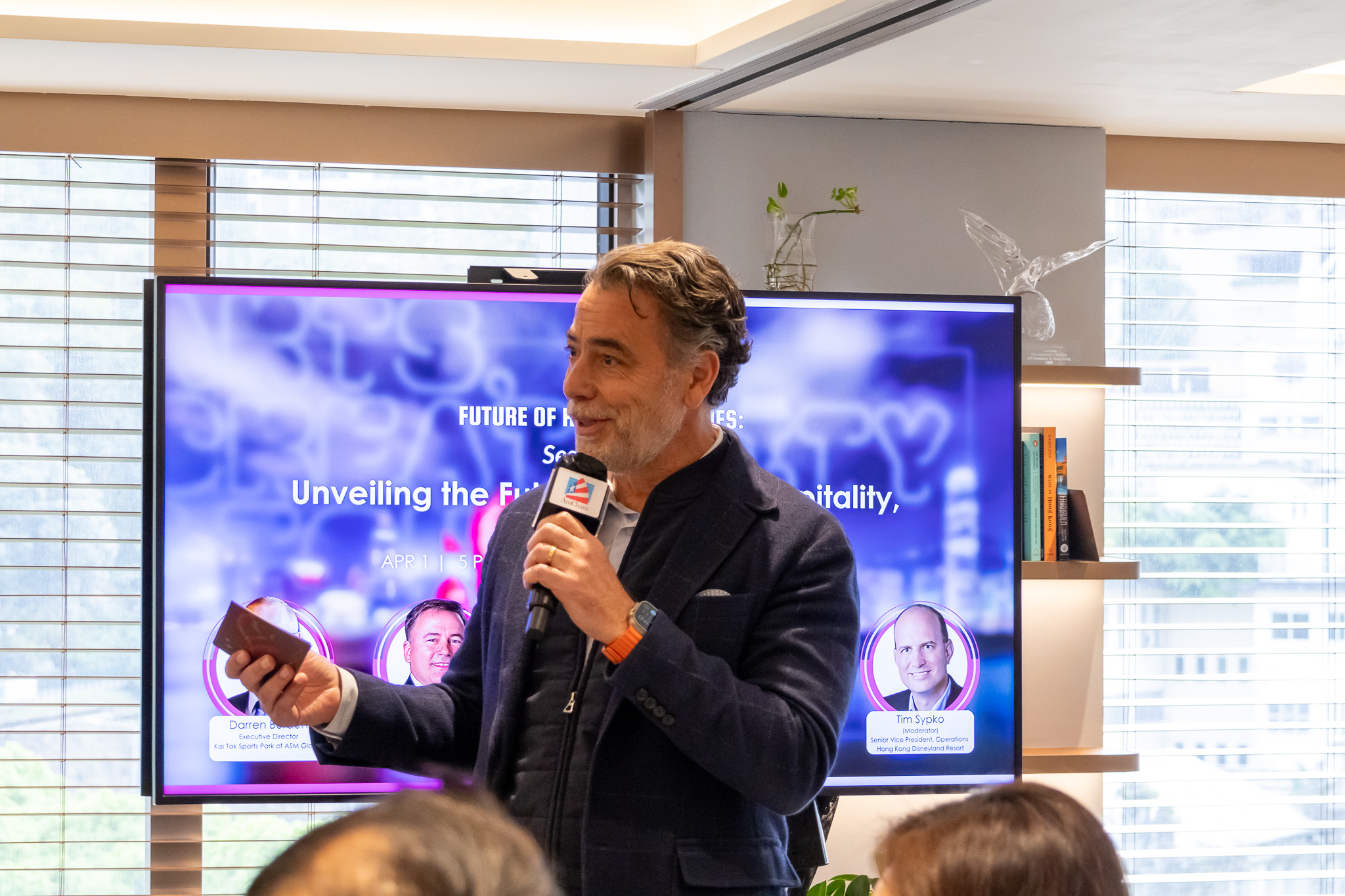
The Future of Hong Kong panel was introduced by Michel Chertouh, managing director of the Regent Hotel and co-chairman of the Retail, Hospitality and Tourism Committee and moderated by Tim Sypko, senior vice president of operations, Hong Kong Disneyland Resort. The panelists were Darren Burden, executive director of Kai Tak Sports Park, ASM Global; Walter Dias, managing director of Greater China and Korea, United Airlines; Samy Redjeb, general manager, APAC, Longchamp; and Caspar Tsui, executive director, The Federation of Hong Kong Hotel Owners.
Since this was an event under Chatham House rules for members and guests, the following summary anonymizes speakers when quoted. Some data is included from outside the panel discussion for context.
New infrastructure, new records
Hong Kong tourism has yet to recover to pre-Covid levels, with 44.5 million visitors in 2024, well below the peak of 65 million in 2018. That is changing, with visitors up by 7% to 8.4 million in the first two months of the year. Nearly 80% from mainland China, even though the number of non-mainland visitors was up by 20%, mostly from neighboring countries.
How to rethink Hong Kong tourism was the shared question for AmCham’s panel “Unveiling the Future of Events, Hospitality and Tourism”. Together with the new museums in West Kowloon, the new Kai Tak Sports Park (KTSP) is clearly among the important game changers for Hong Kong, since it was designed not only for sports but also for concerts and MICE (meetings, incentives, conferences and exhibitions) tourism. KTSP hosted its first Hong Kong Sevens, with a spectacular fly-by of a Cathay A350 plane at 1,100 feet, and its first major concert with British rock band Coldplay a week later. The question is not how KTSP will be used for attracting greater levels of tourism, but how to go about “creating tourism, particularly around sports”, said one panelist.
“It’s all about bringing content or getting content into the sports park, but a by-product of that is a benefit to the whole of Hong Kong, because there are always going to be visitors with the events we put on, whether that’s sports or concerts or cultural or whatever it might be,” said a panelist. “They don’t necessarily need to be major or mega-events, as we call them. They could be smaller things which attract a handful of people for events that are happening across the (KTSP) precinct. It’s the by-product of what we do that benefits the rest of the week, whether it’s retail or the number of bed nights compared with a typical weekend.”
The numbers so far this year have been impressive. Hong Kong’s “Super March” of events brought in more than 3.4 million visitors to the city, including 960,000 non-mainland travelers, according to Financial Secretary Paul Chan Man-po, writing in his blog on March 27. Hotels reported occupancy rates up to 90% in popular districts and retailers saw a “skyrocketing increase in foot traffic,” according to Secretary Chan.
The Hong Kong Sevens saw attendance of 110,000, up 15% from the previous year, with 30,000 international visitors. The four Coldplay concerts generated an estimated HK$1.2 billion ($153.5 billion) with almost 200,000 fans. Art Basel, which ran from March 28-30 reported 91,000 visitors to its 240 galleries from 42 countries and territories. The quirky ComplexCon event from March 21-25 attracted 35,000 attendees and reported sales over HK$87 million ($11.15 million) up 16% from the same events in 2024.
Planning needs to go beyond Super March, however, building on Hong Kong’s considerable strengths. “We don’t need to build something new,” said one panelist. “Yes, we need to always redefine ourselves, but not to deviate too much from our strengths”.
More thought needs to be given to coordinating events such as Art Basel and the Hong Kong Sevens so that they are not all over the same weekend. “It’s not ideal for brands or for retailers,” according to another panelist. In retail, Hong Kong is not competing with Singapore, but rather with Bangkok, Tokyo and Seoul, the panelist said. “Retailers are suffering in Hong Kong, and it’s not to kill the good mood but we need to focus on local consumption and local retailers. How do we maintain local customers in Hong Kong, so that they are not all shopping every weekend in Shenzhen or Macau”?
Hong Kong tourism 2.0
The panelists were all familiar with Hong Kong’s The Development Blueprint for Hong Kong’s Tourism Industry 2.0, Hong Kong’s new tourism road map released last December, which highlights themes such as pandas, horse racing and mega-events. It aims at generating HK$120 billion ($15.5 billion) and adding about 50,000 new jobs over five years, increasing employment in tourism from 145,600 in 2023 to 210,000.
“We still have a lot of opportunities in Hong Kong, whether it’s retail, food and beverage or hotels,” said a panelist. “There’s ups and downs, and the blueprint is intended to address some of these concerns”.
Among the interesting ideas within the Tourism Industry 2.0, said another panelist, is how to balance the pipeline. “Seasonalities are different in different markets, how to look at how to smooth out overall total demand”. But, the panelist added, he had concerns because the document focused more on new source markets like the Middle East and Southeast Asia, rather than Hong Kong’s traditional tourism markets in North America and Europe.
“The Hong Kong Tourism Board is still promoting North America, but I would encourage them to continue that and not to get discouraged by some of the headwinds that we’re seeing. Americans are kind of independent thinkers and independent travelers, and they’re going to get on the plane regardless of what’s going on, because they’re interested in the markets,” the panelist continued.
Others agreed that Hong Kong needs to re-focus on long-haul visitors who spend more and are more likely to book business class and stay in five-star hotels. Now that Hong Kong has KTSP and the museum suite in West Kowloon, the game is to bring in international conferences and exhibitions.
Hong Kong has 330 hotels, with a total of about 93,000 rooms, but average daily room rates decreased by about 4% in 2024 compared to 2023, reflecting the cost-consciousness of tourists and the impact of the strong Hong Kong dollar. New supply of hotel projects will be limited in the near future, with only about a total of 1,200 rooms due to be completed between 2025 and 2026 according to real estate advisory firm CBRE. Henderson Land is among the few building a new upscale hotel, the 91-room Miramar Hotel in Tsim Sha Tsui.
“If you ask our hotels, they’ll say yes, we want the European market, the US market, the Canadian market. We need to bring those tourists back. We need to be the ambassador to bring them in,” said a panelist. “We have the offerings. We have Kai Tak. We have the West Kowloon cultural district. These are all new after Covid. They are brand-new for lots of tourists coming to Hong Kong. We love the Chinese market. But again, where do we position ourselves? Don’t deviate. Don’t give it up. We need to continue to go out.”
The Greater Bay Area is so vast that just finding out about events across the region is problematic. The Federation of Hong Kong Hotel Owners began keeping an events calendar for Hong Kong consolidating the most important sports and cultural events, but it’s generally out of date. “We’re saying that we need to plan ahead two to three quarters,” said one panelist.
“Even if it’s not confirmed, you can put a bracket around it that says it is to be confirmed, especially if it’s an annual event. If you’re visiting Hong Kong, let’s say you want to come in June. What can you do? You can go into the website, but it’s not user-friendly, and it’s not promoted to target audiences and markets yet.”
Questions were also raised over hurdles to get approvals for events, as well as access to funding. “The government has done a really good job over the past year or two to try to refine that and make it smoother for event organizers coming into Hong Kong, but I think there is still a lot of work that needs to be done,” said a panelist. Post-Covid, there was a surge in demand for live events, and booking demand is likely to increase through the second half of the year.
The 15th National Games of China from November 9-21, an event that is held once every four years, will create opportunities for collaboration with National Sporting Associations, other venues, commercial partners and government agencies. “It’s not just about the events, it’s how they get done, reducing frictions and hurdles so that we can actually sign deals and get them done,” another panelist agreed.
This applies to retail as well, with both brands and malls raising their game to provide experiential shopping. Louis Vuitton is in talks to open one of its largest outlets in Asia at the K11 Musea mall in Tsim Sha Tsui, a store of about 40,000 square feet that may include a museum, café and lounge for VIP customers.
In the end, the panelists agreed, the future of tourism in Hong Kong is not just getting more volume into the city. “For us, we’re at the American Chamber here, so I’ll go US-centric a little bit,” said one panelist.
“Attracting US consumers to Hong Kong again is a pretty easy sell. We just need to make sure that we’re promoting effectively within the United States. But they spend. Americans are the highest spend per capita of any of the long-haul destinations coming into Hong Kong right now. So, every person coming in will spend that cash throughout the city, depending on how effective the local businesses are in attracting the customers.”
With that, the panel came to an end, not having solved all the problems facing Hong Kong’s retail, hospitality and tourism industries, but having raised questions and shared optimism around near-term prospects.
Stay tuned for the next events in AmCham’s Future of Hong series.