
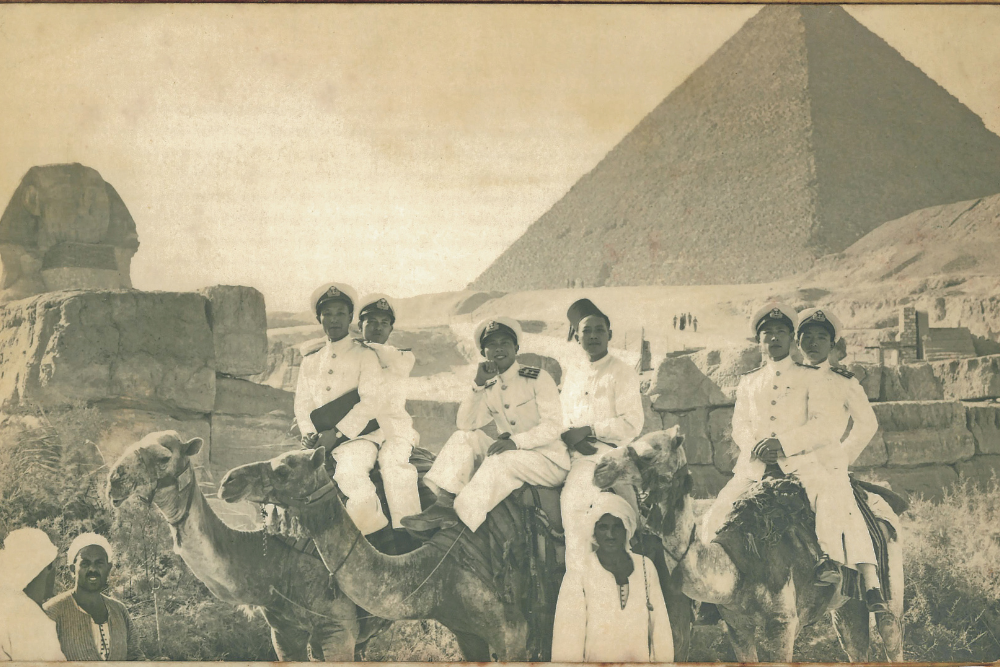
Chinese naval officers_ voyage to Europe in 1943 (Credit_ Huang Shansong)
When two young Hongkongers exchanged name cards in August 2023, they had no idea they would be spending much of the next year together. John Mak, 32, and Angus Hui, 30, bonded over a shared passion for Hong Kong and questions about its global relevance. Hui, a historian, was a graduate of the University of Cambridge, where his master’s thesis was about the Civil War in China in the 1940s. One of his sources was a diary of a Chinese naval officer that had been recovered from a building set for demolition in Sai Ying Pun.
Hui transcribed parts of the diary through the 1940s for his thesis, but there was a bigger story, that he shared with Mak, a public policy professional. The diarist, Lam Ping-yu, had been a graduate of the Whampoa Naval Academy in Guangzhou, and one of 24 Chinese naval officers sent to train with at the Royal Naval College, arriving in October 1943. Lam was sent to join the Allied fleet at Normandy for D-Day on June 6, 1944, on the Revenge-class super dreadnought battleship HMS Ramillies, built during the First World War. The next year, Lam also participated in Operation Armour to deliver supplies to Hong Kong after the Japanese surrender in August 1945.
Here Mak and Hui share with AmCham HK e-Magazine editor Edith Terry what they did next.
“Everything started in 2024,” says John Mak, on a Zoom call with Angus Hui as they rush hurriedly from a school visit. They were spreading the word with students to get them excited about their exhibition, Lost and Found in Hong Kong: The Unsung Chinese Heroes at D-Day.” Just one year after they first met, the pair were about to launch the first of a series of roaming exhibitions at the Hong Kong Fringe Club between September 10 and 19, followed by the University Library of The Chinese University of Hong Kong between September 23 and December 25.
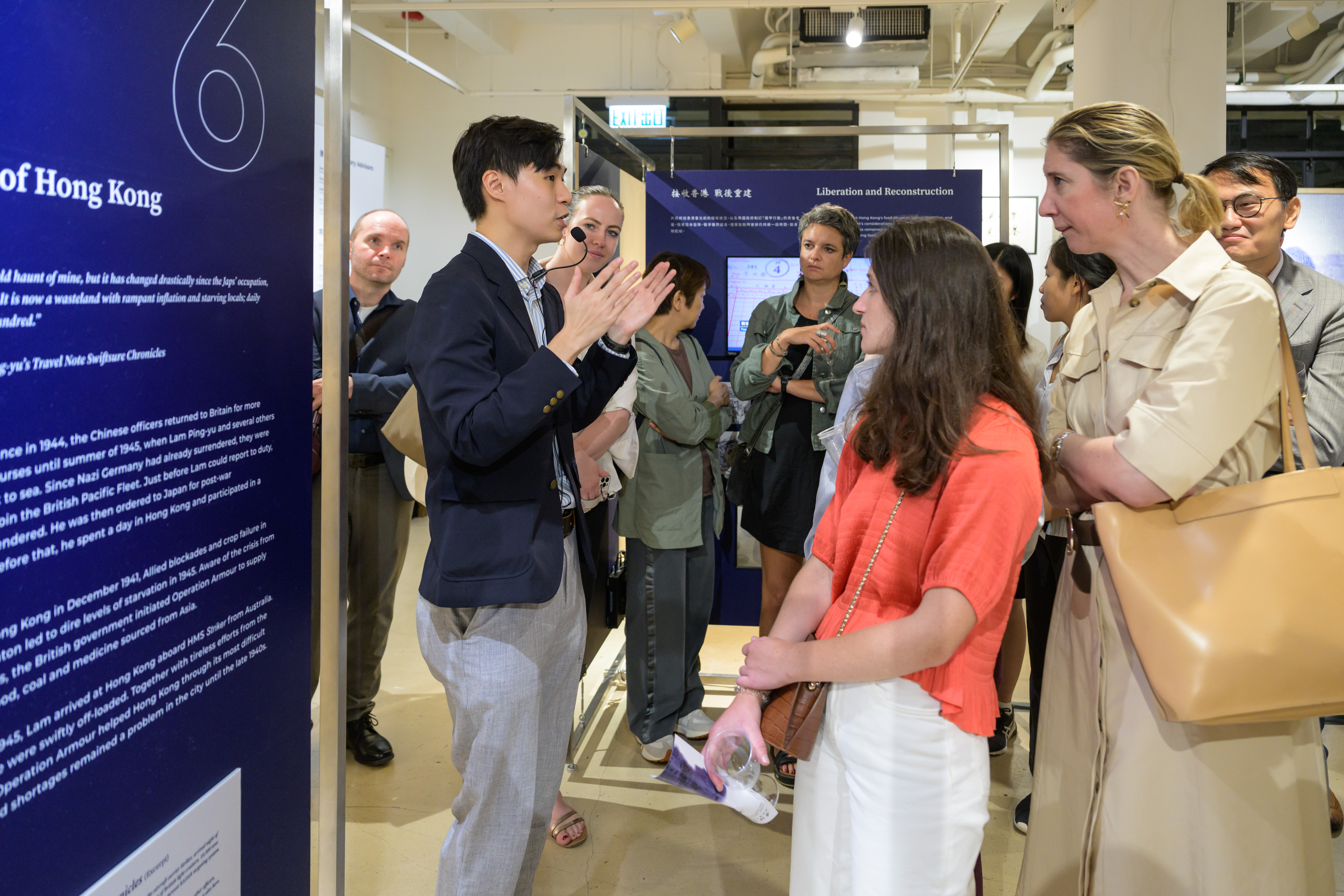
They had an extraordinarily short timeline to put the exhibition together for the 80th anniversary of D-Day this year. “We defied a lot of expectations,” Mak said. “Many said we wouldn’t be able to pull it off in such a short time.” But they did, with help from the Urban Studies Institute, legal partner Mayer Brown, logistics support from Crown Worldwide Group, in-kind contributions from Lenovo Group Limited (0992.HK) for devices, and a 50% discount from the Fringe Club.
Even so, they were using their own funds up until the last minute, which covered setting up a website with a 5-minute clip, The Importance of Transmitting Memory, that involved visits to London and Normandy itself.[1] Most of the sponsors provided in-kind support, although they have reached the final stage of securing support from donors.
Why it mattered
Why this mattered so much that Hui quit his job to work full time on the project and Mak is dedicating “almost full-time” is simple. Both believe that the story of Lam Ping-yu illustrates how Hong Kong was and remains globally relevant. “Hong Kong has always had a very, very robust global network,” says Mak. “While we may not be the protagonist, we bear witness to global history.”

“It’s genuinely the curators’ takeaway from six months of researching into the past of this city, our city, that there was clear international relevance. The other takeaway was how the past resonates with the present.”
“As we embarked on the journey, we have come across people, experts, veterans who have had connections with Hong Kong from around the world. These are random figures and random connections. Maybe their grandfather used to serve in the colonial government during wartime and was held at the Stanley internment camp under the Japanese occupation, or there were Taiwanese naval veterans with Hong Kong connections who could speak fluent Cantonese. And we just kept coming across people who had past and present ties to Hong Kong. Also, as we reached out to museums in Britain and Europe, there was clear interest in leveraging this story as a means of diversifying the D-Day narrative to show that it was an international effort, rather than solely an Anglo-American effort.”
“Again, this speaks to Hong Kong’s international role at a time when there are external doubts and internal self-doubts about Hong Kong’s international relevance. I’ve come to appreciate a lot more Hong Kong’s relevance and how Hong Kong matters to the world,” Mak says.
When Mak and Hui first got together over lunch after their chance meeting, Mak was reading The Education of an Idealist, the memoir of Samantha Power, the former US ambassador to the United Nations and administrator of the US Agency for International Development.[2] In it, Power asks “What can one person do? “I found it to be exceptionally motivating,” says Mak.
“You can read about the Churchills and the Roosevelts and the Joe Bidens of the world, and how they change history overnight, but when you look at individuals, it’s how they react to powerlessness – when the tides of history move and when the currents flow in a certain direction. Do you conform, or do you defy it? And if you attempt to change the world as it is, how do you go about that as an individual? As one character in the tide of history, you look exceptionally small, and I find that to be something quite inspiring. And so clearly, we bonded in our view of history and how we see history to be relevant in the modern day. That was the first hour of our lunch.”
Hui mentioned Lam Ping-yu in the second hour of the lunch. “I was mind blown,” says Mak. “As a student who has studied abroad, I knew what D-Day was, but I never, never knew there was Chinese presence or a Chinese involvement.” Mak asked what he had done with the material, and he said he planned to use the papers for his doctoral thesis. A few months later, he nudged Hui to take the story out of the ivory tower to a wider audience, and Hui agreed. Mak reached out to a potential partner in January who immediately wrote to six other people. By February, they realized it was going to be bigger than a one-off exhibition. And they started digging.
Who was Lam Ping-yu and why was he important?
Born in 1911, Lam was Chinese-Indonesian. He entered one of the most prestigious naval academies in China during the Republican era, the Whampoa (Huangpu) Naval Academy in Guangzhou. Lam joined in 1930, and was among the 24 naval officers later sent to Britain for training by the supreme leader of China at the time, Chiang Kai-shek, who wanted to build a professional Chinese navy. During all this time, he kept accounts of his experience. In one of his diaries, labelled 1944, he chronicled his impressions of the Normandy invasion, where his ship had been sent the night before.
The night before the invasion, Lam wrote: “Around 8 pm: Saw the army’s crafts, as numerous as ants, scattered and wriggling all over the sea, moving southwards […] Around 9 pm, all troops arrived at their respective posts according to plan. We should be able to reach our designated location around 4-5 am tomorrow and initiate bombardment of the French coast. The minesweepers shall clear the route for the invasion fleet.”

Lam saw the first shots coming from the British flagship, the HMS Warspite, the cue to open fire. “Before 6 am: Ramillies also opened fire. Three torpedoes were fired at us; we managed to dodge them as we were at that moment turning around to adjust our firing position,” he continued. “At noon the Ramillies moved further ahead, employing what we learnt in gunnery school.”
The historical importance of the diary can hardly be under-estimated, since they are the only direct account by one of the 24. The only comparable document is a book written by a son of one of the officers, Huang Shansong, written in the last decade. At the time of the discovery of the materials, very little was known about Chinese participation in the European theatre of World War II; most first-person accounts are from the Battle of Hong Kong or Southeast Asia.[3]
The main source materials on Lam were discovered in 2015 by a photographer who was interested in abandoned sites and wandered through an open door in a condemned building in Sai Ying Pun. He found an apartment on the ninth floor that had not been cleared out. It contained a Japanese sword, a flag of the Republic of China, uniforms, scattered papers and a diary. The photographer uploaded it to his Facebook page, and a group of history enthusiasts, including Kelvin Hang, asked if they could visit the site together. He realized that they had historic value.[4]


“Kelvin made a judgement call at the time,” says Mak. “Legally, it’s a bit of a grey area, but if they had not preserved the stuff, it would have ended up within weeks in landfills. And so they decided to take away just the materials of historical relevance, which were later publicized in news reports and online. That was how Angus came across the story.”
“I noticed the news coverage in 2015,” says Hui. “I was still an undergraduate, then I worked as a journalist for a few years, and then decided to apply for an MPhil at Cambridge. That was when I contacted Kelvin, because I knew that this was a really interesting and special story, and I wanted to learn more about it. He gave me the right to digitize all the documents and the letters.” Once at Cambridge, Hui went into the British National Archives and other sources to flesh out Lam’s story.
Lam was idealistic and a patriot, Hui says. During his years at the navy, he filled his notes and diaries with his musings on Chinese naval development, the fight against Japan, international politics and China’s position in the world. His essays and commentaries were among the scattered commentaries found in the Sai Ying Pun flat, which had belonged to his younger brother.
The only intact diary in chronological sequence was the 1944 diary, which included the first-hand account of the Normandy invasion, as well as his experience at the Operation Dragoon, the campaign to liberate southern France. The information is scattered and disorganized to the extent that Hui was only able to work out a broad timeline of his life.
What was Lam Ping-yu’s connection with Hong Kong?
The Sai Ying Pun flat became open after Lam’s brother died in 2008 and it was acquired by a property developer in 2010. Lam’s papers were discovered just before the building was about to be demolished five years later.
Lam came from a family of the Chinese diaspora, which was common in Hong Kong during that era. Most of the 11 siblings were in Hong Kong from the 1950s onwards. According to Hui, Lam came to Hong Kong with Operation Armour in September 1945 for the British reoccupation of its crown colony. He was third in command of one of nine naval vessels given to the Republic of China Navy by the UK in 1946.[5] After 1949, according to Hui, the 24 naval officers split into two, with some going to Taiwan and some to mainland China, where they became founding members of the People’s Liberation Army Navy.
Lam was the only officer known to have refused to choose sides. He moved to Hong Kong and worked as a merchant seaman. In Hong Kong, he married a Japanese woman and had a son and daughter, before moving to Brazil in the 1970s. His last letter to his brother was in 1996, when he was 85, when he said he wished to move to the United States. Mak and Hui have recently achieved breakthroughs in contacting the family.
The 24 naval officers kept in touch with each other over the years. By the 1990s, they were in their 70s and 80s. Tensions between China and Taiwan were mounting. They had stayed in touch even at moments of crisis. Reunions were in the mainland, with a Taiwan officer traveling to Shanghai to meet with their old comrades. “Such a lovely reminder,” says Mak. “Chivalry and brotherhood during wartime supersede politics.”
Huang, whose father remained in China was expected to visit Hong Kong in late September and share his late father’s wartime experience.
According to Mak, Huang thought it was ironic that on the 80th anniversary of D-Day, it took two nobodies, Hong Kong youngsters, to uncover history he thought would be forgotten. “He also said that in the Greater China region, Hong Kong was always the best place to conduct research on this topic for an international audience. Those in the mainland have limited access to historical documents in Taiwan, while those in Taiwan couldn’t easily travel to the mainland to conduct interviews. It was only in Hong Kong that people had the ability to not only dig deeper into the story, but to bring the story to light and promote it to the world.”
And that about sums it up. To have discovered an incredible story, and put together an exhibition from scratch, is itself a powerful Hong Kong story, and Hong Kong has the public space to make it happen.
Angus Hui Chong-yinis is a journalist-turned-historian specialising in Chinese modern history and Hong Kong local culture and heritage. He has garnered multiple awards for his work, including the Society of Publishers in Asia Awards and the Business Journalism Awards of the Hang Seng University of Hong Kong. Hui holds an MPhil from the University of Cambridge, where he was awarded the Hong Kong Scholarship for Excellence, and a BA from the University of Hong Kong.
John Mak Hiu-faiis is a public policy professional, with an interest in local community development and building bridges across different sectors, cultures, political affiliations and generations. He has received multiple accolades and recognitions, including being selected as an inaugural Obama Scholar, Forbes 30 Under 30 Asia honouree, and an Asia 21 Next Generation Fellow by Asia Society. John holds an MA from The University of Chicago, and a BA from the University of Durham.
[1] D-Day Hong Kong, “Lost and Found in Hong Kong: The Unsung Chinese Heroes at D-Day,” https://www.dday.hk/
[2] Samantha Power, The Education of an Idealist (William Collins, 2019)
[3] SCMP Reporters, “Never forgotten: Six veterans who lived through conflict remember lessons of the second world war,” South China Morning Post, September 3, 2015, https://www.scmp.com/print/news/china/policies-politics/article/1854885/remembering-lessons-war
[4] Samuel Chan, “Is this diary the only Chinese eyewitness account of the D-Day landings at Normandy? Insights and humour revealed in surprise find,” South China Morning Post, December 6, 2015, https://www.scmp.com/print/news/hong-kong/education-community/article/1887383/diary-found-may-be-only-first-hand-account
[5] Bill Hayton, “Calm and Storm: The South China Sea After the Second World War,” Asia Maritime Transparency Initiative, August 13, 2015, https://amti.csis.org/calm-and-storm-the-south-china-sea-after-the-second-world-war/