

Jack Lau, former president of Qatar Science and Technology Park. Photo courtesy of China Daily.
July/August 2025 Issue
By Edith Terry
Serial entrepreneur Jack Lau uses the analogy of a shopping mall to describe Hong Kong’s growing tech ecosystem because going from one merchant to 100 shops takes a long time. “But after 100 to go to 500 shops, it’s fairly easy,” he says, in conversation with AmChamHK e-Magazine. Here he lays out what has changed in Hong Kong’s tech ecosystem since the 1990s, and why, in his view, “it is moving in the right direction.”
A group of high school students wears the bored expressions of teenagers around the world.1 They are listening to a talk on “AI and you,” on Artificial Intelligence, a subject that has become a global buzzword since OpenAI released its first free chatbot, ChatGPT in November 2022.
The speaker, Jack Lau wins them over with humor and his high energy level, as he walks them through the basic mathematical structures behind ‘generative’ Artificial Intelligence (AI). Lau uses the nursery rhyme, Jack and Jill went up the hill, replacing Jack and Jill with different combinations of names, including former President Joe Biden and former Vice President Kamala Harris. For the latter, going “up the hill” means something entirely different than the original Jack and Jill going up hills.

AI works by statistical probability, not human intuition (although there are arguments for and against AI’s status and prospects). At this stage, AI needs to be trained to make the connection.
“AI is not smart, you are,” he tells them, in a talk that is as informative to adults as it is to the young learners. Many of them are already using AI-based apps. Now they know more about how they work, and they may have been inspired to become entrepreneurs themselves through Lau’s engaging example.
From Sha Tin to Silicon Valley and back
Lau is not just any expert. His career has straddled Hong Kong, Silicon Valley and tech manufacturing in mainland China. He was most recently the president of Qatar Science and Technology Park (QSTP). Now that he is back in Hong Kong, he is playing his own part in building the tech ecosystem through his company, Swanland.AI and teaching.
Lau was among the original pioneers in Hong Kong’s tech start-up community. After degrees from the University of California, Berkeley, he returned to Hong Kong to complete his doctorate in electronic engineering at the Hong Kong University of Science and Technology (HKUST) in 1994, making him the first PhD from the university, which had only just opened its doors in 1991.
In 1999, as a tenured faculty member of HKUST, and with support from the university, Lau founded Perception Digital Holdings, which provided manufacturing solutions for portable music player brands. He took the company to a public listing on Hong Kong Exchanges and Clearing (HKEX) in 2009 and exited in 2015. The invitation to head QSTP after a chance stopover in Doha in 2023 to give a talk at the Hamad bin Khalifa University on how to create an innovative science park.
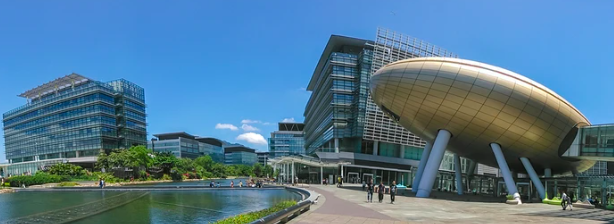
As a participant-observer in Hong Kong’s tech evolution, Lau takes the long view. Hong Kong was called “Silicon Harbor” in the 1990s for its ambition to become a new Silicon Valley. Even before that, Motorola Solutions, Inc. (MSI) had a research center in Tai Po, not far from where the Hong Kong Science and Technology Park, Inc (HKSTP) is today.
Motorola’s research team in Hong Kong invented the DragonBall processor, which supplied the chips for three out of four personal digital assistants (PDAs) globally. Design and assembly were in Hong Kong, a feat that even Huawei Technologies has yet to duplicate. (The name, DragonBall, came from a Japanese anime series).
“When China opened up, the majority of the [tech] companies in Hong Kong either left, or became more manufacturing-centric,” Lau says. Hong Kong’s first chief executive, Tung Chee-hwa, earmarked HK$5 billion for an Innovation and Technology Fund in 1998, in his second policy address, after reports submitted by Professor Tien Chang Ling from Berkeley. One of the contributors to the reports, Dr. Ta-in Hsu, chairman of H&Q Asia Pacific, asked, “Can Hong Kong become the Silicon Harbour of the Pacific?”.
The name stuck, in ways that Lau believes was (and is) misleading. “Silicon Valley was always an anomaly,” says Lau. “It started so early [in 1951] and the area is so large, that by now it has momentum.” The main reason for its evolution was the creation of a financial ecosystem, where people with successful start-ups became investors. “Everybody knows everybody and knows what is needed. They know mergers and acquisitions (M&A), they know initial public offerings (IPOs) and they know each other. The hardest ecosystem to duplicate would be Silicon Valley.”
Hong Kong’s tech ecosystem got a different start, as first one, then two high-tech industrial parks. Despite the inspiration from Silicon Valley, high-tech industrial parks sprang up across East Asia in the wake of Taiwan’s successful Hsinchu Science Park in 1980. Governments used free land and tax incentives to encourage their development. The Hong Kong government did the same with Cyberport in 1999 and HKSTP in 2001.
“Internationally, to encourage entrepreneurship, there are only a couple of tools,” says Lau. “The easiest is literally to throw money at the problem. And it’s not just Hong Kong or China. Normally, if there is a tax regime, the government will give you free taxation, in what are called free zones, which are the most popular. They allow currency exchange, no import or export duties, or tax-free for individuals, sometimes free housing and human resources. Hence, the concept of a Science Park.”
“And there are different varieties. They like to have strong linkage with a research university, close enough to encourage interactions between the research at the universities and the entrepreneurs themselves.”
A distinguishing feature of Hong Kong’s start-up incubation and tech hubs is the government’s emphasis on financial self-sustainability, primarily through rental income. “While some see this as a constraint,” Lau notes, “it reflects a long-standing philosophy that encourages responsible growth and operational independence—seen also in landmark projects like West Kowloon and private recreational clubs. The government provides the land at nominal rent, but expects organizations to chart their own sustainable paths, fostering resilience and accountability.”
Why a tech ecosystem is like a shopping mall
A sore point to some, Hong Kong continues to fall behind Singapore in terms of unicorn start-ups – a term that refers to valuations over US$1 billion (there are also ponies and centaurs in the start-up lexicon, referring to smaller valuations). As of June 2025, according to Tracxn, Singapore had 33 unicorns to Hong Kong’s 11, both far behind China’s 102,000 start-ups and 248 unicorns.
In 2025, Startup Genome placed Hong Kong at number 27 in its ranking of global startup ecosystems, moving up 20 places in the list but still behind Singapore (number 9) and four mainland Chinese cities – Beijing, number 5, tied with Boston; Shanghai, number 10; Shenzhen, number 6, tied with Washington, DC; and Hangzhou, number 23. Silicon Valley remained in the top place.
Lau doesn’t dismiss the metrics but describes Hong Kong’s tech ecosystem as moving in the right direction, for at least four reasons.
First, it is an issue of critical mass. Lau uses the analogy of a shopping mall. “Momentum takes time to build,” he says. “If you build a shopping mall, going from one shop to 100 shops takes a long time. But after 100 up to 500 shops, it’s fairly easy.”

Another huge factor is that with the economic slowdown after Covid-19, residential and office rents have come down. It’s also much easier and less stressful going to China since the high-speed rail station in Kowloon opened in 2018.
“The funny thing is that Hong Kong in a sense is better than California, because when people leave California and move to Austin, they leave completely. I cannot imagine anyone leaving Hong Kong and saying, I will never come back. They will keep some sort of linkage, at least a Hong Kong ID, and it’s better, because when you meet with people, they will say, I have this opportunity in China, when they meet in Hong Kong.”
The fourth factor is a change in mindset not so much among the young as among their parents. “I think young people have been misunderstood,” he says. “I mean really young, like after college, when they’re still staying with their parents.
“Young people are universally driven by a sense of curiosity, the good ones, and they want to be appreciated, and enjoy what they do. In the past, the problem was that people didn’t appreciate what they did, socially or financially. If you sit at home and write software, your parents would ask, Why don’t you go out? Why don’t you join a bank or the Hong Kong government or become a police officer?”
“I think the fundamental thing with the science park is that you get a bunch of these [young people] and your parents and society don’t question you too much. It’s not about venture funds. And then software development is relatively cheap. You don’t need a big computer. You can use your notebook and location and subscribe to some services, at least for a year or two.”
“That was not possible in the past, if you woke up at home in a smaller flat and your parents think you are playing video games even after graduating.”
“That is the biggest change,” Lau adds. “You talk to like-minded people; you are learning the software and other people are doing it. And gradually you can get momentum and attract venture capital. Of course, you need to generate a prototype. And some may generate a prototype even before they graduate. Then you sprinkle a bit of government incentive, give them a grant to develop projects, you know, rent-free for a while.”
While most start-ups flame out, pivot, or change their minds, a few succeed, based on the law of large numbers. He adds: “It’s like growing sprouts. Once you start, it’s very easy to continue. You only need water and sun.”
The emergence of the software industry meant that young people could work from home, communicate via Zoom calls and form collaborative networks that become companies. AI has been essential along with software, and part-time and remote workforces.
In mainland China, too, software and AI start-ups don’t need office space at the initial stage. But once you have a company, with sales and marketing, and a corporate presence, you need an office. “Hence you see a clustering of these companies, because young people like to be closer together. Usually they’re in a nicer district, and the government couples that with attractive living spaces, schools, parks, whatever. So you see an emergence of pockets, which sometimes will be detached from universities, not hours away or a plane ride, but no longer just in the vicinity.”
Manufacturing and biomedical start-ups are a different story, Lau notes. Regulatory frameworks are needed for conducting biomedical experiments and storage of biomedical material. Hardware and robotics need workshops. “If it’s only software, people will ask what is the point of Science Park? If you’re in biomedical or robotics, the distributed work-from-home model doesn’t work. So HKSTP has pivoted towards more towards tangible assets science.” Cyberport, meanwhile, has remained focused on digital and information technologies.
At the university level, all eight research universities in Hong Kong have knowledge transfer programs, which are duly reported to the University Grants Council. According to Lau, Hong Kong universities have learned how to deal with the intellectual property issues to encourage innovation.
Lau’s first company, Perception Digital, made history as the first spin-off from HKUST’s Technology Entrepreneurship Program to be listed on the Main Board of the Hong Kong Stock Exchange (HKEX). He co-founded the company with several students, developed its products in university labs, and scaled up manufacturing in Dongguan, Guangdong province. Lau served as chairman and CEO until he sold his shares in 2015.
Why it matters
According to its website, HKSTP now has a working population of more than 24,000 people, 2,300 innovation and technology companies, and 15,000 Research and Development (R&D) practitioners. It has three industrial centers, accommodations, a Shenzhen campus and a rising campus in the San Tin Technopole, part of the Northern Metropolis, and describes itself as the “city’s largest incubator ecosystem and R&D base.”
Half an hour away by car, and the southwestern side of Hong Kong Island, Cyberport has more than 2,200 information and communications technology (ICT) companies, including 440 fintech companies, 160 digital entertainment companies, 850 smart living enterprises and 260 companies specializing in R&D on AI or big data, according to a report by Hong Kong’s Legislative Council in March 2025.

It launched an AI Supercomputing Center in December 2024, and another 280 blockchain or Web 3.0 companies are linked through Web3 Hub@Cyberport. A fifth phase of Cyberport is under planning.
Why does this matter? “From a purely economic point of view, innovation drives Gross Domestic Product (GDP) faster than traditional business. That’s fundamentally why anybody wants a technology company. The employees are paid more. And that is why any city would turn farmland into a technology park, because people who use a technology park will earn more money and pay more taxes.”
“Of course, unicorns are important, but I look at it more simply. How many people are employed in technology business? It doesn’t matter if they are financial people or marketing professionals, or engineers. The benefits and risks are completely different. From that angle, Hong Kong is working in the right direction.”

Jack Lau was president of Qatar Science and Technology Park in Doha from February 2024 until recently. Currently he is an adjunct professor at Hong Kong University of Science and Technology (HKUST), and was a Council member from 2016 to 2022, including as vice-chairman of knowledge transfer. He has a bachelor’s and master’s degree in electrical engineering and computer science from the University of California, Berkeley, a PhD from HKUST, did post-doctoral research at Stanford University and has an Executive MBA from the Kellogg School of Management at Northwestern University.
- The students were participants in the inaugural week of the Mini Business America Camp organized by The American Chamber of Commerce in Hong Kong from July 7-11, 2025 ↩︎