
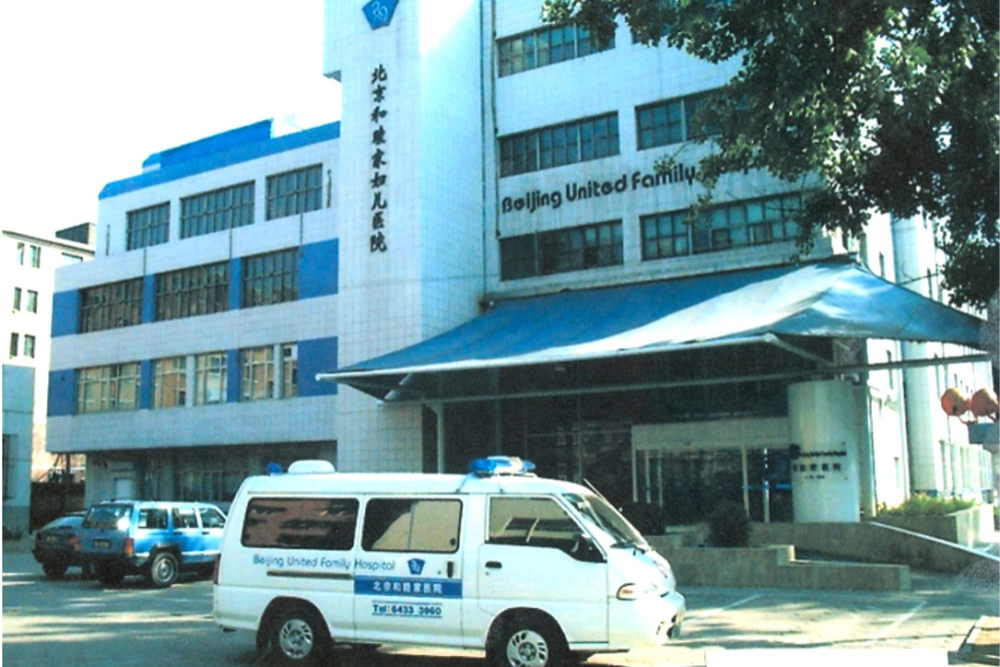
Lipson’s first hospital soon after it opened in 1997
When Long Islander Roberta Lipson arrived in Beijing in 1979 at age 24, she wasn’t expecting to make history. But as an American businesswoman in China, she has continuously broken barriers, building China’s first private hospital, now a chain, and a series of businesses under the New Frontier Health brand. A former chair of the American Chamber of Commerce in China, over the last few years the company has brought her United Family Healthcare brand to Hong Kong and Shenzhen, making her a ground-breaking entrepreneur in the emerging powerhouse economy of the Greater Bay Area. Here she shares how she got from the days when the twice-yearly Canton Trade Fair was the only place to do business with China to her present role as vice chairman of New Frontier Health, and why she never thought about leaving the China business despite its many challenges.
What was it like doing business with China in the 1970s and 1980s?
It was a gift of history and timing. I started college in 1972. Before that, I grew up in a very homogeneous community in the suburbs of New York City. I had never met a Chinese person until I went away to my pre-college course at Cornell as a junior in high school and became very close friends with a second-generation Chinese woman. I was interested in the comparative experience of second-generation Chinese families and second-generation Jewish families and did my high school thesis on that. When I went off to college, I became very interested in studying Chinese history.
As we all know, 1972 was a landmark year for US-China relations, and we watched Henry Kissinger and President Nixon make history. It was then I decided to study Chinese with the thought that I might take an academic route as a historian. And as the US-China relationship continued to develop, I said, why not be part of making history instead of just reading about it? I ended up going to business school for the express purpose of getting a job in China. And it all worked out. I found myself there, and the time was right after a couple of years to start a company. And the rest is history.
What were some of the intermediate steps between graduating from college and going to China?
I went straight from university to business school, something which is much more difficult to do these days. And when I got out of business school, I thought I would immediately go to China, but it was 1977 and it was too early. I ended up going to work with Schering-Plough, an American pharmaceutical company that later merged with Merck & Co. That was great, because I got to see how corporate America works. And over the next two years, I wrote to everybody who was ever mentioned in any newspaper about China trade and China relations. And finally, I got a response from Julian Sobin, who said, I’d like to meet you – meet me at the United Nations on this day.
And anyway, he offered me a job.
Sobin Chemicals, Inc was one of the first American companies to be invited to open an office in Beijing, and I was fortunate enough to be one of the people hired to run that office and work in it. And because at that point I had worked for two years in the healthcare industry, I began to look at opportunities in China and the situation in healthcare.
I found that hospitals in China were not only very overcrowded, but their doctors, who were very dedicated, had no modern technology or hardware with which to do their job. So, I started looking at the possibility of importing medical devices and equipment, and, my extremely supportive boss allowed me to look at new businesses for the company. Unfortunately, or fortunately for me, after two years, Sobin Chemicals was sold to a merchant bank that wasn’t particularly interested in the business that I did.
That gave us the opportunity to start Chindex in 1981, which eventually became the largest distributor of imported medical equipment in China. I started Chindex together with Elyse Silverberg, who was then the representative of the US-China Business Council in Beijing. We eventually grew the business to quite a large national footprint. And 10 years later, we decided to expand into healthcare services, and eventually opened our first hospital. Several years after that, we sold our medical equipment distribution business to Fosun Group, which took over the old medical devices import business.
How did you and Elyse Silverberg meet?
When I was at Sobin Chemical, I was also helping them to supply other kinds of hardware, and one project was for the Tianjin Port Authority, which needed a lot of different kinds of material handling equipment, including forklift trucks. We sourced these from a US company called Clark Equipment. Elyse was a student at Peking University and working at the US-China Business Council, which had its Beijing representative office in the Peking Hotel. The representative of Clark Equipment was obviously also getting advice from the Council, and he said to me, you have to meet this other Jewish girl from Long Island on the 12th floor. We decided to put our fortunes together and start Chindex.

Julian Sobin stayed on as a consultant to the company after it merged and eventually retired. I joined him on his 80th birthday, on a five-day trek in Nepal. He gave me an amazing gift, the opportunity to come to China.
Can you talk about what it was like for you and Elyse doing business in China with Chindex in the early days?
One of us would be in New York, one would be at the Canton Fair, which was six weeks twice a year. Whoever was in New York would be sourcing products, while the other would be in Guangzhou at the fair. The way it worked, the end-use customer would deliver requisitions to the state trading company, which would bring piles of handwritten requisitions for equipment to the Canton Fair.
And every morning, we would go and sit at the tables of the various foreign trade corporations, and they would parcel out these requisitions. And one would have to be an absolute detective, first of all, to read the handwriting to figure out what they actually wanted. Often, they had just copied equipment lists from research papers or journals that they had read, and sometimes the journals might have been 10 years old. It was a detective job on both sides of the Pacific to figure out what it was those customers wanted.
Then we would take the requisition lists, and go to the telex office, and type out telexes to whoever was sitting on the US side and that person would have to spend the day sourcing the products, figuring out where to get them, and convincing the US companies that we could actually give them letters of credit and cash if they agreed to sell their products.
In the evening in the US, one of us would have to type out a telex, and the other go the next morning to the telex office to receive it and present the quotes the next day to the foreign trade corporation. Then there was a negotiation. That was how business happened. In those early years, most of the business for the year happened in the cumulative 12 weeks of the two Canton Fairs.
And then, after a couple of years, we got access to the end-use customers, and we were able to become more proactive, as distributors, when we found there was demand for our products in China. We were able to then form long-term relationships with vendors in the United States, with manufacturers and their sales and service teams. For many years, we had to live in hotel rooms because there was no housing available for foreigners.
And yes, did I ever think of giving up and going home? It did get a little bit old living in hotels for so many years. At one point, we started a letter writing campaign to the central government and the Beijing municipal government, saying that if they wanted continued participation by foreign companies in China, they should consider to make it a more normal living situation, and we needed to have access to other kinds of facilities. And eventually, Vice Premier Wan Li sent a secretary to investigate our living situation and showed us a route to being able to have a house and an office outside a hotel.
We were able to renovate a beautiful courtyard in downtown Beijing, which became our home, and another one next door as an office, where we spent a wonderful 15 years. It was eventually taken over by the city and demolished to make room for Soho on the second ring road. The company moved to more of a regular office, while my family moved to the suburbs, to a villa on the edge of the city.

What were the obstacles, and how did you overcome them, as Chindex became UFH and now New Frontier Health?
In the beginning, we were learning how to do business in China. The challenge was just figuring out the system. When we decided to open our first hospital, there was no precedent or rules to follow. Then, with the hospital, the big challenge was financing. There was no capital market in China. There were no loan facilities available to us. Our only solution was to go to the US, where we were able to launch a very small IPO. I think any savvy businessperson would say this was not the right time in our corporate history and that it was too early to go public. But it did offer us the opportunity to build our first hospital on a very small scale, and that was transformational, and we were able to grow it from there.
Financing was always challenging for us, but eventually we also got support from the International Finance Corporation (IFC), which was a big leg up for us because it helped us to expand. I think it was difficult for people in the US to understand the uniqueness of our value proposition in China and why the potential was so amazing. We eventually decided to privatize. We joined a consortium with TPG Inc, the American private equity firm, and Fosun Group to buy the public shares. When it was time for TPG to exit, that’s when we found New Frontier and discovered they shared our values.
The next challenge, after financing, was that in the 1990s, when we began thinking about establishing a private hospital, there were no regulations that clarified how one goes about doing that. The government thought it was a weird idea. Once we started talking with the government in 1992 about the concept, it took until 1994 to get anybody to take us seriously. And once it looked like we would be allowed to do this, we had to raise the money. It took us until 1997 to figure out how licensing and investment would work. And finally in 1997, we were able to open our first hospital.
At first, we were very focused on young expat families. So, very early on, we developed an obstetrics and gynaecological practice together with paediatrics. And then, as Chinese started going abroad, and experiencing healthcare in a different way, some people started saying, this is like the health care in America that I really liked. Chinese people also started coming.
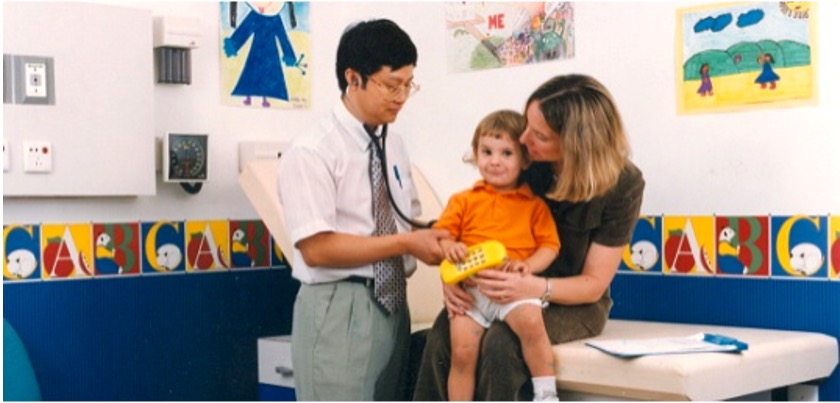
Our earliest customers were film and sports stars. The first decision would be to have a baby in our hospital, because with the one-child policy, the idea that people could have a happy experience with childbirth was appealing, and it was the kind of healthcare experience that people liked to crow about. Internet influencers began to share their experiences. And the people who delivered their children at our hospital then used our facilities for paediatric care, and as they got older, for other services.
Can you tell us what United Family Healthcare is doing in Hong Kong, and how it fits into your overall operation?
In 2019 we merged with a Special Purpose Acquisition Company (a SPAC) that was put together by a Hong Kong consortium to acquire United Family. All of a sudden, we had an interest and a presence in Hong Kong. That inspired an ambition to expand our services here and also uncovered an opportunity for us to open a facility in Shenzhen. Since then, we’ve not only opened a big, beautiful hospital in Shenzhen, but also several clinics in Hong Kong under the New Frontier and Heal brands, including a primary care clinic, a fertility clinic, and cancer treatment centers.
Since we’ve expanded our services to Greater China there is an interesting cross-border dynamic between Hong Kong and Shenzhen. Although we only have out-patient care in Hong Kong, it’s such a fast, easy ride to get to our hospital in Shenzhen, in Futian District, that we’re able to offer continuity of care to the people that we treat for primary care, outpatient care, and even chronic disease and cancer care in Hong Kong on an out-patient basis. We can admit patients and hospitalize them in Shenzhen if they need it.
And we have a very brisk business of Hong Kong residents that are seeking all their medical care at our hospital in Shenzhen, especially on weekends, when perhaps half the patients are coming from Hong Kong. Part of that is due to the wonderful service we provide, and part is due to the relatively long wait times in public facilities in Hong Kong, as well as our cooperation with the Hong Kong government, which offers elderly medical vouchers for care at our facility in Shenzhen. Shenzhen is our fastest growing hospital, and our Hong Kong services are doing well and are well appreciated.
Our biggest investor in the SPAC was Nan Fung Group, and the consortium also included family funds and investors from Hong Kong and Greater China. We privatized the year after merging with the SPAC, with the same shareholder base. With the new investors, we had a lot of Hong Kong expertise and a network.
They understood there were longer wait times in Hong Kong and a need for our style of concierge, evidence-based healthcare at international standards. Our chairman at New Frontier Health is Antony Leung, group chairman and CEO of Nan Fung Group, former chairman of Greater China of Blackstone and Hong Kong financial secretary from 2001 to 2003. Our CEO is Carl Wu, who was one of the youngest managing directors at Blackstone, when he left in 2016 as a co-founder of New Frontier Group. I am vice-chair.
Our prices in Shenzhen are not as expensive as most of the private services in Hong Kong, although pricier than the public hospitals in China. It’s also infinitely more convenient and pleasant and no wait time for procedures. Our Shenzhen hospital opened at the end of 2022, and the final finishing was done during Covid-19. The construction team and management were quarantined in the hospital while they continued to finish the building.

Has your customer base changed over time? What about your approach to care?
Has it ever! When we opened our first hospital in Beijing in 1997, our patient base was 99.9% foreign expats. Now, it’s close to 90% based on local Chinese patients. Our approach to care has only changed insofar as it’s gotten more complete and more comprehensive. We’ve always held to the principles of evidence-based care, patient first and patient-doctor relations as key to the way we approach care, and that hasn’t changed, but our ability to provide more different types of service for our patients, and more advanced medicine has evolved as our system has become more mature over these past 28 years.
Our approach to care is based, number one, on an evidence-based approach, keeping the patient first in every instance; providing a comfortable, convenient, caring and compassionate approach to service; and continuity of care, from prevention to chronic disease management to acute intervention. Circling back to prevention, after we solve the acute problem, we start with further prevention.
We try to integrate best practices from all over the world but also taking the best from the traditional Chinese medicine approach. Every one of our hospitals has a department of traditional Chinese medicine (TCM), and of our four hospitals in Beijing, one of them is registered as an Integrated Chinese/Western Medicine General Hospital. We acquired it three years ago and have since transformed it into a United Family branded and operated facility. Absorbing the experience and knowledge base of that hospital has helped us to better integrate TCM into our service offerings.
What is your current business model, at both the parent company level and with United Family Healthcare?
United Family is a brand that has been developing since 1997. We’ve expanded to quite a few cities in China. We have 11 hospitals under the United Family brand and some 20 out-patient clinics. We also have an Internet hospital under the United Family brand and are about to roll out a longevity and anti-aging center. All the hospitals are managed according to a single operating system. All the patients and their electronic medical records go across the system, so we have continuity of care, from out-patient care to in-patient care, and all the patients and their historical records are within the system.
Our patients are busy people who often travel from city to city. If a patient is based in Beijing and is traveling in Guangzhou and has a problem, they can go to our hospital, and all their history and records are available for the doctor to see. Not only that, we’re also able to take advantage of our expert professional network from the whole country, so that all of our doctors are available for consultation.
If there’s a doctor in Beijing who’s the expert in a particular kind of cancer, a patient in Shanghai can take full advantage of multi-disciplinary consultations, including that expert. We manage the system in a coordinated, standard way. It doesn’t matter where you are in China, if you are walking through a United Family hospital, it will be very recognizable to you.
Under New Frontier Health, in addition to the United Family brand we also have sister companies. New Frontier Vitality operates in almost 50 cities, including home healthcare services, rehabilitation and geriatric hospitals and clinics. We have 27 rehabilitation hospitals, mostly in second-tier cities under the Care Alliance brand. Another sister company is YDCare Home Health, which does 20,000 visits a day across 30 cities in China. Nurses go to people’s homes to provide care.
Another sister company is an insurance platform. We work with insurance and reinsurance companies to customize health insurance policies for our customers on the corporate or group level and will give them full access to United Family Healthcare, as well as other options.
Our newest sister company is a contract research organization, so we can have access to the latest drugs used in clinical trials, making them available to our patients and giving our doctors an opportunity to participate in clinical research.
And that’s not all. The final one is our international medical services division, which makes it possible for Chinese patients to seek care abroad when the therapy, the drugs or clinical trial that they need is not available in China. That division also facilitates patients from other countries to come and get care at United Family in China and Hong Kong. That sort of medical tourism, and the development of biomedical solutions that are happening both in China and outside China, is important so that people can get access to new interventions and new therapies that might not be available to them where they live.

How have US-China tensions affected your business?
For the past two years, and I don’t think we’re unique, we’ve felt a great big panda hug. The Chinese government has been very much welcoming and desirous of increasing foreign investment and willing to help companies achieve their ambitions. The fact that they continue to reduce the negative list, like taking off the domestic equity requirement for healthcare institutions, is just one sign of that. But there have been other liberalizations over the last two years. We’re frequently asked by various arms of the government at a very, very high level to give feedback and talk about our challenges. And amazingly, we get responses to the issues that we bring up.
A month does not go by where there are not two or three different central or local government authorities asking for feedback, asking what are the challenges for foreign companies? What are the specific issues that your company faces, and how can we help you solve them? Obviously, China is a big place, and there are many levels of government authority. Things don’t always filter down immediately when they look to make changes and improve the investment environment, but I would say that in all aspects, the government is doing all it can to increase foreign direct investment and help companies with the challenges they have.
We’ve been working on our fifth hospital in Beijing, which will be our flagship hospital, an integrated campus with clinical services, research, training and teaching. It is going to be quite a large investment, and we’ve had the utmost support from the Beijing government to help us fulfill this dream and make the project a reality, including support for us to be able to select the best location I could have dreamed of, and encouragement that we will be able to make all the things we want to happen on that campus a reality. It will be located very centrally in the northeast quadrant of Beijing.
Was there ever a time when you felt like leaving or giving up?
I feel so fortunate to have been here not only to witness the amazing developments in China over the last 45 years, but also to have had the opportunity to be a small part of it. We always looked to the needs that China had and the needs of the market, and tried our best to fill those needs, which turned out to be a great business opportunity.
I can say that there have been challenges and even disappointments along the way, but looking back at the trajectory and forward at the opportunities, I don’t think there was ever a point where I could have pulled myself away and I still feel that way. I think the excitement of where this company, and this country has come from, and where it’s going, and the developments in biomedical research and healthcare giving us the opportunity to provide new cures for people, are enough to keep anyone’s interest.
And so, no, I don’t think I ever wanted to pack up and leave. And I still don’t feel like I’d like to pack up and leave. I’m still following this, seeing how we can continue to participate.

Founder of United Family Healthcare and vice chair of New Frontier Health, Roberta Lipson began her 40-year career in China working for Sobin Chemicals Inc. A 1976 graduate of Brandeis University, Lipson obtained an MBA from Columbia University in 1978. She was co-founder with Elyse Silverberg of Chindex, a medical devices trading company, and United Family Healthcare, as well as United Foundation for China’s Health, a not-for-profit dedicated to providing life-saving interventions and health management to underserved populations in China. She was chairman of the Board of Governors of the American Chamber of Commerce in China in 2024. A recipient of multiple awards for her pioneering entrepreneurship, she was most recently a recipient of Global Women Asia’s Groundbreakers Award.