
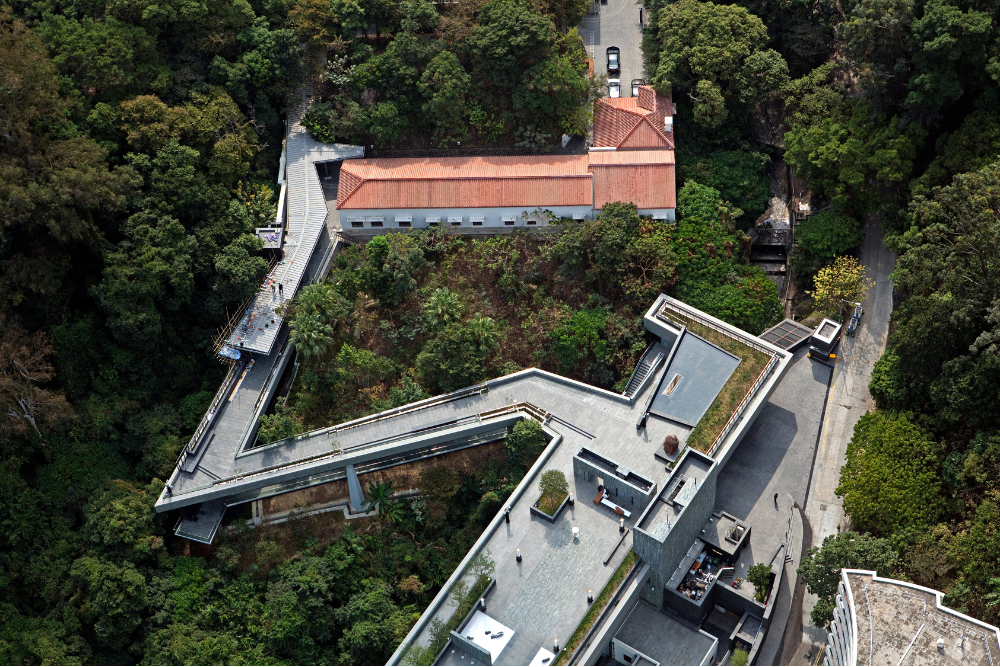
As one of the principal architects behind the Asia Society Hong Kong Center, Billie Tsien has left an indelible mark on a city that, under other circumstances, might have been her home. The Center itself, which opened in 2012, is by now familiar, both for its lively programming and for the beautifully restrained horizontal slab of a building that serves as an entrance and bridge to its barely tamed hillside and the restored colonial structures above, nestled in a profusion of green.
Tsien’s parents were part of the Chinese diaspora. They fled Shanghai in 1948 as civil war was raging and never went back. Their first stop was Ithaca, New York, where they studied biochemistry and electrical engineering for their master’s degrees at Cornell University. Tsien’s mother gave up getting her PhD in biochemistry after she gave birth to Billie in 1949. Although they had intended to return to China, they feared the chaos they left behind and what it might mean for their young family. “There were a lot of things they never, ever talked about,” Tsien said in an interview.
Their escape route did not pass through Hong Kong. But when Tsien and her husband and partner, Tod Williams, won an international competition mounted by Asia Society in 2001, her experience between cultures helped shape the Asia Society Hong Kong Center, whose mission is to bridge Asia and the United States. Over the past 14 years, it has done at least as much to educate Hong Kong about Asia, as its original mandate to introduce Asia to Americans, with experts, exhibitions, programs and performances from every part of the vast region.

A Chinese-American story
From Ithaca, the family moved to Michigan and Berkeley Heights, New Jersey. The suburb was close enough to New York City that as a teenager Tsien could play hooky, take a bus into Manhattan to visit the Museum of Modern Art (MOMA) and get back in time to pretend she had gone to school. Afraid to take the subway, she would walk from Port Authority to 53rd Street.
Tsien didn’t learn Chinese growing up. Her parents spoke in Shanghai dialect to each other when they didn’t want to be understood by their three children, and English the rest of the time. Tsien’s mother attended the elite Aurora College for Women in Shanghai, taught by the Sisters of the Sacred Heart, and spoke British-inflected English. Her father’s English was less perfect, but that was the language they used at home.
Tsien only started learning Chinese two and a half years ago, after her mother’s death, using Duolingo, the language-learning app. “It’s more of a kind of greeting to my mother every morning,” she said. “I realized when she died, that was my last physical connection to China, and so I decided to make some small connection.”
Growing up, “I wanted to be like everybody else,” Tsien said. “I tried out for cheerleading, with no idea of what the actual game of football meant. My culture was American, but psychologically I was still very Chinese, because of the sort of things that were unsaid. I realized by the time I was in my 20s that I wasn’t really one thing or the other.”
That ambiguity served her well, when, in 2000, as a relatively unknown architect, she and Williams were invited to join the competition for the new home of the Asia Society in Hong Kong. The 13,600-sq ft site between Pacific Place and Kennedy Road was hidden behind stone walls and unknown even to Mid-Levels residents.
A project between Asia and America
“I would not have been so interested if the project had been purely Asian or purely American,” she said in November 2025, on her first return to Hong Kong in 12 years.
“Asia Society, as an institution, began in America, trying to create understanding between Asia and the United States. And the fact that it was in Hong Kong, which was itself a bridge, felt so interesting to me. I just felt like, these are my people.”
The New York headquarters of the Asia Society was founded in 1956 by John D. Rockefeller III and, like the Asia Society Hong Kong Center, features a museum, exhibitions, and a vibrant series of lectures and events. Currently led by President and CEO Kevin Rudd, prime minister of Australia from 2007 to 2010, the Asia Society continues to celebrate Asian culture, art and its diaspora, as well as provide perspective on current affairs involving Asia. The Hong Kong Center was the first outside the United States to have a building of its own and now serves as part of a network of centers in Asia-Pacific, Europe and the United States.
In 2001, Tsien’s New York-based architectural firm, TWBTA, won the international competition for the Asia Society Hong Kong Center against two other finalists and international heavyweights, Japan’s SANAA and Barcelona’s Elías Torres + J.A. Martínez. The winning design was as culturally intermediate as Tsien herself. Its key elements owed a debt to Suzhou’s famous gardens as well as one of the giants of mid-century modernism, the architect Phillip Cortelyou Johnson.
“I’ve always loved the idea of moving from one place to another across a bridge,” Tsien said. A specific reference is to Johnson’s Rockefeller Guest House on East 52nd Street in Manhattan, in which stepping stones and a pool divide the living room from the bedroom at the rear of the property.
The Hong Kong site in the old Victoria Barracks, a former British military compound, was divided by a gully, or nullah, and so the idea of a bridge to cross the nullah took shape. Tsien’s initial encounter with Chinese landscape architecture was in 1979, when her parents took her to China for the first time, visiting Suzhou. The zigzag or ‘nine-turn’ bridges of Suzhou’s famous gardens were designed to reveal a different view at every turn, and although the Asia Society Hong Kong’s double bridges were an adjustment to a resident colony of fruit bats, they accomplish the same purpose.
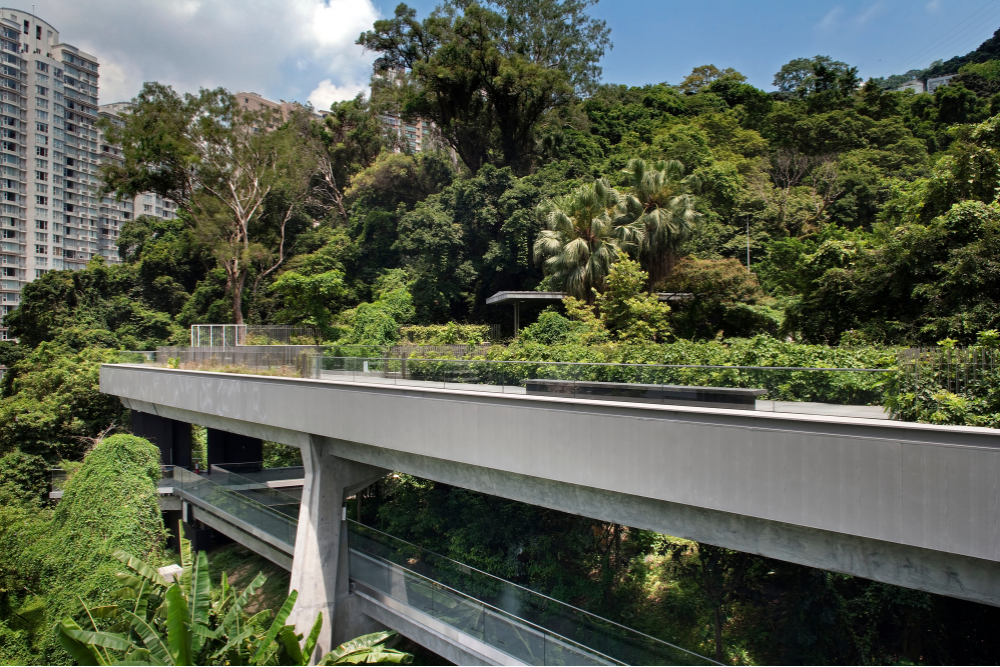
Fourteen years after its opening, the Asia Society Hong Kong Center remains a zone of quiet, unusual in this noisy city. Walk into the entrance at 9 Justice Drive and the sense of calm is immediate. Its largest structures, a cantilevered reception hall and the double bridges supported by Y-shaped columns, hover lightly over a densely forested hill, the hall faced with greenish stone that echoes the greenery in which it is set.
The entrance building, taken up mainly by the Hong Kong Jockey Club Hall seating 350, is open to the surrounding forest, with 17-ft high glass window walls extending 110 ft on its east and west sides. The later addition of the Lippo Amphitheater beneath the events hall is open air.
The Joseph Lau & Josephine Lau Roof Garden was designed with the care normally given to building facades, with mechanicals hidden in a nearby pit. A cascading fountain, pool and sculptures are its main features, including Zhang Huan’s Long Island Buddha, a monumental head lying aslant, Antony Gormley’s Another Time XX, and Vaan Ip’s Lost City No. 5.

“The roof garden of the Asia Society is in many ways its primary face,” said Tsien. “We realized that it is surrounded by tall buildings and that many people will see the roof as the primary face of the building. So we made the roof as intentionally beautiful as we could and designed it to be looked at from above.”
The reception hall connects to an upper site with a gallery, theatre and offices, in two former explosives magazines on the site and an explosives laboratory, with 2.5-foot-thick walls. Its stone-faced berms have the heft of medieval castle walls. Hanging fans, arcades and tiled roofs give the upper zone a distinct colonial vibe. The Chantal Miller Gallery is one of the few small public museums in Hong Kong, and has held a series of stellar exhibitions of artists from Hong Kong, mainland China and the Chinese diaspora. The Miller Theater, with a capacity of 101 seats, has been used for lectures, performances and film screenings in a more intimate setting than the Jockey Club Hall in the entrance building.
Overgrown with banyan trees, vines and populated mainly by fruit bats, the original site was part of Victoria Barracks, the first British military compound in Hong Kong constructed in the 1840s. Black powder from its two explosive magazines was delivered to waiting ships by sedan chair and later an aerial ropeway.

When Tsien and Williams began work on the Center in 2002, after the Asia Society took possession of the site, TBTWA, the name of the architectural firm based on their initials, had never previously worked outside the United States. Their first encounter was during the competition, when as finalists they were invited to view the site.
“At the time, we were younger architects, and we were just gobsmacked. I mean, it was really kind of amazing with these buildings with giant trees growing out of the tops of them, and it looked as if people were squatting on the site and living in some of the buildings. Everything was sort of green and wet and there were a lot of mosquitoes. It was like nothing I had ever seen,” she said.
“It was overwhelming. We really hadn’t built outside the United States before, and that’s the way we have continued, even in my new practice” with Studio Tsien, a smaller architectural firm independent of TWBTA.
Coming back to Hong Kong after a long absence, Tsien was impressed by how well the center has been maintained. “I was very moved, because non-profit institutions always struggle, and it takes money to take care of any building,” she said.
“These are complicated buildings in a challenging site, and I think they have been caring for the building, and I truly appreciate that. I mean buildings are not your children – your children are your children, but they are in some sort of sense an offspring. So I felt grateful, and I felt like it offers a place of respite, and we all need places of respite, more and more.”
The Asia Society Hong Kong Center was the first of several large-scale restoration projects in Hong Kong over the course of the 2010s, setting a high standard. Public buildings that reflect its influence include the former Police Married Quarters, known as PMQ, a “creative hub” that opened in 2014; Tai Kwun, the former Central Police Station, in 2018; and the Bauhaus-style Central Market that opened in 2021. Like the Asia Society Hong Kong Center, Tai Kwun combined restoration with work by a major international architectural firm, the museum galleries designed by Herzog & de Meuron.
Post Hong Kong
Nearly all of TWBTA’s work since the Asia Society Hong Kong Center has been in the United States, where they have won multiple awards for a practice built on signature values rather than signature styles, according to Architect magazine.
TWBTA’s buildings are “small, but so sure of themselves that it would be inaccurate to call them modest. They are confident buildings, but not boastful ones,” the magazine noted in a 2013 article on the American Institute of Architects awards. “They have a way of insinuating themselves into the landscape, behaving as if they have always been there.” TWBTA has won more than two dozen AIA awards, including the 2013 Architecture Firm Award.
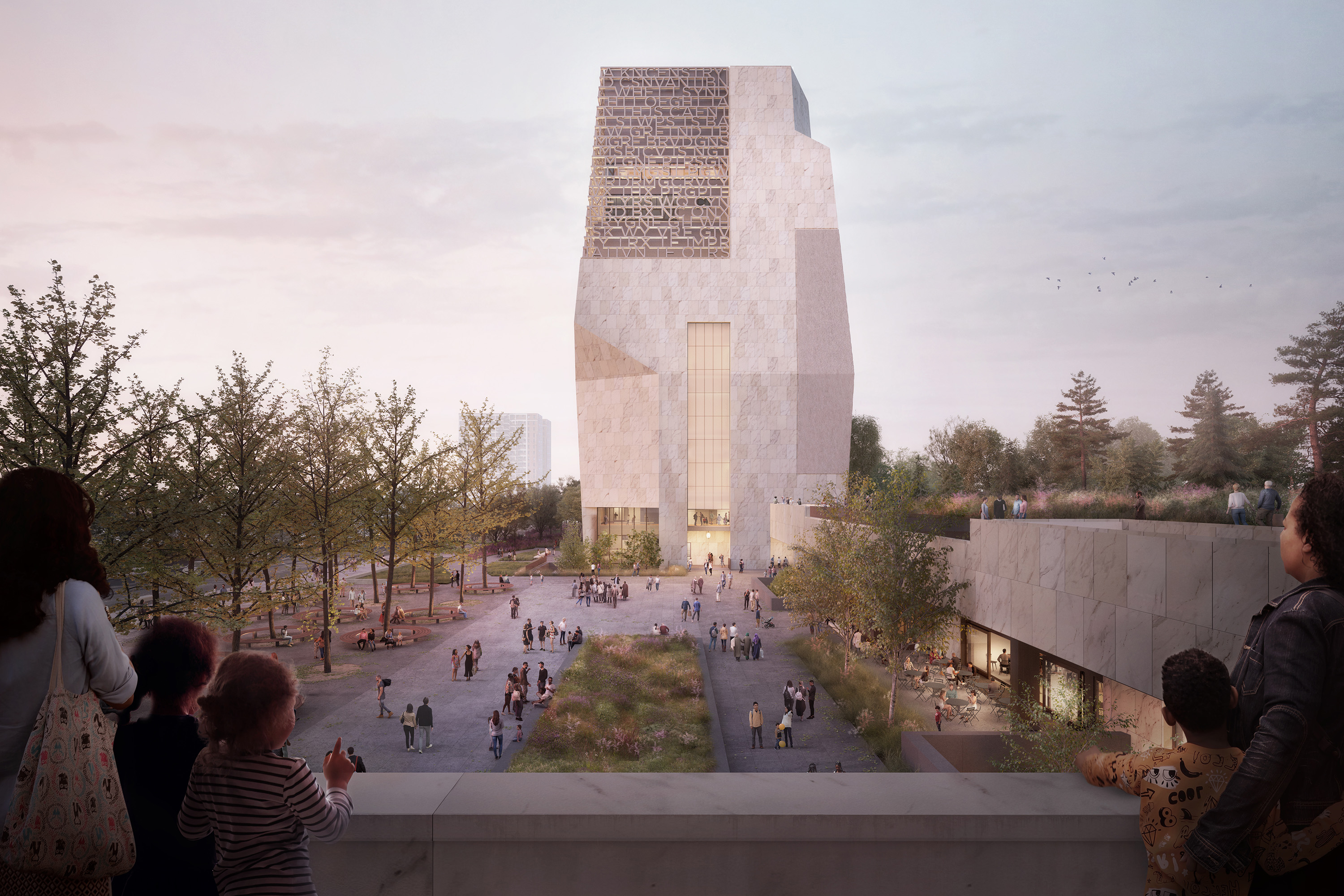
Their recent international work has included the US Embassy in Mexico City and Tata Consultancy Services Banyan Park in Mumbai, India. Among their most prominent buildings in the United States are the Obama Presidential Center in Chicago and the David Geffen Hall at Lincoln Center in New York City. Tsien recently founded a smaller practice called Studio Tsien, which is working on projects at the University of New Mexico, University of Washington, and a public library in Deanwood, a largely African-American neighborhood in Washington, DC.
“These projects all speak to me about reaffirming belief in democracy,” said Tsien. With the Deanwood library, “We don’t have a big budget, we have high aspirations.” The three new projects are on a very different scale from the 1 million sq ft US Embassy in Mexico City. “Each time, it comes with a kind of excitement and sense of challenge, and it’s like, you don’t know what you are going to do. And it’s very frightening, but also very exciting.”

Billie Tsien is a New York-based architect, mentor, and leading voice in the design and broader cultural community. Her approach to architecture is rooted in the spirit of collaboration with a portfolio imbued with a sense of optimism, warmth, texture, and serenity. She is a founding partner of Studio Tsien with recent commissions including Ana Mari Cauce Welcome Center at the University of Washington and the New Humanities and Social Sciences Building at the University of New Mexico. She is also a founding partner of Tod Williams Billie Tsien Architects (TWBTA) whose notable projects include the Asia Society Hong Kong, the Barnes Foundation in Philadelphia, and the Obama Presidential Center in Jackson Park, Chicago. She teaches at Yale University, where she was a 1971 graduate in fine arts. Her M.Arch is from the University of California, Los Angeles.