

“As a capital markets lawyer, I was able to tell investment stories the same way that I was writing songs, telling the love stories of my friends.”
At the age of 15, she wanted to be a classical pianist, and then she felt an urge to dive into Cantopo and began writing music. Some of Hong Kong’s most famous Cantopop artists have recorded her songs. Nearly three decades later, Aveline San heads banking operations in Hong Kong for Citigroup at a time when decentralised finance (DeFi), based on 24/7 blockchains and tokenised assets is disrupting traditional finance (TradFi) and rapidly converging with Artificial Intelligence (AI). This latest trend is condensed as DeFiAI. AmCham HK e-Magazine catches up with the musician who is one of Hong Kong’s leading experts on this rapidly evolving industry that used to be called, simply, banking.
Q. How did you go from aspiring musician to banker and – how to put it? – an expert on DeFi, AI and what some call DeFIAI, while keeping your sanity in TradFi?
A. I started writing songs when I was nine, and that prompted me to become a lawyer because I saw that my musician friends did not get paid very well by the record companies and publishing houses. They were also pretty bad at saving money or building wealth.
So, I decided in university to do a double degree in law and finance to help my friends. But as I delved into the world of finance and law, I was impressed by a lot of the clients who were entrepreneurs. They wanted to grow their companies to fulfil their entrepreneurial dreams, and I loved telling their stories. As a capital markets lawyer, I was able to tell investment stories in the same way that when I was writing songs, I was telling the love stories of my friends. You have to make people resonate, understand and feel for your story. That’s how I became a capital markets lawyer.
One thing led to another. I joined a bank, with their in-house transaction team, running IPOs and M&As [mergers and acquisitions]. I also came to understand the pain points at banks. The processes are cumbersome, especially compliance processes, so I was exploring regulatory solutions with the Hong Kong Fintech Association in order to help my bankers not feel so burdened by the compliance steps, with the help of technology. And that’s how I became more interested in financial technology.
I joined Citi initially as the regional chief compliance officer, to help transform some of the compliance programs with technology. That was the pitch of the global boss who was hiring me. He said: ‘It will be fun. You can help us transform with technology’. I was involved with that program for a few years, and then the opportunity to run the Citi franchise in Hong Kong came up, and I put up my hand.
Q. AI and decentralized finance are converging. How is that affecting your business?
A. When I talk to university students in Hong Kong, they always want to know if AI is going to keep them from getting jobs. My answer is always that AI is a tool and a teammate. You need to learn how to work with it, rather than worry about it taking over your job. However, if you don’t learn about AI, somebody else will take your job.
AI adoption is everywhere, not just in the banking and finance industry, and the point for us is how to help our clients use it better and grow with it. I don’t look at this as a choice. We are investing in the future to make ourselves AI ready.
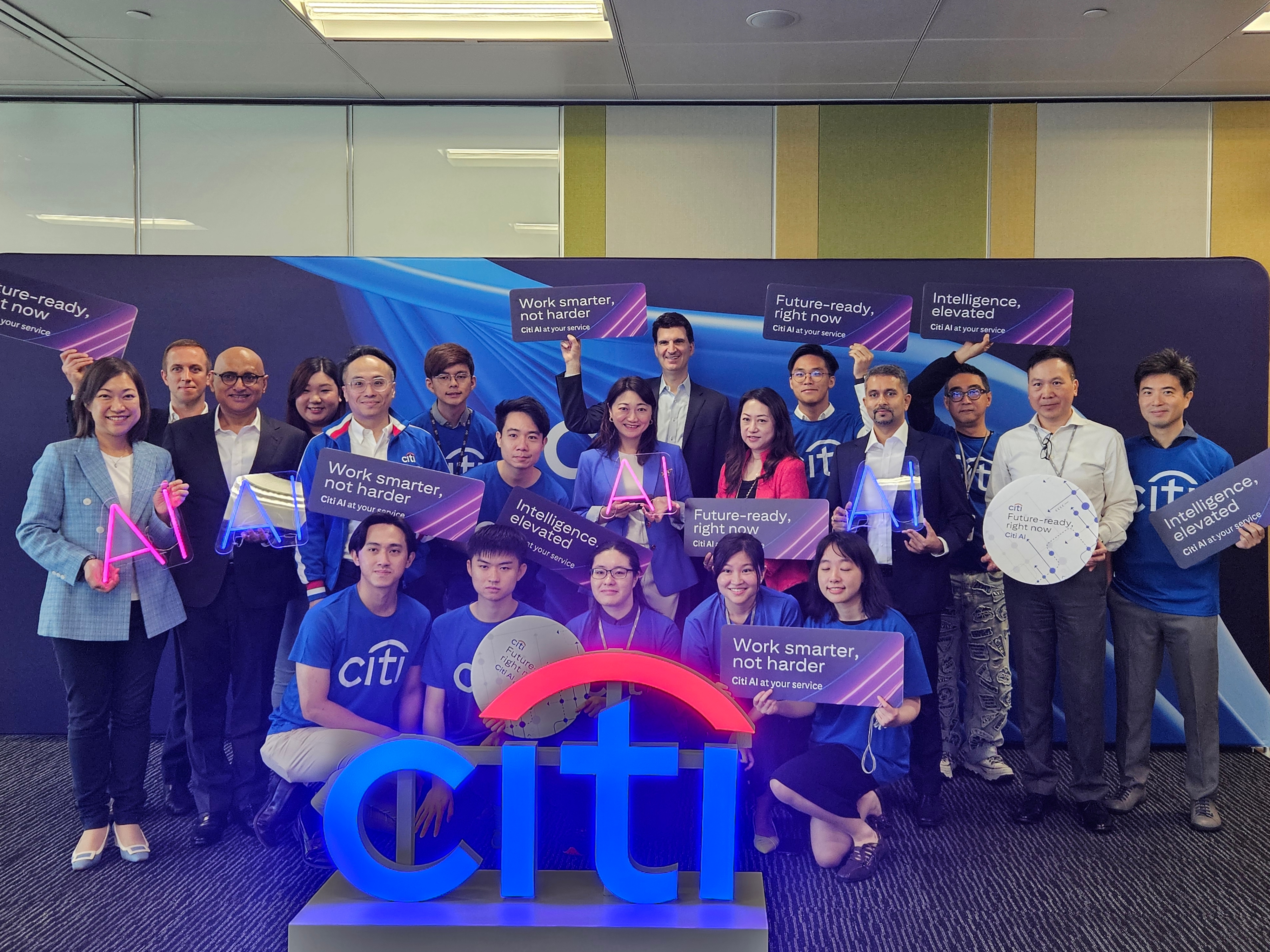
In 2024, Citi rolled out a suite of AI tools for workplace efficiency and productivity, which are now available to 182,000 employees across 84 markets, including Hong Kong.
We have moved away from just driving adoption, because everybody has adopted AI. Now it’s about scaling and delivering a true AI transformation. We use AI to make our processes more efficient in risk management and credit evaluation, as well as identifying opportunities for our clients.
Ultimately, we need our bankers to understand our clients before we can use AI to help them. For example, how does a private bank client want his investment to result in legacy planning? What is his or her vision of a philanthropic initiative? All of these would be input for us to use different tools to find solutions for the client. The human-to-human connection is still very key.
For us at Citi, while we continue to develop better tools, we are upskilling our staff and sharing with them the importance of the durable human skills that are required to differentiate themselves from pure AI agents. Having said that, our clients are using agentic AI and other AI tools day-to-day. We need to keep up with the pace. Imagine a hedge fund that is using agentic AI to come up with their trading strategy for the ultimate portfolio manager, so that they can click a button and say, yes, OK, trade. What then is the value-added of our traders and markets sales?
We also need to enhance our own electronic trading capability and our insights and how we can still add value. Our clients, say a private wealth client, can use agentic AI to choose the cheapest mortgage rate in the market or the best credit card deals. Our job is to find the space where we can still provide value that agentic AI cannot. We will be assisted by AI-based hyper-personalization, where we utilize all the data and find the solutions that are best for our clients.
Q. How fast is the use of tokenized assets growing?
A. In our forecast, the base case of stablecoin issuance is USD 1.9 trillion a year by 2030, while the base case of bank tokens is USD 100 trillion, and the bull case is USD 140 trillion. But that is simply a projection based on 5% of global large-value payment volumes. At Citi, we move USD 5 trillion a day, which means that USD 100 trillion and certainly USD 1.9 trillion aren’t very big numbers in relative terms. We see tokens taking a more center stage in payments because of the ability to service 24/7 and more importantly, programmability.
Q. Hong Kong, with its new licensing regime for stablecoins, is among the global leaders in digital finance. Can you share what Hong Kong looks like from your close up?
A. In Hong Kong, the different industry associations have been working actively with regulators to design the regulatory framework. Whether it is the FinTech Association of Hong Kong or the Hong Kong Association of Banks, everybody is chipping in. For the experimentation side, the Hong Kong Monetary Authority (HKMA) has created the Project Ensemble Sandbox. Many banks are participating in it by conducting experiments with tokenizing real-world assets.
At Citi, we are already quite advanced in commercializing Citi Token Services (CTS), which has been a live commercial solution since 2024. Our clients use it every day to move money on our proprietary blockchain. It’s frictionless and 24/7.
Q. What does Hong Kong need to do to raise its game as a global financial center?
A. Hong Kong has a label as an international finance center, notwithstanding some challenges in the perception that it is just another Chinese city. Of course, the China gateway proposition is really important for Hong Kong, but a lot of us agree that it cannot just be China’s gateway.
The international part of the proposition is also very important, which is why our industry has been supporting the government’s effort in enabling regional headquarters to set up in Hong Kong. How to make the process easier? How to facilitate the marriage of capital, talent and innovation? If you get these three elements right, more international companies will want to establish their regional headquarters here.
Q. How is technology impacting Citi’s business?
A. In this new digital, interconnected era, technology is not just a tool. We see it very much as an intrinsic component of our business, driving innovation, client satisfaction, and even our strategic positioning. Citi has been in Hong Kong for over 124 years, and all along we’ve been looking for ways to improve client experience, find solutions for our clients, and work smarter.
We went from the mobile wave to the Cloud wave and now the AI [Artificial Intelligence] wave, and throughout the journey, continued to innovate. On a day-to-day basis, we see that technology and finance are inseparable.
For example, we launched a global API [Application Programming Interface] Developer Hub in 2016, which makes it easier to collaborate with technology companies and build client solutions.
With AI, we look for ways to change the way we work, how we can be smarter in identifying fraud and financial crimes, and how we do KYC [Know Your Customer] in the back office through to the very forefront of how we serve clients.
To give you another example, Citi Token Services is where we have invested in blockchain technology to connect Citi branches in Hong Kong, Singapore, the United Kingdom, and the U.S., enabling seamless and instant movement of liquidity and funds between our clients’ Citi accounts worldwide on a 24/7 basis, even on public holidays and after hours.
We have also piloted Citi Token Services for trade, using tokenized deposits and smart contracts to automate conditional payments and reducing processing times from days to minutes.
In partnership with PwC and blockchain platform Solana, we are exploring ways a bill of exchange could be transformed into digital asset in a tokenized format. We recently completed an internal POC that represented a bill of exchange as token on a blockchain and simulated the entire lifecycle — the supplier inputting details, the platform generating a token, buyer review and electronic signing, and ownership transferring to the supplier. The POC resulted in faster settlement, and fewer manual steps and errors.
Q. How have Citi clients responded?
A. We have seen an increase in activity and adoption of Citi Token Services, having processed billions in transactions value since its launch.
Q. Are you worried about pricing pressure from AI agents and other fintech tools?
A. I’m not worried about competition from fintechs because we are also actively deploying technology at scale to stay ahead. On the contrary, I would like to partner with them. One, I see them as my clients. I would like to be their banker and help them grow. Two, I would like to be their partner, if they can serve a segment of our clients more efficiently with their offering, we can enhance our client experience together. Third, Citi also acts as an investor. We would like to invest into some of the fintechs that are strategically aligned with us, so we can grow together.
Last but not least, I like to see us as builders of the ecosystem. We can help them identify investors and work with regulators together to create an environment where they can thrive. And I learn from the fintechs day-to-day too. The whole ecosystem gets stronger. That is my four-dimensional fintech strategy.

Q. With the dramatic changes in the trade landscape over the past year, how are your clients responding?
A. Disruption is no longer a bug in global trade, it is a feature. I’ve been very pleased to see how resilient our clients have been. They know tariffs are here to stay, so they’ve been diversifying. Diversification in the past was a cost. Now the ability to diversify is a strategic asset. We have seen the emergence of new trade corridors. As global trade and capital flows shift, these changes are creating pathways for growth, especially for businesses that can adapt quickly.
In a survey of our corporate clients, we found that export growth from North and East Asia has shifted to emerging markets, with gains to Latin America up 59% and to the Middle East and Africa up 52%. South Asia and ASEAN [the Association of Southeast Asian Nations] have emerged as the biggest winners of the realignment, with a 44% increase in shipments from North and East Asia to the region and a 57% rise in flows from South Asia and ASEAN to Latin America.
Everybody is looking at new ways to be more agile and flexible than in the past. Our clients have also moved away from reacting to policy shocks and sticking to their long-term strategies. If they took a wait-and-see attitude after ‘Liberation Day’ on April 2 last year, now they have resumed investments but with flexibility built in.
They are also using machine learning and AI to predict where there may be port congestion and supply chain stress, to manage their inventory better. Investment into the tech sector, into advanced manufacturing and data centers, has meant that supply chain components have also shifted because of advances in AI. Our clients are reacting very quickly to these new kinds of opportunities.
Q. How has the new trade landscape affected Citi itself?
A. Our value proposition has become more prominent during this period of uncertainty and disruption, because we are the bank with the largest global network of over 180 countries and jurisdictions.
We are seeing more clients who want to diversify and operate in more places for their own risk management. If a client wants to move their China operations to Latin America, or establish themselves in Africa and ASEAN, we can help them set up locally .
If they need to build new factories, we can provide them with local financing and hedging and foreign exchange solutions. One of the greatest values we bring is in our ability to help clients optimize liquidity across the many places they do business, because they bank with us.
U.S.-Asia trade remains one of the fastest growing corridors for our clients. We are supporting foreign direct investment and outbound trade into the U.S. and helping them find efficiencies so that tariff and transport costs are not passed on to their customers.
Q. How did you come to Hong Kong?
A. I spent most of my childhood in Sydney, then Hong Kong, when my parents came here for work. I went to St. Stephen’s Girls’ College then German Swiss International School, and returned to Australia for senior high school and college. I went to University of New South Wales and then came to Hong Kong for work in 1997.
Leading up to Hong Kong’s handover to China, a vast number of people emigrated to Canada or elsewhere. I thought, what an interesting time to be in Hong Kong. And so, I came, and with the number of transactions and bringing Chinese SOEs [state-owned enterprises] to get listed as H-shares, I had a ball. It was so fun doing all these transactions, and I never looked back.
Q. Are you still writing and playing music?
A. I write mainly pop music, and sometimes jazz or folk rock.
I play the piano but when writing music, I like using an electronic keyboard connected to my computer to experiment with different sounds and arrangements. I also use AI to write AI-assisted music.

Q. Last question – what do you do for fun?
A. I got married to a Hong Kong guy, so I’m stuck here ever since. We have three kids, and my eldest is already in college at Cornell University in the US, but my two younger ones are still in Hong Kong, so I try to spend quality time with them on the weekends. My youngest one is into K-pop dancing. I play music with my friends, and I golf with my husband.
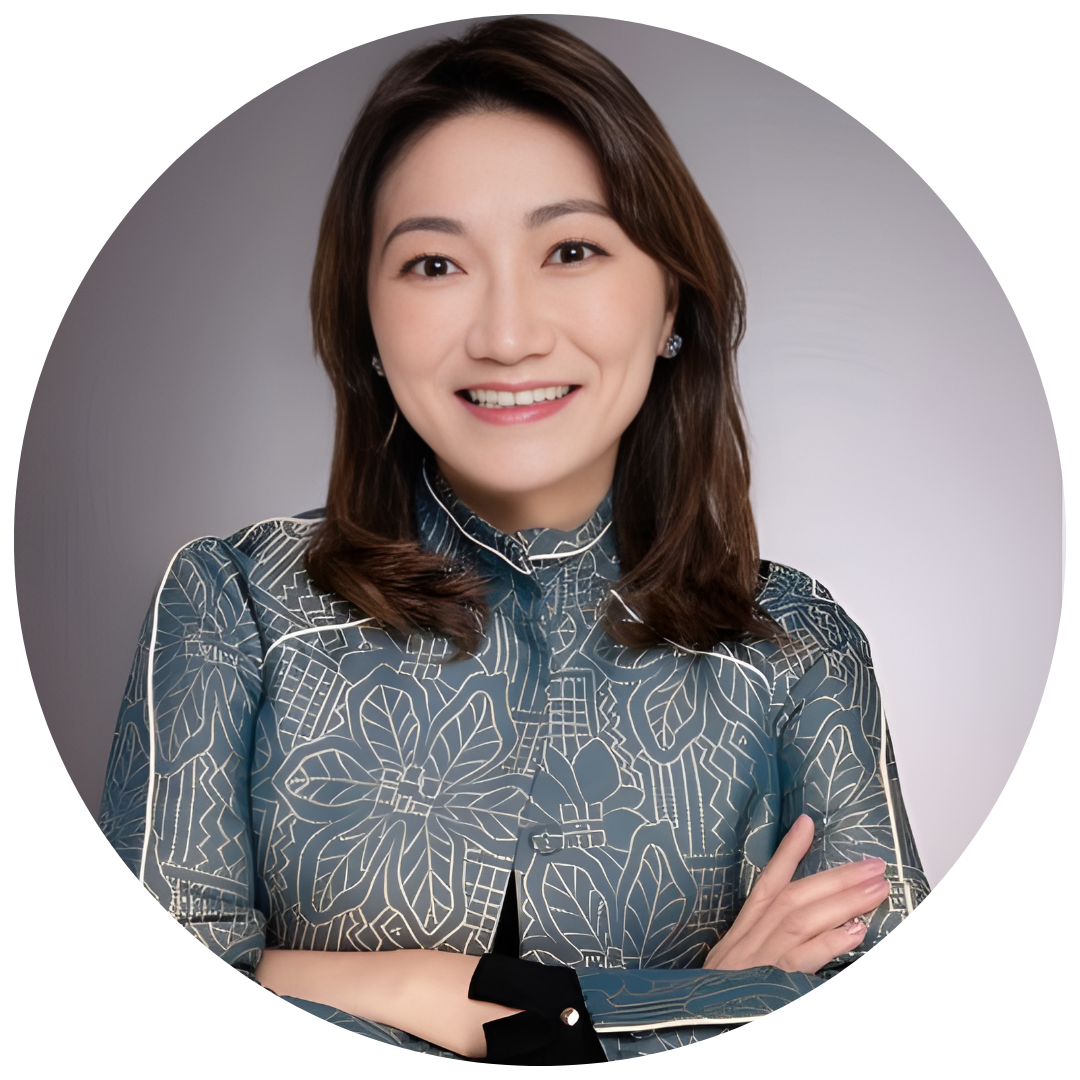
Aveline San was appointed CEO for Citi Hong Kong in 2022. She became Hong Kong CEO and Banking Head in 2023 and was interim CEO for Citi China from October 2024 to July 2025. She currently serves as Board Director and Chair of Citibank (China) Co., Ltd.
She joined Citi in April 2019 as Regional Chief Compliance Officer for Asia Pacific (APAC). Prior to Citi, she spent 14 years with UBS in senior management positions, including acting as APAC Group Regional Head of Compliance & Operational Risk Control, General Counsel of Wealth Management for North Asia, and Supervisor of the Board of UBS’ China banking entity. She was involved in various major banking transactions and strategic initiatives for its investment bank and wealth management businesses. She currently serves on the boards of the FinTech Association of Hong Kong, The Women’s Foundation, the Community Chest Hong Kong, the Financial Services Development Council and various Citi entities.