

Five years ago, in 2019, the last time AmCham Hong Kong held its highly popular China Conference, the US-China trade war was well underway. The next year, in 2020, the US ended Hong Kong’s special trade status. Despite hopes that the new Biden Administration would change course, decoupling just kept getting worse. Covid-19 restrictions made it impossible to hold in-person events in Hong Kong between 2020 and 2023, so the China conference was not alone in being sidelined. But on April 8, 2024, when it resumed – the first annual China conference was held in 1992 – the context was decidedly different. The underlying question was not so much whether things could get worse, but how to adapt to a very different and new environment, and how to look at the future. Following is a summary of the highlights.
This year’s China Conference, subtitled “Change and Continuity in China: Business Challenges and Opportunities,” might easily have marked a high point in US-China relations if it had been held between governments. As it was, the conference underlined the power of “track two” diplomacy by non-governmental organizations in conducting dialogue on difficult subjects. It also reflected Hong Kong’s relative openness in tackling some of the difficult topics in US-China relations, ranging from US sanctions against Chinese technology to decoupling and prospects for Chinese growth in the face of such constraints.
AmCham Hong Kong’s Community Hub is considerably smaller than the ballrooms where events have been held in previous years, and it was packed with about 120 people. But more than the numbers, it was about who was who and who was there – the current US consul general, Gregory May, as well as former consul general Kurt Tong; the acting commissioner of the Ministry of Foreign Affairs in Hong Kong, Li Yongsheng; and Hong Kong Financial Secretary Paul Chan. Minister Li and Secretary Chan gave keynote speeches, together with Jin Keyu, an economist at London School of Economics and author of “The New China Playbook.” Consul General May gave opening remarks.


The three main panel discussions were about China’s capacity to innovate, the capacity of business to adapt to sanctions and decoupling, and Hong Kong’s capacity to play a role given the direction of policy of its sovereign and the US. Each of the sessions explored ground that reflected the front-line exposure of the speakers and their depth of experience, including much that was counterintuitive.
The costs of losing access to Chinatech?
The first of the three panels, “China’s New Innovative Economy,” featured two Chinese company founders, Spencer Deng of Dorabot and Zhang Wenzhong of Wumart; together with the chief advisor to Tencent Group on sustainability, Zhai Yongping, former head of the Energy Sector at the Asian Development Bank; the general counsel to Electric Vehicle maker XPENG, Zheng Yeqing; and a top technology, media and telecommunications (TMT) lawyer, Wilfred Ng, a partner with Bird & Bird. George Chen, who previously worked at Meta and is now co-chair of the digital practice at The Asia Group served as moderator.


Zhang, besides founding Wumart, China’s largest retailer, also founded an omnichannel, smart retail solution provider and software-as-a-service platform called Dmall, which entered the Hong Kong market in 2020 and has clients including two of Hong Kong’s largest supermarket chains, Wellcome and Market Place. Dmall is using Hong Kong as a gateway to Southeast Asia and potentially Europe and Japan. Deng, founder of Dorabot, fell in love with logistics, Artificial Intelligence and robotics, not necessarily in that order, and has a client list ranging from UPS, a former employer, to DHL, FedEx, IKEA, Maersk and Siemens. These are technologies that have broad applications, but which would suffer if the US and China develop as separate ecosystems. Wilfred Ng echoed concerns about the future of AI, which is shaping up as a regulatory background, which could reinforce localization.
In a very different domain, Tencent Group is developing tools to measure carbon footprints and connect people in the field of carbon neutrality, as well as investing in Tsinghua University’s New Carbon Lab as well incubating carbon capture start-ups. Chinese companies no longer look at ESG as a burden to their businesses, and Tencent is gaining a reputation for its expertise. Similar to Dmall’s end-to-end customer service app and Dorabot’s AI robotic arms, the technologies raise questions about the cost of losing access if AI becomes not just a regulatory battleground, but a casualty of US-China conflict.

On the subject of electric vehicles ( V), where China’s over-capacity has recently been the subject of diplomatic negotiations, one panelist explained that China’s EV over-crowdedness is rapidly becoming past tense, as the 200 domestic competitors in the market have become around 20 and the regulatory authority, the National Reform and Development Commission, is unlikely to grant more licenses. While China’s rise to become the world’s largest vehicle exporter in 2023 made headlines, two-thirds were internal combustion engine (ICE) vehicles and most of those went to Russia.
We have to deal with the China that we see today
The second panel, “Business Strategy in a Changing China,” reflected changing conditions for business as foreign direct investment plummets, geopolitics trumps economics, and demographics and policy move China away from a focus on the export economy. Participants included two asset managers – Eddie Tam of Central Asset Investments and Derek Cheung of Ascendent Capital Partners; James Sun, a former chairman of AmCham Hong Kong and head of Asia of Tradeweb, a global operator of electronic marketplaces for rates, credit, equities and money; Tatman Savio, a partner at Akin Gump Strauss Hauer & Feld and expert in sanctions law; and Zak Dychtwald, author of Young China: How the Restless Generation Will Change Their Country and the World. Eden Woon, president of AmChamHK, was the moderator.
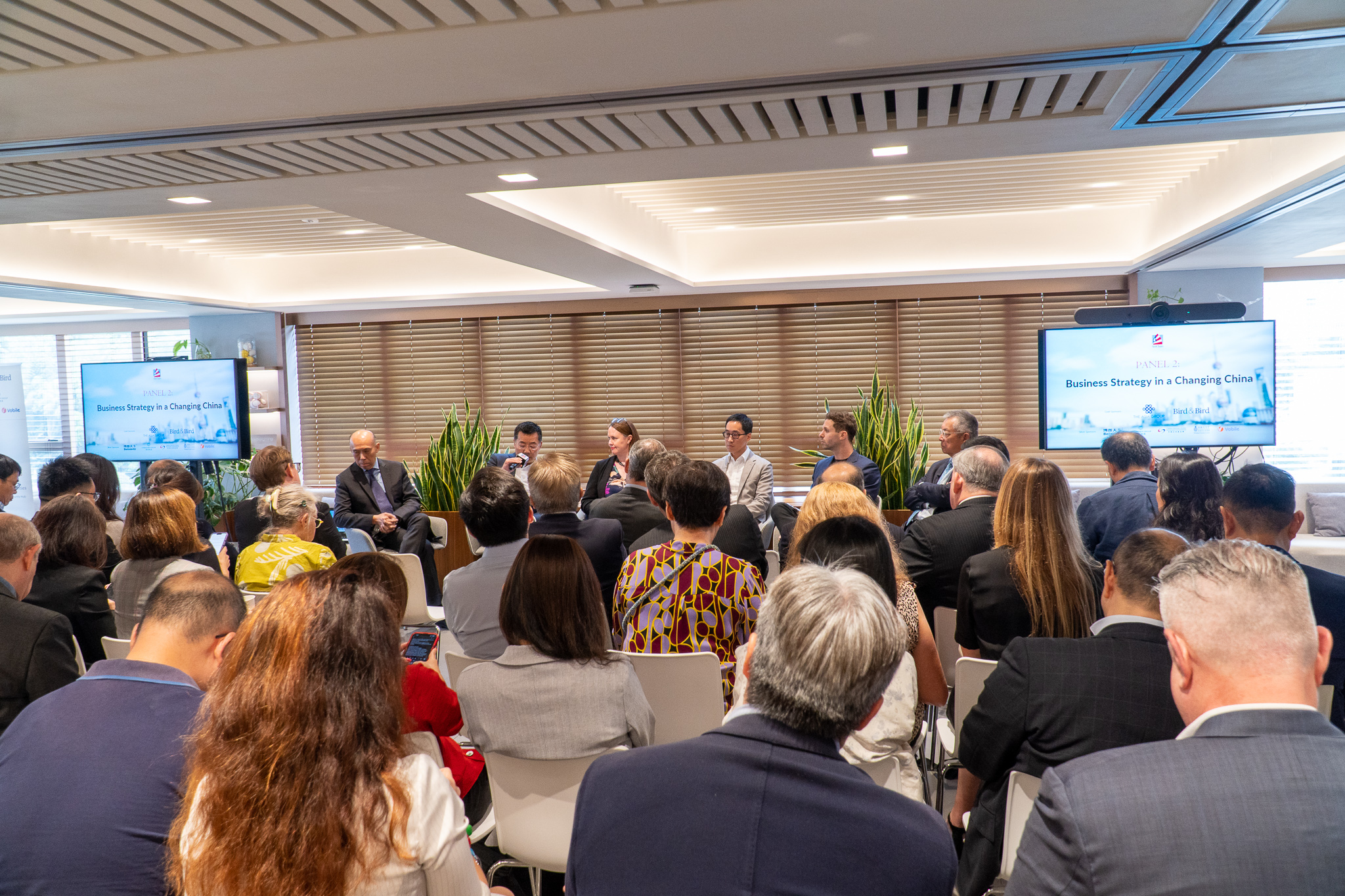
A common theme was that both China and the US shared responsibility for the downturn of the relationship since 2016. In mainland China, it has led to a series of shifting priorities; in Hong Kong, it has translated into anxieties about the resilience of the legal system, most recently with the bankruptcy of China Evergrande Group; for investors, it has meant the need to be sensitive to macro as well as micro issues. Uncertainty has become the norm in transactions. Investors have always needed to calibrate risk but need ever more tools to do so. In contrast to the era of US-China engagement, many foreigners have left China, leading to a lack of reliable business intelligence. There are fewer foreigners in China now than there were in Shanghai in 1924, according to one panelist. And consumer spending is developing its own ecosystem, with young Chinese preferring domestic brands to foreign ones.
Among the young, participants learned, many are renegotiating what it means to have a good life. The reality has sunk in – that China’s economy is not a perpetual growth machine.
US Government continues to view Hong Kong negatively

The last of the three panels, “Hong Kong’s Role in China’s Economy,” included former US consul general Kurt Tong, now managing partner at The Asia Group; Charles Wong, CEO of Silkwaves Holdings, who founded the Bauhinia Party to reflect the political views of mainland Chinese in Hong Kong; Kin Chan, founder of Argyle Street Investment Management; David Lie, chairman of China Concept Consulting; Katherine Cheung, a partner at Dorsey & Whitney and expert on Hong Kong law; and moderator Brian Wong, a fellow at the Center on Contemporary China and the World at the University of Hong Kong.
Article 23, which was passed in March 2024 just before the China conference, has had a negative reaction in the US, with Washington restricting visas to a few HKSAR government officials—which was considered “mild”. But at the same time, Washington has not done anything to repair the relationship, underlining Hong Kong’s vulnerability. Panelists said that Hong Kong needed to be a better salesman, both to China and to the US and EU, and look to partners and opportunities in Southeast Asia and the Middle East. And it needs to restore people’s confidence in Hong Kong, whether by giving young people involved in the 2019 protests amnesty, or by moving ahead on universal suffrage for the chief executive and legislators. Like Article 23, universal suffrage was mandated in the Basic Law of 1992, Hong Kong’s “constitution.”
“The New China Playbook”
Jin Keyu, an associate professor at the London School of Economics and a World Economic Forum Young Global Leader, raised questions about China’s growth prospects without structural changes, particularly to internal barriers to migration through the hukou or local registration system. Her 2023 book, The New China Playbook (Viking 2023), looks at the system she calls the “mayor model,” which put local finances behind the expansion of electric vehicles and solar power. “In the new geo-economic era, China has a new plan,” she said. “But everyone else does too,” whether it is President Biden’s CHIPS Act or the European Union’s new green act.

Gold sponsors for China 2024 Conference were The Asia Group and Bird & Bird. Silver sponsors included Guangzhou Belink Translation Co Ltd; Chinachem Group; the China-United States Exchange Foundation; the HKUST Business School; and Vobile.
Panelists and speakers represented companies and professional firms including: Akin Gump Strauss Hauer & Feld LLP; Argyle Street Management Holdings Ltd; Ascendant Capital Partners; The Asia Group (TAG); Central Asset Investments and Management Holdings (HK) Ltd, China Concept Consulting Ltd; Dorsey & Whitney LLP; Dorabot; Bird & Bird; Silkwave Holdings Ltd; Tencent Holdings Ltd (0700.HK); Tradeweb Markets Inc. (TW.NASDAQ); Wumart Group; XPeng Inc. (XPEV.NYSE); and Young China Group.